Pioneers began to settle in the Groveport area around the year 1800. Subsequent growth was spurred by the opening of the Ohio Erie Canal, and, in 1847, the adjacent settlements of Rarey’s Port and Wert’s Grove merged to form the village of Groveport. The canal, which crossed Main Street immediately east of this marker, declined in importance as a commercial lifeline with the local arrival in 1868 of the faster and more flexible railroad system. By 1900, boat traffic on the canal ceased entirely. Traces of the canal bed are still visible throughout the area.
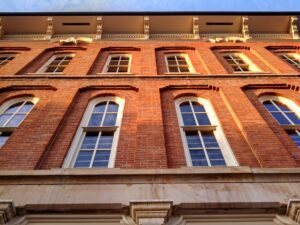
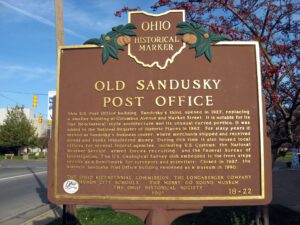
This U.S. Post Office building, Sandusky’s third, opened in 1927, replacing a smaller building at Columbus Avenue and Market Street. It is notable for its fine Neoclassical-style architecture and its unusual curved portico. It was added to the National Register of Historic Places in 1982. For sixty years it served as Sandusky’s business center, where merchants shipped and received goods and banks transferred money. During this time it also housed local offices for several federal agencies, including U.S. Customs, the National Weather Service, armed forces recruiting, and the Federal Bureau of Investigation. The U.S. Geological Survey disk embedded in the front steps serves as a benchmark for surveyors and scientists. Closed in 1987, the historic Sandusky Post Office building reopened as a museum in 1990.
Cornelius D. Battelle was born July 13, 1807 in Washington County, Ohio. He entered the Methodist Episcopal Church on October 30, 1825 and the Pittsburgh Methodist Conference in 1833. He was assigned pastoral circuit duties in rural eastern Ohio and the small river settlement of “Belle Aire” where he delivered his first sermon in a warehouse during the winter of 1838. He established the first Methodist class of eleven members in 1839 and rallied subscriptions to build the first church in the community. He served the Ohio Conference for 64 years before his death on July 2, 1897.
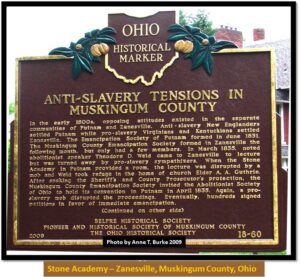
In the early 1800s, opposing attitudes existed in the separate communities of Putnam and Zanesville. Anti-slavery New Englanders settled Putnam while pro-slavery Virginians and Kentuckians settled Zanesville. The Emancipation Society of Putnam formed in June 1831. The Muskingum County Emancipation Society formed in Zanesville the following month, but only had a few members. In March 1835, noted abolitionist speaker Theodore D. Weld came to Zanesville to lecture but was turned away by pro-slavery sympathizers. When the Stone Academy in Putnam provided a room, the lecture was disrupted by a mob and Weld took refuge in the home of church Elder A.A. Guthrie. After seeking the Sheriff’s and County Prosecutor’s protection, the Muskingum County Emancipation Society invited the Abolitionist Society of Ohio to hold its convention in Putnam in April 1835. Again, a pro-slavery mob disrupted the proceedings. Eventually, hundreds signed petitions in favor of immediate emancipation. [continued on other side]
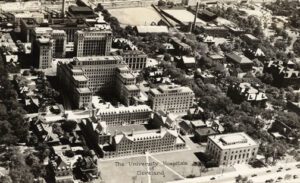
Named for the streetcar turnaround once located at Euclid Avenue and East 107th Street, University Circle is a 600-acre district that is home to many of Cleveland’s major cultural, educational, medical, and service institutions. The area was first settled in 1799 by tavernkeeper Nathaniel Doan and became known as Doan’s Corners. In 1882, Western Reserve College moved here from Hudson, followed in 1885 by the Case School of Applied Science from downtown Cleveland. These two colleges federated in 1967 to become Case Western Reserve University. (continued on other side)
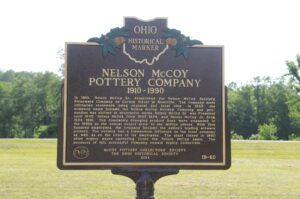
In 1910, Nelson McCoy Sr. established the Neleson McCoy Sanitary Stoneware Company on Gordon Street in Roseville. The company made utilitarian stoneware using regional and local clay. In 1933, the company name became the Nelson McCoy Pottery Company and production was shifted to decorative wares. Nelson McCoy Sr. was President until 1945, Nelson Melick from 1945-1954, and Nelson McCoy Jr. from 1954-1981. The constantly changing product lines were expanded in the 1950s as the annual output grew to ten million pieces. WIth five hundred employees, the company became the nation’s leading artware pottery. The pottery had a tremendous influence on the local economy as well as on the lives of its employees. The plant closed in 1990 after eighty years operating under the Nelson McCoy name. The products of this successful company remain highly collectible.
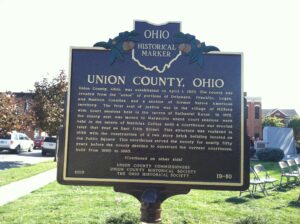
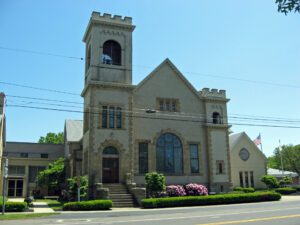
Union County, Ohio, was established on April 1, 1820. The county was created from the “union” of portions of Delaware, Franklin, Logan, and Madison Counties, and a section of former Native American territory. The first seat of justice was in the village of Milford with court sessions held in the tavern of Nathaniel Kazar. In 1822, the county seat was moved to Marysville where court sessions were held in the tavern of Matthias Collins until a courthouse was erected later that year on East Fifth Street. This structure was replaced in 1838 with the construction of a two story brick building located on the Public Square. This courthouse served the county for nearly fifty years before the county decided to construct the current courthouse, built from 1880 to 1883.
On this site, the Canfield Congregational Church, the first church in Canfield village, was built in 1822. The congregation was organized in 1804 by Joseph Badger and Thomas Robbins, both missionaries from the Connecticut Missionary Society. This was the fifth Congregational Church organized west of the Allegheny Mountains and the fourth organized on the Western Reserve. In 1853, there was a division in the church and a faction split off to form the Canfield Presbyterian Society. In 1837, an antislavery speech was given by Reverend Miller from the Poland Methodist Church. A rowdy group of outsiders protested his words and threw eggs onto the pulpit. They waited for him outside with tar and feathers, but the ladies of the church hastily escorted him out the back door to his horse and buggy, and he made a hasty and safe departure. The Bible with egg on it is displayed in the church.