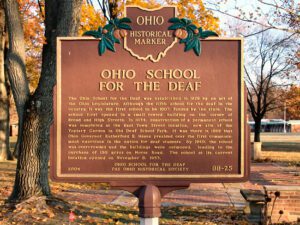
The Ohio School for the Deaf was established in 1829 by an act of the Ohio Legislature. Although the fifth school for the deaf in the country, it was the first school to be 100% funded by the state. The school first opened in a small rented building on the corner of Broad and High Streets. In 1834, construction of a permanent school was completed at the East Town Street location, now site of the Topiary Garden in Old Deaf School Park. It was there in 1869 that Ohio Governor Rutherford B. Hayes presided over the first commencement exercises in the nation for deaf students. By 1940, the school was overcrowded and the buildings were outmoded, leading to the purchase of 130 acres on Morse Road. The school at its current location opened on November 8, 1953.
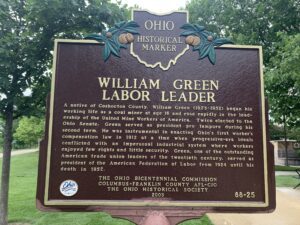
A native of Coshocton County, William Green (1870-1932) began his working life as a coal miner at age 16 and rose rapidly in the leadership of the United Mine Workers of America. Twice elected to the Ohio Senate, Green served as president pro tempore during his second term. He was instrumental in enacting Ohio’s first worker’s compensation law in 1912, at a time when progressive-era ideals conflicted with an impersonal industrial system where workers enjoyed few rights and little security. Green, one of the outstanding American trade union leaders of the twentieth century, served as president of the American Federation of Labor from 1924 until his death in 1952.
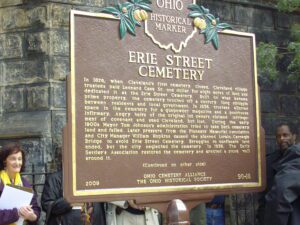
In 1826, when Cleveland’s first cemetery closed, Cleveland village trustees paid Leonard Case Sr. one dollar for eight acres of land and dedicated it as the Erie Street Cemetery. Built on what became prime property, the cemetery touched off a century long struggle between residents and local government. In 1836, trustees allotted space in the cemetery for a gunpowder magazine and a poorhouse infirmary. Angry heirs of the original lot owners claimed infringement of covenant and sued Cleveland, but lost. During the early 1900s Mayor Tom Johnson’s administration tried to take back cemetery land and failed. Later pressure from the Pioneers’ Memorial Association and City Manager William Hopkins caused the planned Lorain Carnegie Bridge to avoid Erie Street Cemetery. Struggles to confiscate land ended, but the city neglected the cemetery. In 1939, The Early Settler’s Association restored the cemetery and erected a stone wall around it. (continued on other side)
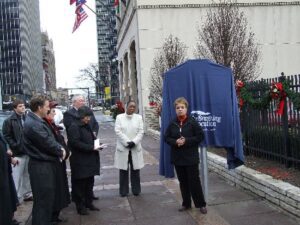
The Breathing Association was founded in 1906 as the Tuberculosis Society under the leadership of public health advocate Carrie Nelson Black. The society provided nutrition, medical care, and sanitorium services to people who could not afford proper medical care. A tuberculosis dispensary was operated at 40 South Third Street in Columbus for Ohioans needing consultation and treatment. Tuberculosis, known as the White Plague, killed one out of nine persons in Columbus during the early 1900s. An Open Air School was established on Neil Avenue in 1913 for children in homes where there were one or more cases of tuberculosis. In 1931, the Nightingale Cottage was opened on Brice Road as a tuberculosis preventorium for children. As tuberculosis became controllable, the agency became focused on emerging lung health issues. Today, The Breathing Association continues as a leading resource on lung health issues and preventing lung disease.
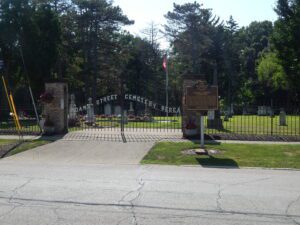
Known as the “Village Cemetery,” this was Berea’s main burial ground from 1834 to the 1880s. However, in 1886, the Cleveland Stone Co. purchased quarries adjacent to the cemetery, where Coe Lake is today. Quarrying had already caused flooding and landslides in the area. Local stories say that the company operated too near to the edge of cemetery, causing a landslide in the northwest corner that exposed some graves. Worried families moved their loved ones’ remains to other cemeteries, including those of five Civil War veterans. Pioneering families, 16 Civil War veterans, 3 mayors of Berea, several quarry owners, and many ordinary people still rest here. Of the original 589 burials, 40% were children. (Continued on other side)
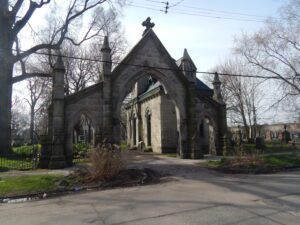
In January 1836, Barber and Lord sold a six-acre parcel for $160 that was to be used “forever as a public burying ground.” When Ohio City incorporated, the township cemetery became the city cemetery. Ohio City’s council established the cemetery’s rules and regulations, appointed a sexton, arranged for the ground to be platted, and purchased a hearse. After annexation by Cleveland, the cemetery became known as “the west side cemetery” and, later, the Monroe Street Cemetery. Under Cleveland’s charge, the cemetery was landscaped, protected by patrolmen, and fenced to keep out wandering hogs. Until the late 1890s, Monroe Street was the only public cemetery on Cleveland’s west side. Architect Joseph Ireland designed the cemetery’s Gothic Revival gateway arch (1874). Architect Walter Blythe designed the cemetery’s gatehouse, also in the Gothic Revival style (1876).
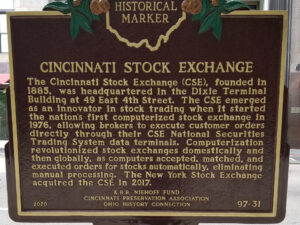
The Cincinnati Stock Exchange (CSE), founded in 1885, was headquartered in the Dixie Terminal Building at 49 East 4th Street. The CSE emerged as an innovator in stock trading when it started the nation’s first computerized stock exchange in 1976, allowing brokers to execute customer orders directly through their CSE National Securities Trading System data terminals. Computerization revolutionized stock exchanges domestically and then globally, as computers accepted, matched, and executed orders for stocks automatically, eliminating manual processing. The New York Stock Exchange acquired the CSE in 2017.
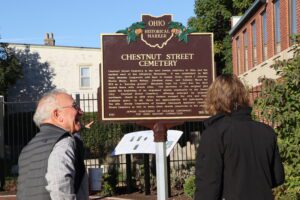
Chestnut Street Cemetery is the first Jewish cemetery in Ohio and the earliest west of the Allegheny Mountains. It was established in 1821 when Nicholas Longworth sold land to Joseph Jonas, David I. Johnson, Morris Moses, Moses Nathan, Abraham Jonas, and Solomon Moses for $75 as a “burying ground.” Benjamin Lape (or Leib) was the first buried there with Jewish rites. The purchase of the original plot marks the beginning of an organized Jewish community in the Queen City. Chestnut Street Cemetery, although enlarged by adjacent purchases, closed in 1849 when cholera ravaged the city and filled available space. In all, there are approximately 100 interments on the site. Jewish Cemeteries of Greater Cincinnati maintains Chestnut Street Cemetery as well as many other Jewish cemeteries in the region.