801 E. Pete Rose Way, Bicentennial Commons at Sawyer Point
Cincinnati
, OH
In memory of the Irish people who left a country where only their rivers run free. The Irish came to Cincinnati where they contributed to housing, education, employment, religious freedom, medical care and recreation, and embraced all aspects of life in the city. The descendants of Irish immigrants hope that our hands will ever be extended in friendship and never in want.
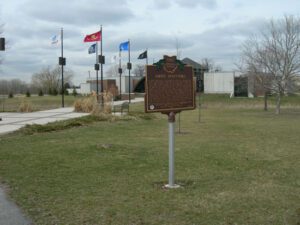
In 1810, early settlers here were Major Amos Spafford (1753-1818), his wife Olive (1756-1823), and their children Samuel, Aurora , Chloe (Mrs. Almon Gibbs), and Anna (Mrs. Richard Craw). In 1796, Spafford, a native of Connecticut, was a surveyor for the Connecticut Land Company. He drew the first map laying out Cleveland and named the city. He left there in 1810 following appointment as custom’s collector and postmaster for the new port at the foot of the Maumee River rapids, Port Miami of Lake Erie. Spafford was granted a 160 acre land patent on River Tracts #64 and #65 in Waynesfield township, signed by President James Monroe and was able to purchase it following the 1817 Treaty of the Rapids that extinguished Native American claim. Two years later, 67 families lived in the area, but most fled at the outbreak of the War of 1812.
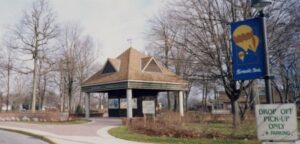
One of the earliest and largest amusement parks in Northwest Ohio dedicated in 1906 on site of old waterworks. Trains brought visitors from as far away as Cleveland. 1907: Dance Pavilion and 2,000 seat auditorium built. 1908: Bathing beach made in old reservoir. 1925: Green Mill Dance Hall built on side near dam. Big name bands highlight entertainment. 1936: Shelters, band shell, and pool bath house made from bricks of old waterworks. 1978: Renovation of waterfront begins new era.
Ellamae Simmons, born and raised in Mount Vernon, became the first African American woman physician to specialize in asthma, allergy, and immunology in the country. Graduating in the top of her high school class, she dreamed of attending Ohio State University to become a nurse but was rejected as that program “did not have the facilities for training” the young black girl. Whenever Simmons encountered a barrier in life she refused to accept rejection, tenaciously steered the course of her own life, and blazed new trails for others. She ultimately earned degrees in nursing (Hampton, 1940), pre-med biological sciences (OSU, 1948), social work (OSU, 1950), and medicine (Howard University, 1959). Dr. Simmons again broke gender and racial barriers when hired by Kaiser Permanente in 1965. She practiced there until retiring in 1989. Simmons died aged 101.
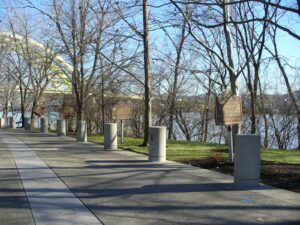
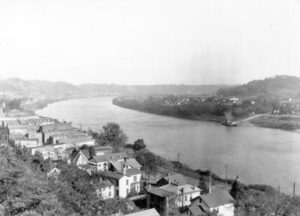
The Ohio River begins at the confluence of the Allegheny and Monongahela rivers in Pittsburgh, Pennsylvania, and flows 981 miles to join the Mississippi River at Cairo, Illinois. The Iroquois called the river “Oyo” or “Ohio,” which the French translated as “La Belle Riviere,” the Beautiful River. It was an important transportation route for countless generations of Native Americans and, beginning in the 1780s, for Euro-American settlers. It was the main route to the opening West and the principal outlet for the region’s growing farm output. Congress first acted to improve navigation in 1824 and, later, by canalizing the river with a series of locks and dams beginning in 1878. River commerce has increased with industrialization, moving up to 150 million tons annually.
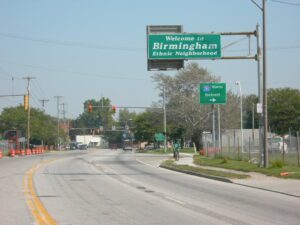
The Birmingham and Ironville neighborhoods were so named because of their early iron industries located along Front Street and the Maumee River. This became Toledo’s first area of heavy industrial development with iron manufacturing, coal shipping, oil refining, shipbuilding, and flour milling operations. In 1864 the Manhattan Iron Company built a charcoal blast furnace near the river’s mouth, securing fuel from nearby forests.
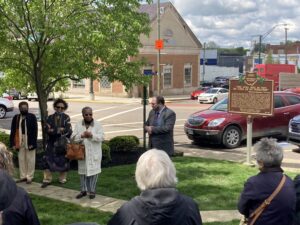
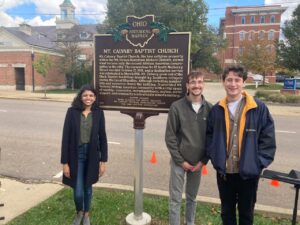
Mt. Calvary Baptist Church, the lone religious property within the Mt. Vernon Downtown Historic District, served what became only the second African American congregation in the city. The cornerstone for 13 South Mulberry Street was laid October 17, 1915, and a dedication service was celebrated in March 1916. Mt. Calvary grew out of the Black Baptist traditions brought by Southern refugees during the Great Migration. Although dwindling membership and resources closed the building, it provided Mt. Vernon’s African American community with a vital space of worship, communion, mutual assistance, asylum, social support, and community celebration for almost a century.
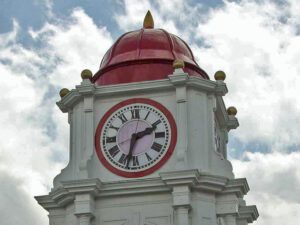
The Bellaire High School Clock Tower was erected in 1925 as the second town clock to be mounted on Bellaire’s public schools. C.W. Bates of Wheeling designed this tower, built by C.D. Keyser & Co. of Bellaire. The school building stretches 256 feet along 35th Street, and the tower rises 40 feet above the 3rd floor parapet of the roof. The clock faces are 6 feet, 7 inches in diameter. At the exterior corners of the bell room are 11 foot columns. The tower dome is painted red. E. Howard & Co. of Boston made the clock works and the McShane Bell Foundry of Baltimore cast the bell in August 1888. The BHS Alumni Association lighted the tower in 1998 to honor all “faithful and true-hearted” graduates of the school.