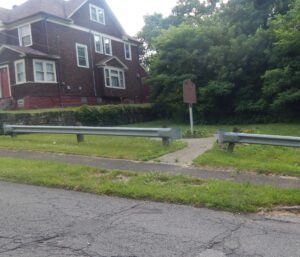
Oscar D. Boggess (1832-1907) was born in Virginia, the son of a slave and her master. He and his family were granted freedom in the will of his father and master. The will was contested up to the United States Supreme Court, which upheld Boggess’ freedom. Boggess moved to Pennsylvania at age 20, and during the Civil War, joined the 43rd United States Colored Troops. He earned the Butler Medal of Honor for bravery at the Battle of the Crater near Petersburg, Virginia, in July 1864. Boggess moved to Youngstown after the war, and worked as a stonemason. He was a charter member of Tod Post 29, Grand Army of the Republic, in Youngstown, and a co-founder of the Oak Hill Avenue African Methodist Episcopal Church, the city’s first African American religious congregation. The Boggess home, formerly located near this site, hosted the church’s first meetings in 1870.
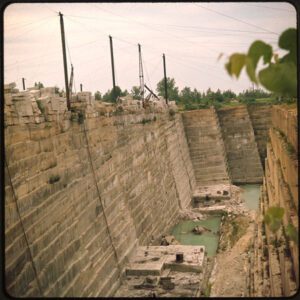
For more than ninety years, this area was the heart and soul of Berea’s sandstone quarries. In the early 1830s, John Baldwin discovered that the area’s sandstone deposits made superb grindstones and building stones. In the 1840s, thriving sandstone quarries developed and became Berea’s lifeblood. Searching for the “American Dream,” German, Irish, Italian, Hungarian, and Polish immigrants, among others, came here to work. The quarries eventually encompassed nearly 250 acres and consumed the fashionable houses of Berea’s “South Side” and the buildings of Baldwin University. The Cuyahoga County Court House, Ohio’s Capitol, and Canada’s parliament buildings are among many structures in North America and Europe constructed of Berea sandstone. Decreasing demand for sandstone and the Great Depression closed the last of Berea’s quarries in the mid-1930s.
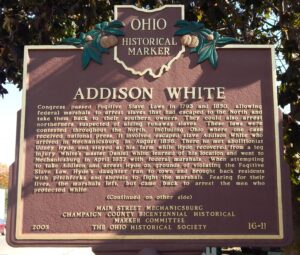
Congress passed Fugitive Slave Laws in 1793 and 1850, allowing federal marshals to arrest slaves that had escaped to the North and take them back to their southern owners. They could also arrest northerners suspected of aiding runaway slaves. These laws were contested throughout the North, including Ohio where one case received national press. It involved escaped slave Addison White who arrived in Mechanicsburg in August 1856. There he met abolitionist Udney Hyde and stayed at his farm while Hyde recovered from a leg injury. White’s master Daniel White learned of his location and went to Mechanicsburg in April 1857 with federal marshals. When attempting to take Addison and arrest Hyde on grounds of violating the Fugitive Slave Law, Hyde’s daughter ran to town and brought back residents with pitchforks and shovels to fight the marshals. Fearing for their lives, the marshals left, but came back to arrest the men who protected White. [continued on other side]
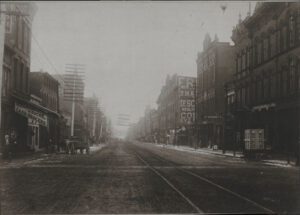
The center of African-American culture in Akron during the mid-20th century, Howard Street was home to many of the city’s black-owned business and entertainment establishments, and provided an atmosphere in which minority-owned businesses could thrive. Attracted to the vitality of the neighborhood, entrepreneur George Mathews (1887-1982) established a barbershop here in 1920 and in 1925 opened the adjoining Mathews Hotel. The hotel quickly became the anchor of the Howard Street district. Mathews’ success allowed him to endow a scholarship fund at the University of Akron in 1964.
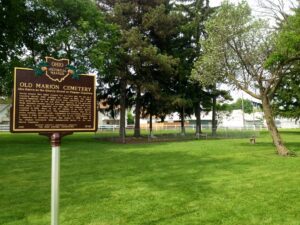
Marion founder Eber Baker donated this two-acre plot for use as a cemetery shortly after platting the village in 1822. The oldest legible headstone bears an 1812 burial date, indicating that it may have been moved to the site after the opening of the cemetery. While complete records are not available, approximately 200 burials took place in the cemetery with the final one believed to have occurred in 1872. Many of the 65 victims of an 1854 cholera outbreak were buried here. The cemetery’s location next to an active railroad, combined with unfavorable soil conditions, eventually created a need for relocation. This led to the establishment of a cememtery on Delaware Avenue that opened in 1858. Many of the original internments were subsequently moved to the new Marion Cemetery.
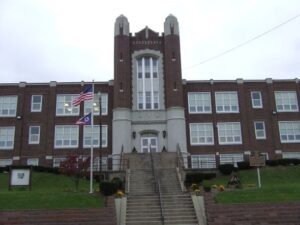
An October 23, 1927, ceremony was held for the laying of the cornerstone for the Dennison High School Building. It opened in the fall of 1928 and was called “Angel’s Castle” in honor of school superintendent William Hiram Angel. The building was designed by J.K. Griffin, an architect from Canton, Ohio, in a style that has the elements of Collegiate Gothic that was popular for school and college buildings during the early twentieth century. The distinguishing architectural features of the entrance towers enhance the school’s prominent location above the street level. Dennison High School is an important visual landmark in the community, as its towers are visible from the downtown area and surrounding neighborhoods. It has retained its integrity of location, materials, design, and association and conveys the early twentieth century ideals of education that the original design of the building was intended to inspire. (Continued on other side)
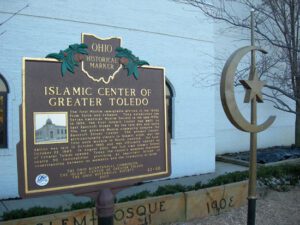
The first Muslim immigrants arrived in the 1900s from Syria and Lebanon. They established the Syrian American Muslim Society in the late 1930s. In 1954, the first Islamic Center was built on East Bancroft Street. By the late 60s and early 70s, the growing Muslim community outgrew the Bancroft Street Center. The present Center, architecturally classic in Islamic style, was the first such mosque in North America. Its foundation was laid in October 1980 and was officially opened on October 22, 1983. In August 2001, the full time Islamic School of Greater Toledo opened. Today, the Center’s members represent nearly 30 nationalities, providing an important bridge of understanding between its members and the community at large.
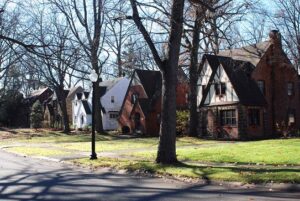
Situated in the township of Boardman and developed in the 1920s, Newport Village was one of Youngstown’s earliest automobile accessible suburban developments. The twenty four and a half acre district is comprised of Jennette Drive, Chester Drive, seven lots on Overhill Road, and a majority of the area on Market Street’s west side. Gently curving streets with both Tudor and Colonial architecture blend into the natural landscape of the area and Mill Creek Park. Newport Village became part of the National Register of Historic Places in 2006.