In 1805, a burial ground was dedicated to Champaign County at the intersection of Ward and Kenton Streets, which was then at Urbana’s town limits. It remained open until 1856. Among those interred there was Elizabeth Kenton, eight-year-old daughter of Simon Kenton. When she died in 1810, Kenton, the county jailer, was forbidden from crossing out of the town limits due to his unpaid debts. After following the funeral procession as far as he could, he watched Elizabeth’s burial from across the street. Also buried there were unknown soldiers from the War of 1812; Captain Arthur Thomas and son, who were killed by Native Americans in August 1813; four Bell children, who died in the tornado of March 22, 1830; and numerous early settlers of Champaign County. Many, but not all, were reinterred and rest in Oak Dale Cemetery.
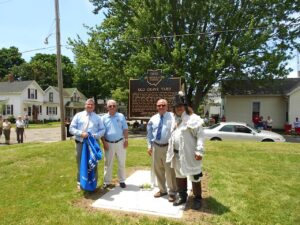
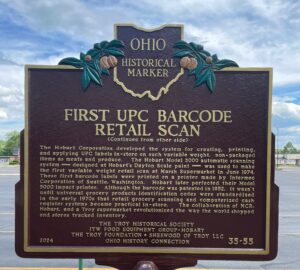
On June 26, 1974, the first retail scan of a product marked with a Universal Product Code (UPC or barcode) was made in the checkout line of Troy’s Marsh Supermarket located at 982 N. Market Street. A ten-pack of Wrigley’s Juicy Fruit chewing gum was scanned to simulate the purchase of a product. The barcode was scanned on the NCR 255 computerized check-out system developed by National Cash Register (NCR). The system featured a Spectra Physics Model A scanner and an NCR 726 in-store computerized cash register. The Troy grocery store, considered a “typical” American grocery, was conveniently located near NCR and Hobart facilities. Spectra Physics and NCR later donated one of the original scanners and cash registers used at Marsh’s to the National Museum of American History, Smithsonian. (Continued on other side)
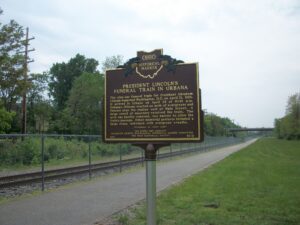
The nine-car funeral train for President Abraham Lincoln departed Washington, D.C. on April 21, 1865. It arrived in Urbana on April 29 at 10:40 p.m. Urbana’s citizens erected an arch of evergreens and flowers near the station west of Main Street. A large crowd of mourners received the train. The arch was hastily removed, too narrow to allow the train’s passage. Other memorial gestures included a large cross, entwined with evergreen wreaths.
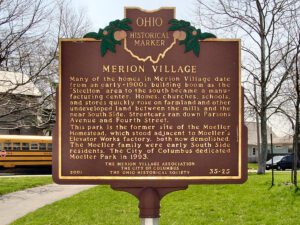
Merion Village was named for the Nathaniel Merion family, who in 1809 settled what is now the South Side of Columbus on 1800 acres of the Refugee Lands. Entrepreneur William Merion operated “Merion’s Landing” in the 1830s to capitalize on the canal trade from the Columbus Feeder Canal. This area saw a large influx of German immigrants as the South Side industrialized in the mid-nineteenth century. Later, many Irish, Italian, and eastern European immigrants who worked in the local steel mills and foundries made their homes here.
Steel-frame skyscrapers and retail buildings replaced wood-frame residences as the downtown evolved into a commercial district. A small public library branch occupied the north side of the square from 1923 to 1954. The Keith-Albee Theater (later the Palace) in the northeast corner of the square from 1926 to 1964, featured vaudeville performances and movies. Streetcar tracks around the square were removed for scrap during World War II. With expansion of suburban shopping malls, downtown theaters and department stores gradually closed. In 1973-74 Central Square was converted to a pedestrian Federal Plaza by closing off traffic on Federal Street one block east and west of Market Street. Central Square reopened in 2004 with a new traffic pattern, planting beds, and street furniture. Marker for “Central Square (1798-1899)” across the street.
Toledo’s first fire station was built in November 1837 one city block due north of this site at the southwest corner of Cherry Street and Eagle Lane at 519 Cherry on what is now the driveway for the Goodwill Industries Building. It was a small non-descript, wooden building, built by contractors Hoisington and Manning for $78. It was replaced by a two-story brick building with tin-clad window sills and trim in December 1854. With fire trucks becoming larger and heavier, it was necessary to construct a new building in 1872 at a cost of $7000. Designated Station No. 2, it remained in service until 1953 when the new headquarters station at Huron and Orange streets was dedicated. It disappeared for good during the Urban Renewal projects of the late 1950s and 1960s.
Built over a two-year period, from 1936-1937, by the Federal Works Progress Administration, the Glendale Steps survive as a monument to the work of stone craftsmen during the Great Depression. Spanning a 200-foot slope, the purpose of the Glendale Steps was to enable Akron residents to descend from South Walnut Street to a city park along Glendale Avenue. The 242 sandstone steps were dressed on site and hand laid by WPA laborers at a cost of $22,000. Depression-era budget problems prevented the City of Akron from completing planned improvements to the park.
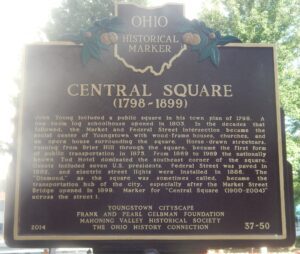
John Young included a public square in his town plan of 1798. A one-room log schoolhouse opened in 1803. In the decades that followed, the Market and Federal Street intersection became the social center of Youngstown with wood-frame houses, churches, and an opera house surrounding the square. Horse-drawn streetcars, running from Brier Hill through the square, became the first form of public transportation in 1875. From 1869 to 1969 the nationally known Tod Hotel dominated the southeast corner of the square. Guests included seven U.S. presidents. Federal Street was paved in 1882, and electric street lights were installed in 1886. The “Diamond,” as the square was sometimes called, became the transportation hub of the city, especially after the Market Street Bridge opened in 1899. Marker for “Central Square (1900-2004)” across the street.