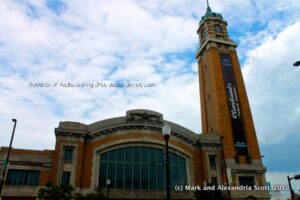
Since opening in 1912, the West Side Market, Cleveland’s oldest continuously operating, municipally-owned market, has been an anchor to the historic Ohio City neighborhood. Built to replace the Pearl Street Market and the Central Market. All three served Cleveland’s growing population in the early 20th century, but only the West Side Market remains. Designed by architects W. Dominick Benes and Benjamin Hubbell, the 30,000 square foot space has a dramatic vaulted Guastavino tile ceiling and a signature clock tower that is 137 feet high. The Seth Thomas clock Company manufactured the clock. (Continued on other side)
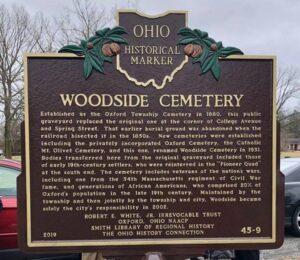
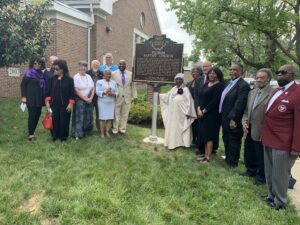
Established as the Oxford Township Cemetery in 1880, this public graveyard replaced the original one at the corner of College Avenue and Spring Street. That earlier burial ground was abandoned when the railroad bisected it in the 1850s. New cemeteries were established including the privately incorporated Oxford Cemetery, the Catholic Mt. Olivet Cemetery, and this one, renamed Woodside Cemetery in 1931. Bodies transferred here from the original graveyard included those of early 19th-century settlers, who were reinterred in the “Pioneer Quad” at the south end. The cemetery includes veterans of the nation’s wars, including one from the 54th Massachusetts regiment of Civil War fame, and generations of African Americans, who comprised 20% of Oxford’s population in the late 19th century. Maintained by the township and then jointly by the township and city, Woodside became solely the city’s responsibility in 2002.
On January 9, 1919, a group of eight men and three women, being led by the Holy Spirit, met at a house on Wallace Street to form a new black Missionary Baptist Church in Hamilton, Ohio. The group quickly raised $150 to make the down payment on a two-story brick building at 333 Chestnut Street being sold for $1,850. The building was occupied on March 25, 1919, and the name Pilgrim Baptist Church was suggested and accepted. On May 11, 1919, a special council requested admittance into the Western Union Baptist Association, a district association now affiliated with the Ohio Baptist General Convention. Requirements for admission were met and Pilgrim Baptist Church was recognized as a Missionary Baptist Church. In 2019, Pilgrim Baptist Church celebrated a centennial of faithfulness in Hamilton.
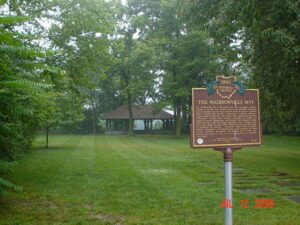
The Madisonville site is the largest and most thoroughly studied village of the late Fort Ancient culture (AD 1450 – 1670). Artifacts were so abundant here that local residents called this site the “pottery field.” Between 1879 and 1911, a generation of Harvard archaeologists trained at this site. Dr. Charles Metz, assisted by Harvard University’s Frederic Ward Putnam, excavated the remains of numerous houses, storage pits, and burials. The presence of glass beads and bits from iron kettles indicates these villagers may have been among the first native Ohioans to learn of the coming of Europeans to America. Mariemont street names Cachepit, Midden, Flintpoint, and Hammerstone, are reminders of these earlier residents. The pavilion was designed by the noted town planner John Nolen in 1921, but not constructed and dedicated until 2001.
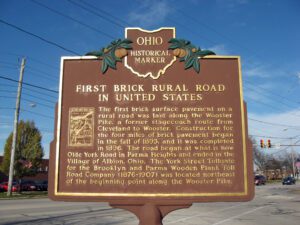
In the late nineteenth century, a movement to improve inadequate plank and dirt roads was brought on by the popularity of bicycling, the introduction of the automobile, and the need to improve travel to and from rural areas. Ohio, as a leader in the manufacture of brick paving blocks, was quick to upgrade roads. Toll roads were waning in popularity and the need for free roads was recognized. An act passed in 1892 authorized Cuyahoga County to levy a road tax. With funds levied, the Commissioners selected the Wooster Pike as one of three road improvement projects.
The Lincoln School building stood at 2402 Central Avenue for almost a century. In 1919, a twenty-year bond levy provided for the construction of five schools, including the “new east school” Lincoln Elementary. Construction began in 1921 on the eight-acre site while students attended classes in temporary structures. Lincoln School opened in 1923 with 500 students enrolled. Lincoln Field, football grounds for McKinley High School’s “Middies,” stood behind Lincoln from 1930 until 1950 when Barnitz Field Stadium was built on South Main Street. Additions to the original Lincoln building included a maintenance annex in 1935 and a gymnasium in 1959. Lincoln School closed in November 1980 during a 1980-1981 Middletown City School District reorganization. Students from Lincoln and Sherman schools moved to the refurbished Roosevelt School at 2701 Central Avenue.
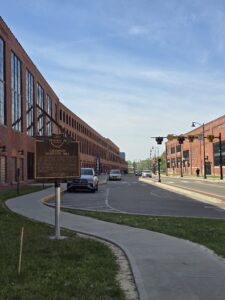
The Champion Coated Paper Company began production April 15, 1894, with less than a dozen employees under the direction of Peter Gibson Thomson (December 16, 1851-July 10, 1931). A Cincinnati businessman, bookseller, and publisher, Thomson recognized that recent changes in half-tone printing would increase the demand for coated paper. In 1893, he acquired the patent rights to a card coating machine, incorporated his new company, and set-aside 45 acres along Seven Mile Pike (now North B Street) to build a plant that would coat paper produced by other mills in the Great Miami Valley. The Champion Hamilton Mill shipped its first coated paper order on May 4, 1894. Within a few years, Thomson had dramatically increased plant capacity and, by 1900, Champion was regarded as the largest coated paper mill in the country.
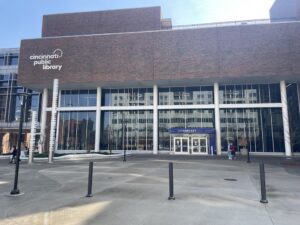
Among the first in America, Cincinnati’s public library dates from March 14, 1853. A public reading room opened in 1856, but funding remained a problem until 1867, when local school board president Rufus King II secured legislation for a renamed Cincinnati Public Library. In 1869, King lured leading librarian William Frederick Poole to organize Cincinnati as a national model for the growing public library movement. Poole designed 19th century America’s most advanced library at 629 Vine Street, which fully opened in 1874. Becoming a countywide system in 1898, the Public Library of Cincinnati and Hamilton County was a pioneer in the 20th century with special services for the blind and for children, bookmobile services, and circulation of audiovisual materials. (continued on other side)