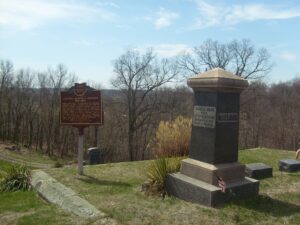
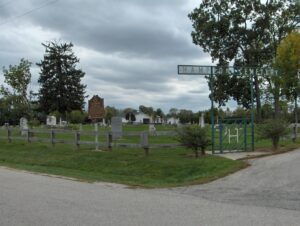
In Greenwood Cemetery, at the end of Greenwood Road
Racine
, OH
Born at Oak Grove, prospected in the California goldfields in 1849. During the Civil War he raised a militia company at Racine, and was later promoted Captain of Co. K, 18th O.V.I. After the war, he served on the Racine Village council, Sheriff of Meigs County, and was a member of the Ohio General Assembly. He was Secretary-Treasurer of the Ohio Commission for the Chichamauga Battleground National Park, and served 14 years as Postmaster of the U.S. House of Representatives.
On September 8, 1803, the year that Ohio became a state, the Associate Judges of Franklin County ordered that a road be constructed “leading from the Public Square in Franklinton to Springfield, Greene County.” This road came to be known as The Old State Road or Ludlow’s Road. On this spot in the summer of 1822, the Village of New Hampton was laid out, the road being Main Street of the village. New Hampton was the forerunner of West Jefferson. It fell into oblivion eight to nine years later when West Jefferson was developed along the National Road. All that remains of New Hampton is the cemetery and this part of the road.
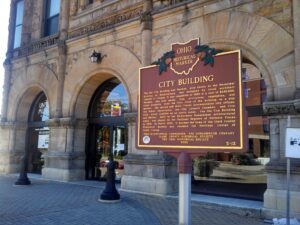
The Old City Building and Market, also known as the Municipal Building or Marketplace, was designed by local architect Charles A. Cregar. It was completed in 1890 at a cost of $250,000. Vendors, who sold meats, fish, provisions, vegetables, and other products, used the first floor of the building as a city market. The second and third floors accommodated city offices, the police department, the City Council Chamber, and City Hall, which doubled as an opera house. The Old City Building and Market, built in the Richardson Romanesque architectural style, was placed on the National Register of Historic Places in 1973. In March 2001, it became the home of the Clark County Historical Society and renamed the Heritage Center of Clark County.
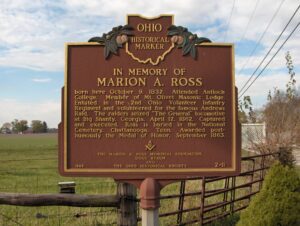
Born here October 9, 1832. Attended Antioch College. Member of Mt. Olivet Masonic Lodge. Enlisted in the 2nd Ohio Volunteer Infantry Regiment and volunteered for the famous Andrews Raid. The raiders seized “The General” locomotive at Big Shanty, Georgia, April 12, 1862. Captured and executed, Ross is buried in the National Cemetery, Chattanooga, Tenn. Awarded posthumously the Medal of Honor, September 1863.
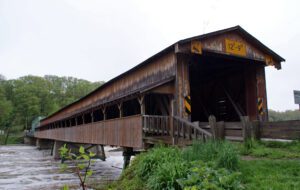
Replacing an earlier bridge that was carried away in a spring flood, the Harpersfield Covered Bridge was built in 1868 and spans the Grand River, a state-designated wild, and scenic river. This bridge, which currently carries County Road #154 (Harpersfield Road), is a two-span wooden Howe truss bridge, with center pier. The great flood of 1913 washed away the northern approach and it was at this time that the additional 140 foot steel truss was added. Extensive rehabilitation in 1992 included strengthening the lower chords, lowering and replacing the floor, and adding a cantilevered walkway. The 228-foot-long Harpersfield Bridge is the longest covered bridge in Ohio and is on the National Register of Historic Places.
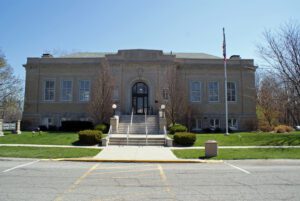
In 1912, the president of the Public Library Association in Paulding requested funding from philanthropist Andrew Carnegie to build a library in Paulding. At first the Carnegie Corporation of New York refused, stating that it only provided funding to communities with larger populations, but when the Library Association said it would serve the entire county, which had a larger population, the request was granted. As a result Paulding became the site for the first “county” Carnegie library in the United States, built for a total cost of $40,000. Carnegie provided funding for 2,811 libraries, of which 1,946 were built in the United States. Placed on the National Register of Historic Places in 1984, the Paulding County Carnegie Library continues to service the needs of all citizens of Paulding County.
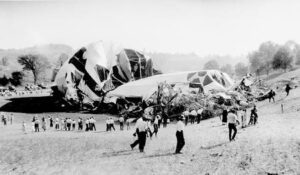
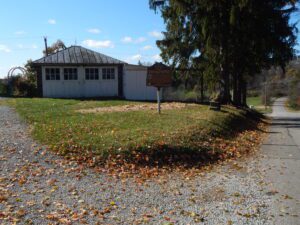
On a stormy autumn morning in 1925, the giant Navy airship, christened Shenandoah, crashed near this site. Initially, the Shenandoah was commissioned to perform scouting missions for the Navy; however, she would soon be flying promotional missions. The Shenandoah had recently begun a six-day publicity tour across the Midwest when she crashed. The turbulent weather of late summer created strong winds, which ripped the 680-feet long Shenandoah in two and tore the control car from the keel. A majority of the 14 crewmen who died in the crash, including the captain, Lt. Commander Zachary Lansdowne of Greenville, Ohio, were killed when the control car plummeted to the ground. The stern section fell in a valley near Ava and the bow was carried southwest nearly twelve miles before landing near Sharon, Ohio. The Ohio National Guard was called in to control the crowds of spectators who traveled to the crash sites.
These structures stand as an exception to the usual wood frame or brick construction of farm buildings in this region in the late nineteenth century. The house and barn, built circa 1871 and 1883-1885 respectively, reflect Frederick Kindelberger’s (1835-1911) creativity and vision to instill a responsibility to the land. The Kindelberger family purchased the farm in 1846, after they had emigrated from Alsace-Lorraine. The walls of the barn were created using a distinct architectural design, whereas they taper from 25 inches thick at the base to 12 inches thick at the top. Stonemasons and family members labored using sandstone, which was quarried on the eighty-acre farm, to construct the buildings. Due to their stone construction, the house and barn were placed on the National Register of Historic Places in 1980.