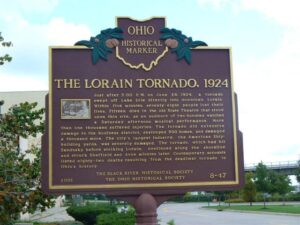
Just after 5:00 P.M on June 28, 1924, a tornado swept off Lake Erie directly into downtown Lorain. Within five minutes, seventy-eight people lost their lives. Fifteen died in the old State Theatre that stood upon this site, as an audience of two hundred watched a Saturday afternoon musical performance. More than one thousand suffered injuries. The tornado did extensive damage to the business district, destroyed 500 homes, and damaged a thousand more. The city’s largest industry, the American Shipbuilding yards, was severely damaged. The tornado, which had hit Sandusky before striking Lorain, continued along the shoreline and struck Sheffield and Avon minutes later. Contemporary accounts listed eighty-two deaths resulting from the deadliest tornado in Ohio’s history.
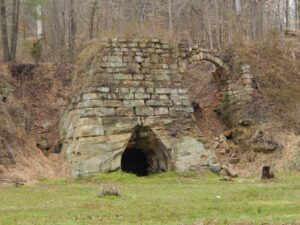
Olive Furnace in Lawrence County was one of 83 blast furnaces in the Hanging Rock iron-making region of southern Ohio and northern Kentucky. John Campbell (1808-1891), the “Father of Ironton,” and others established the furnace in 1846. The base of the furnace is carved out of rock and supported by Roman style arches. Only one of these arches remains some 170 years later. The furnace became a stop on the Underground Railroad. Conductors ushered escaping slaves through the area to points further north. The Olive Furnace was the last charcoal furnace to operate in Lawrence County. After seven decades of service, the furnace was sold and dismantled for scrap in 1915. Olive Furnace was listed on the National Register of Historic Places in 2007.
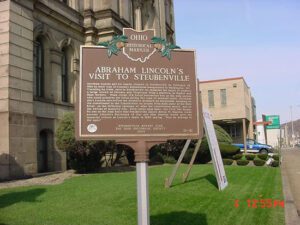
Abraham Lincoln and his family stopped in Steubenville on February 14, 1861 on their way to Lincoln’s presidential inauguration in Washington, D.C. Traveling by train, once in Steubenville he departed the depot to address a large crowd of Ohioans and Virginians from a platform at Market and High Streets. When Judge W.R. Lloyd introduced him as the only person who could preserve the Union during this time of national crisis, President elect Lincoln electrified the attentive audience by eloquently speaking on the commitment to the Constitution by people from both sides of the Ohio River, on the differing opinions of what the Constitution means, and on the virtues of majority rule. Fifty-seven days later, the Civil War began. No one at the time knew that Steubenville native Edwin M. Stanton would become Lincoln’s Secretary of War and that Stanton would give the immortal tribute at Lincoln’s death in 1865 saying, “Now he belongs to the ages!”
Archibald Worthington (1818-1895) was a freed slave from Virginia, a Civil War veteran, and prominent landowner in Highland Township. Census records indicate he was manumitted prior to 1850, and by 1860 owned land in northwest Ohio. Worthington also farmed, boarded freed slaves, and owned apple orchards and livestock. April 1866 township records show that he supported the local school for Black families. He and his wife Elizabeth raised three children: Henry, Mathilda, and James. Henry enlisted in the Massachusetts 54th Volunteer infantry, one of the first Black regiments formed in the Civil War. He died January 8, 1865, in a prison camp and is buried in North Carolina’s Salisbury National Cemetery. Mathilda and James both met partners and married, had children, and left the area. Archibald Worthington died in 1895 and is buried in Wilmington’s Sugar Grove Cemetery.
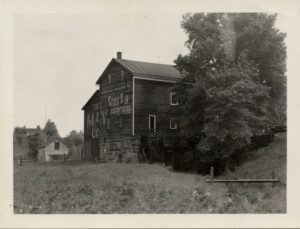
Fowlers Mill (originally Fowler’s Mills) developed around a group of mills built in the 1830s on the Chagrin River. Opportunities from these mills led to Fowlers Mill becoming the commercial center of Munson Township. From the 1830s into the twentieth century, the community expanded with construction of churches, a post office, township hall, stores, hotel, blacksmith shop, schools, and houses built in such styles as Federal, Greek Revival, Italianate, and Queen Anne. This type of community center was common in rural, nineteenth century America, but rarely survives with so much original fabric intact. On Mayfield Road, the Disciple Church was built in 1842. East of the church, the brick central school built in 1913 replaced earlier one-room schoolhouses. The gristmill is the only mill standing in Geauga County. The cemetery contains burials dating from the 1830s. The Fowler’s Mills Historic District was placed on the National Register of Historic Places in 2002.
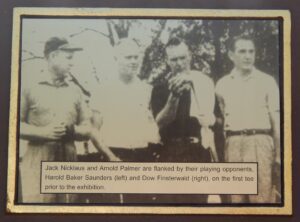
Golfing greats Arnold Palmer and Jack Nicklaus first met on the golf course at the Athens Country Club in Athens, Ohio. The event was a celebration for native son Dow Finsterwald, winner of the 1958 PGA Championship. Due to the significance of the event, Athens city officials proclaimed September 25, 1958, “Dow Finsterwald Day,” and the day featured an 18-hole exhibition golf match at the Athens Country Club. Reigning Masters Champion Arnold Palmer joined his long-time friend Finsterwald for the exhibition. Outstanding amateur Howard Baker Saunders of Gallipolis and eighteen year old Jack Nicklaus of Columbus completed the foursome. Nicklaus, a recent high school graduate, was a promising amateur with an Ohio State Open title and a national Jaycee championship to his credit. [Continued on other side]
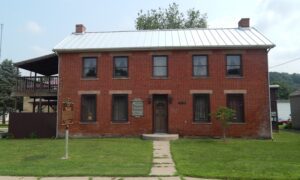
Named for General Zebulon Pike, killed in the War of 1812, Pike County was organized in February 1815. Commissioners were charged with establishing a county seat and on May 12, 1815 accepted a conveyance of 40 acres from Elisha Fitch. The new seat was named “Piketon.” In 1816, the commissioners let a contract for the construction of a courthouse and jail. A fine two story courthouse with brick laid in Flemish bond was finished in 1819. A fire destroyed some country courthouse offices on October 9, 1844. The repaired courthouse was the seat of county government until 1861 and is part of the Piketon Historic District, which was listed on the National Register of Historic Places in 1974. Limestone headers above the windows have the names of the county government offices.
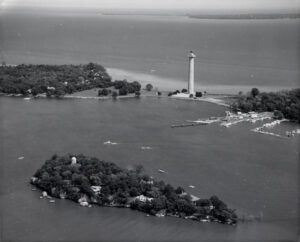
This 6.5 acre island, named for the resemblance of its dolomite ledges to the Rock of Gibraltar, was the likely observation site for Commodore Oliver Hazard Perry’s naval forces during the Battle of Lake Erie in September 1813. Stone Laboratory, located on both Gibraltar and South Bass islands, is the oldest freshwater biological field station and research laboratory in the United States. Founded in 1895 as the Lake Laboratory, it was named for Franz Stone, whose son Julius purchased the island from the Jay Cooke family and presented it to Ohio State University in 1925. It continues as the research and teaching laboratory for the Ohio Sea Grant College Program. The Jay Cooke Castle on the island is a National Historic Landmark.