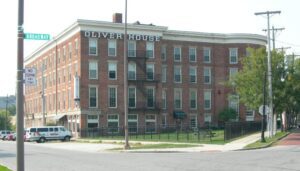
Overlooking the “Middlegrounds,” an early site of railroad, immigration, and commercial activity, the Oliver House opened in 1859 as Toledo’s premier hotel. It was designed by nationally prominent architect Isaiah Rogers, in the Greek Revival style, and built by the family of William Oliver for whom the hotel was named; owner of this land, Oliver was one of Toledo’s earliest real estate investors. (Continued on other side)
The Wyandot called the Grand Reserve home nearly a century before Ohio statehood. They built houses, cultivated the land, and grew bountiful groves of fruit trees. They governed from the nearby Wyandot Council House and operated a productive saw and grist mill. Many sent their children to school and worshiped at the limestone church, built in 1824, and recognized as the first Methodist mission in the country. But Ohioans set their sights on Wyandot lands in the fertile Sandusky River Valley. State and federal governments were unwilling to allow the Wyandot to remain on their chosen homelands, despite their participation in American society and friendly relations with neighboring settlers. Following the Indian Removal Act of 1830, the Wyandot were the last tribe removed from the State of Ohio in 1843.
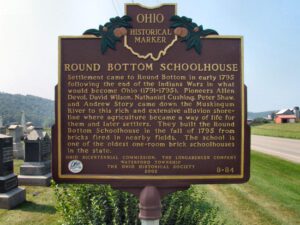
Settlement came to Round Bottom in early 1795 following the end of the Indians Wars in what would become Ohio (1791-1795). Pioneers Allen Devol, David Wilson, Nathaniel Cushing, Peter Shaw, and Andrew Story came down the Muskingum River to this rich and extensive alluvion shoreline where agriculture became a way of life for them and later settlers. They built the Round Bottom Schoolhouse in the fall of 1795 from bricks fired in nearby fields. The school is one of the oldest one-room brick schoolhouses in the state.
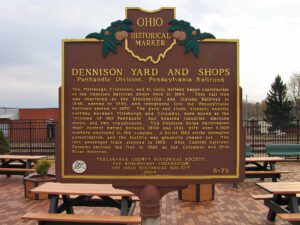
The Pittsburgh, Cincinnati, and St. Louis Railway began construction of the Dennison Railroad Shops here in 1864. This rail line was chartered as the Steubenville and Indiana Railroad in 1849, opened in 1855, and integrated into the Pennsylvania Railroad system in 1870. The yard and shops, situated exactly halfway between Pittsburgh and Columbus, were known as the “Altoona of the Pan Handle” and boasted foundries, machine shops, and two roundhouses. The Dennison Shops experienced their busiest period between 1900 and 1921, with over 3,000 workers employed in the complex. A bitter 1922 strike prompted consolidation, and the facility was gradually phased out. The last passenger train stopped in 1970. Ohio Central Railroad Systems revived the line in 1992 as the Columbus and Ohio River Railroad.
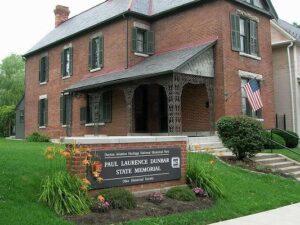
The first African-American to achieve prominence as a poet, Paul Laurence Dunbar was born and raised in Dayton, the son of former slaves. Working as an elevator operator while he established himself as a writer, Dunbar published his first book of poems, Oak and Ivy, in 1893. His third collection, Lyrics of a Lowly Life (1896) with an introduction by another Ohio-born author William Dean Howells, gained Dunbar widespread critical acclaim and popular recognition. Widely published in contemporary journals and literary magazines, Dunbar employed both turn-of-the-century African-American dialect and standard English verse to give a voice to the themes of everyday discrimination and struggles for racial equality. Tuberculosis cut his life short at age 33. Dunbar’s body of work includes twelve volumes of poetry, four books of short stories, a play, and five novels.
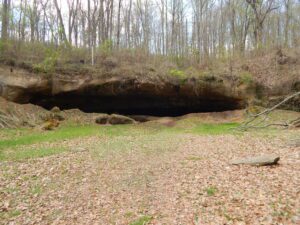
On a forested hillside south of New Straitsville, the spacious 1000 square foot Robinson’s Cave offered a secluded location with great acoustics where large groups of Hocking Valley coal miners could meet in secret. Beginning in about 1870, labor-organizing meetings were held at the cave by various emerging unions including the Knights of Labor. New Straitsville resident Christopher Evans, a well-known union organizer, used Robinson’s Cave to lead miners throughout the long Hocking Valley Coal Strike of 1884-1885. These meetings gave the miners a voice in the formation of a national organization called the National Federation of Miners and Mine Laborers, later renamed the National Progressive Union. The cave was also where non-union miners met to plan to set the Columbus & Hocking Coal & Iron Company mines on fire in a desperate attempt to end the Hocking Valley Strike. [continued on other side]
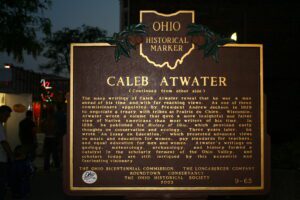
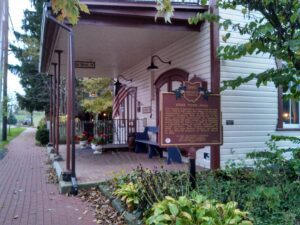
Born in North Adams, Massachusetts on December 23, 1778, Caleb Atwater graduated from Williams College in 1804. He moved to Circleville in about 1814 where he organized the city’s first school board and served as postmaster and prosecuting attorney. His life and work as a teacher, minister, lawyer, legislator, and scholar greatly influenced early 19th-century Ohio. Upon arriving in Circleville, he became interested in local history and the nearby earthworks and in 1820 published his book Descriptions of the Antiquities Discovered in the State of Ohio and Other Western States, the first compilation of prehistoric remains in the Ohio and Mississippi valleys. Elected to the Ohio State Legislature in 1821, Atwater fervently supported canal construction. He also chaired Ohio’s first board of school commissioners and was instrumental in passage of Ohio’s Public School Law. For this, he has been called the “Father of Ohio’s Common Schools.” (continued on other side)
The Society of Separatists of Zoar built the Zoar Town Hall in 1887 when the village was formally incorporated. Established in 1817 by German religious dissidents, Zoar became one of the most successful experiments in communal living during the 19th century. Early hardships encouraged the Zoarites, in 1819, to establish a communal system to ensure economic and social security. The Society disbanded in 1898. The Zoar Historic District was added to the National Register of Historic Places in 1969.