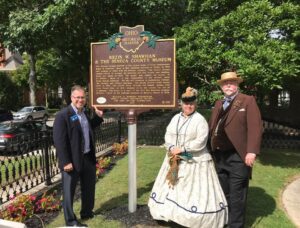
The Seneca County Museum is the former home of local businessman Rezin W. Shawhan. Born in 1811, Shawhan arrived in Tiffin in 1832 and opened a store with his brother Lorenzo. The store’s success enabled Rezin to expand his interests into real estate and banking. Upon his death in 1887, his estate was valued in excess of $1 million. Much of it was bequeathed to his second wife, Della Watson Shawhan. He also left bequests to Heidelberg College, the library, and Tiffin’s churches. The Greek Revival-style house, built in 1853, was passed down through the family, ending with Lynn Troxel who, in 1941, donated it to the county for use as a museum. The house is a part of the Fort Ball-Railroad Historic District, listed on the National Register of Historic Places in 1979.
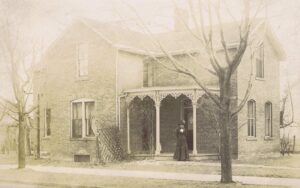
Generations of the Barker family lived in the house that stood at 89 Wood Street from 1875 to 1973. George W. Barker (1836-1913) was born enslaved in Virginia, emancipated age 13, and settled in Mansfield by 1870. He worked as a well-known chef in downtown hotels. In December 1873, Barker married Dayton-native Harriet J. Hurley (1840-1925). The next April, he purchased a corner plot in Snyder’s Subdivision for $450. Completed by 1875, his original brick house sheltered Barker, his wife, and his mother-in-law, Eliza Hurley (1815-1885). The Barker’s children — Sumner (1875-1890) and Sarah Daisy (1877-1973) — were born there. The Barker family were one of Mansfield’s historic Black families and members of the First Congregational Church. Their house once included a decorative wooden porch, numerous outbuildings, and served as an important community gathering place.
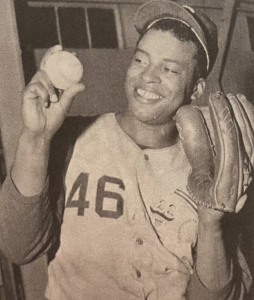
Ulysses Brooks Lawrence was born in Springfield on January 30, 1925. Nicknamed “The Bull,” he broke numerous color barriers throughout his baseball career. In 1976, Lawrence was the first Black player inducted into the Cincinnati Reds Hall of Fame. An all-around athlete at Springfield High School, Lawrence lettered in basketball, track, and football (the school’s first Black starting quarterback). After graduation in 1943, he was drafted into the U.S. Army and earned a Bronze Star in Guam during World War II. Lawrence enrolled at Ohio’s Miami University, becoming that school’s first Black baseball player (1947-1949), before signing with the Cleveland Indians. Acquired by the St. Louis Cardinals (1954), he was assigned to the Columbus Red Birds Triple-A farm team, breaking another team’s color barrier. (Continued on other side)
St. Mary of the Assumption parish — Ohio’s second and Fairfield County’s first — was founded circa 1817-1820 by Father Edward Dominic Fenwick. Dominican priests from Somerset began ministering regularly to Lancaster faithful and a small church was dedicated during Easter 1819. Construction on the parish’s third church building, The Basilica of St. Mary of the Assumption, began in February 1854 under the pastorate of Rev. Henry Lange. On August 15, 1859, the Very Rev. John Purcell, Bishop of Cincinnati, laid the cornerstone and it was blessed by former pastor Rev. Josue M. Young, Bishop of Erie, Pennsylvania. Construction proved slow as the Civil War depleted both parish funds and available workers. Father Lange rallied his parishioners, enlisted local contracters Guy and George Blair, and continued the work until his death in February 1864. (Continued on other side)
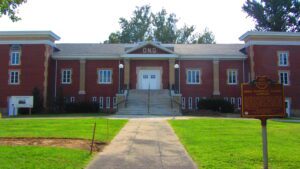
With a mission to protect citizens at home and aboard, the Ohio National Guard was originally established as the Northwest Territory Militia in Marietta on July 25, 1788, and has fought in every war since the War of 1812. Built in 1914, this Ohio National Guard Armory served both as Regimental and Company B, 7th Infantry, O.N.G. Headquarters. Later Company A, 166th Infantry, 37th Division, occupied the dual-purpose armory. The armory served Washington County as a departure point for soldiers leaving for service in World War I, World War II, and Korea. The armory also served the area in times of crisis and celebration, often used by the Red Cross, Marietta College, and other civic groups.
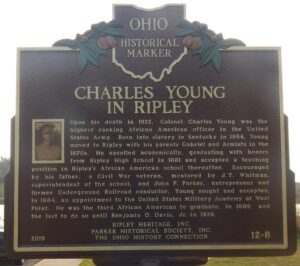
Charles Young in Ripley. Upon his death in 1922, Colonel Charles Young was the highest ranking African American officer in the United States Army. Born into slavery in Kentucky in 1864, Young moved to Ripley with his parents Gabriel and Arminta in the 1870s. He excelled academically, graduating with honors from Ripley High School in 1881 and accepted a teaching position in Ripley’s African American school thereafter. Encouraged by his father, a Civil War veteran, mentored by J. T. Whitman, superintendent of the school, and John P. Parker, entrepreneur and former Underground Railroad conductor, Young sought and accepted, in 1884, an appointment to the United States Military Academy at West Point. He was the third African American to graduate, in 1889, and the last to do so until Benjamin O. Davis, Jr. in 1936.
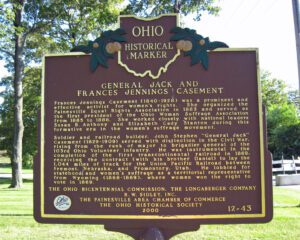
Western Reserve agriculturalist Charles Clement Jennings built the Casement House, also known as the “Jennings Place,” for his daughter Frances Jennings Casement in 1870. Designed by Charles W. Heard, son-in-law and student of Western Reserve master builder Jonathan Goldsmith, it is an excellent example of the Italianate style, featuring ornate black walnut woodwork, elaborate ceiling frescoes, and an innovative ventilation system. It remained in the Casement family until 1953. It was added to the National Register of Historic Places in 1979.
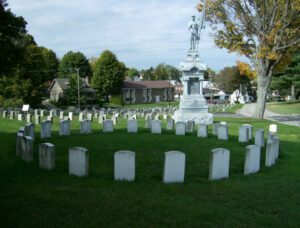
Envisioned as a rural cemetery with careful attention to landscaping design and symmetrical lots, the Riverview Cemetery was established in 1883 on forty acres of land. The chapel was a gift to Riverview from the Grand Army of the Republic, mostly Civil War veterans, and was dedicated on Memorial Day 1899. Plaques inside the chapel list 702 men from Ohio, Pennsylvania, and West Virginia who served in the Civil War, including 311 who are memorialized or buried at Riverview. There are also plaques listing soldiers killed in World Wars I and II, Korea, and Vietnam. The rich history of East Liverpool and Columbiana County is documented in the burials at Riverview Cemetery.