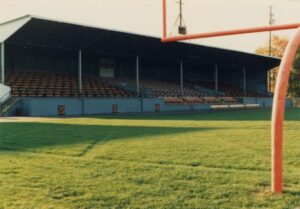
Opened in 1926, Tanks Memorial Stadium became the home of the Ironton Tanks semi-professional football team. The Tanks were formed in 1919 and through the years played other semi-professional teams as well as teams from the American Professional Football Association that became the National Football League in 1930. In twelve seasons the Tanks had a record of 85 wins, 19 losses, and 14 ties, including wins against the Chicago Bears and New York Giants. The Tanks disbanded in 1931, but five players moved on to the Portsmouth Spartans, which became the Detroit Lions, and other NFL teams picked up four other players. Tanks Memorial Stadium is one of the few remaining roofed high school football stadiums in the country.
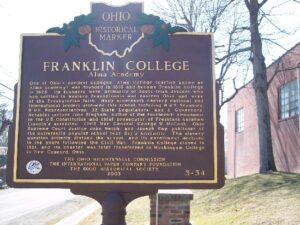
One of Ohio’s earliest colleges, Alma College (earlier known as Alma Academy) was founded in 1818 and became Franklin College in 1825. Its founders were primarily of Scots-Irish descent who had settled in western Pennsylvania and eastern Ohio and were of the Presbyterian faith. Many nineteenth-century national and international leaders attended this school, including 8 U.S. Senators, 9 U.S. Representatives, 32 State Legislators, and 2 Governors. Notables include John Bingham, author of the Fourteenth Amendment to the U.S. Constitution and chief prosecutor of President Abraham Lincoln’s assassins; Civil War General George W. McCook; Ohio Supreme Court Justice John Welch; and Joseph Ray, publisher of the universally popular school text Ray’s Arithmetic. The slavery question bitterly divided the school, and its enrollment declined in the years following the Civil War. Franklin College closed in 1921, and its charter was later transferred to Muskingum College in New Concord, Ohio.
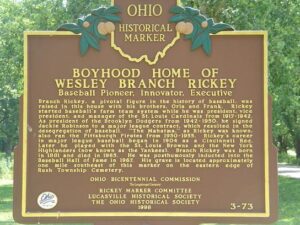
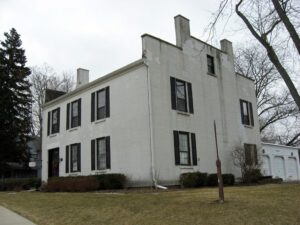
Branch Rickey, a pivotal figure in the history of baseball, was raised in this house with his brothers, Orla and Frank. Rickey started baseball’s farm team system while he was president, vice president, and manager of the St. Louis Cardinals from 1917-1942. As president of the Brooklyn Dodgers from 1942-1950, he signed Jackie Robinson to a major league contract, which resulted in the desegregation of baseball. “The Mahatma,” as Rickey was known, also ran the Pittsburgh Pirates from 1950-1955. Rickey’s career in major league baseball began in 1904 as a Cincinnati Red. Later he played with the St. Louis Browns and the New York Highlanders (now known as the Yankees). Branch Rickey was born in 1881 and died in 1965. He was posthumously inducted into the Baseball Hall of Fame in 1967. His grave is located approximately one mile southeast of this marker on the eastern edge of Rush Township Cemetery.
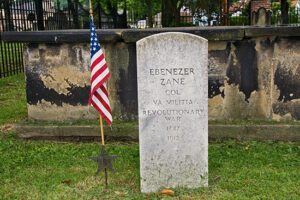
The Walnut Grove Cemetery is the burial place of members of the Zane and Martin families. Their graves lie within the brick enclosure. The cemetery is also the resting-place of many early Martins Ferry residents, including veterans of the Revolutionary War, the War of 1812, the Mexican War, and the Civil War. The Zane and Martin families were significant in the pioneer history of the region. Betty Zane’s legendary heroism at Fort Henry (now Wheeling, West Virginia) helped settlers resist an attack by the British and their Native American allies in September 1782. (Continued on other side)
Old Wood County Jail 1847-1870. Built in 1847, during the Presidency of Polk, when Perrysburg was the County Seat, and used as the Jail and Infirmary until 1870. Continued to serve as the Perrysburg Jail until 1899, sold by the town in 1918. Acquired and restored by Mr. and Mrs. Charles W. Hoffmann in 1954. Listed in the Historic American Building Survey and National Register of Historical Landmarks, Library of Congress.
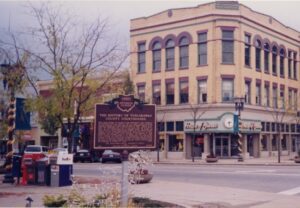
When David Knisely, the founder of New Philadelphia, first arrived in the Tuscarawas Valley on August 27, 1803, he found a sparsely populated, pristine wilderness. Five years later the state legislature approved a bill organizing Tuscarawas County effective March 15, 1808. Shortly thereafter, New Philadelphia was chosen as the county seat, and on April 16, 1808, the first commissioners met at Leininger’s tavern. By August, the tavern proved to be an inappropriate location for the county’s official business, and the commissioners approved the construction of a two-story, combination jail and county office building on land donated by John Knisely on the northeast corner of the square. By 1818 a new, larger brick courthouse was authorized by the commissioners. This building was occupied in 1825 and served as the courthouse until 1882 when the present structure was approved. Occupied in 1888, the building continues to be the center of the county’s business. The beautiful, state-of-the-art annex was dedicated on October 27, 1990.
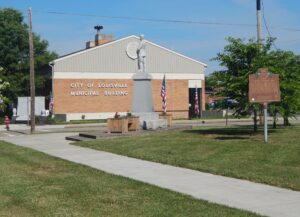
At this site on September 17, 1952, an assembly of Louisville citizens led by Olga T. Weber joined U.S. Congressman Frank T. Bow in commemorating the completion of U.S. Constitution on September 17, 1787. With the goal of promoting a wider understanding of citizens’ rights and responsibilities, the Committee for the Preservation of the Constitution lobbied for both state and national observances. In 1953, Governor Frank Lausche proclaimed September 17 as Constitution Day in Ohio; subsequently President Dwight D. Eisenhower proclaimed the week of September 17, 1955 as Constitution Week. The committee, incorporated in 1962, has marked the anniversary each year since–making this Louisville tradition the nation’s longest continuing observance of Constitution Day.
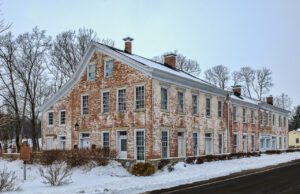
The Bunker Hill House, previously the Bunker Hill Tavern, was built in stages between 1834 and 1862. The building is one of Ohio’s best representations of Federal-Greek Revival style “pike town” architecture. This architectural style is closely associated with pre-Civil War horse-powered turnpike transportation and lodging. The building was a way station for pioneers heading west and for drovers driving their animals to Cincinnati stockyards. It was also a stagecoach stop on Eastern Stage Coach Company’s Cincinnati Omnibus Line that operated daily between Cincinnati and Richmond, Indiana. Tavern operations ceased in 1858 due to decreased turnpike travel resulting from the newly completed railroad through nearby Camden. In 1862, a general store was established to supply the growing population in the area. The store closed in the early 1900s with the advent of the automobile, which made travel to larger, more distant stores viable. The Bunker Hill House was listed on the National Register of Historic Places in 2001. (continued on other side)