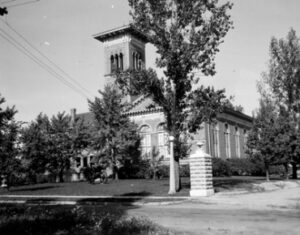
At the turn of the twentieth century, increased enrollment in the Combined Normal and Industrial Department at Wilberforce University (which later became Central State University) spurred construction of new teaching and dormitory facilities. Galloway Hall, which included an auditorium and a tower with chimes and a clock, was completed in 1906. Many famous personalities performed in Galloway Hall’s auditorium, including the renown opera singer Leontyne Price; Robert McFerrin, the first African American male lead with the New York Metropolitan Opera; actors Ruby Dee and Ossie Davis; comedian and civil rights activist Dick Gregory; and composer and conductor Duke Ellington. Noted authors and intellectuals addressed audiences there, including historian John Hope Franklin; writer, poet, actor, and playwright Maya Angelou; Lerone Bennett, author, historian, and editor of EBONY Magazine; and writer and essayist James Baldwin. (continued on other side)
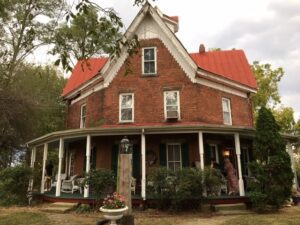
Zimmerman-Bury Octagon House. The Zimmerman-Bury Octagon House was built by Ezekiel B. Zimmerman (1843-1935) and Francis B. Hess Zimmerman (1848-1920) in 1883. Ezekiel graduated from Smithville Academy and was an avid reader. One of Ezekiel’s sons, Ernest Zimmerman (1888-1973), remembered that his father had encountered Orson Fowler’s manifesto A Home for All, or the Gravel Wall and Octagon Mode of Building (1853) and surmised that his father patterned the house after Section V of the book. The approximate 99,000 bricks comprising the house were made on the property, creating exterior walls and a center stairway which are three bricks or about 12 inches thick. Ernest noted the house’s “Russian Tin” roof, referring to its metal standing seam construction. The roof and architectural ornament make the house stand out compared to other octagon structures in Ohio. (Continued on other side)
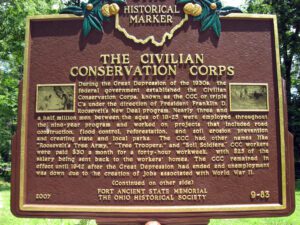
During the Great Depression of the 1930s, the federal government established the Civilian Conservation Corps, known as the CCC or triple C’s under the direction of President Franklin D. Roosevelt’s New Deal program. Nearly three and a half million men between the ages of 18-25 were employed throughout the nine-year program and worked on projects that included road construction, flood control, reforestation, and soil erosion prevention and creating state and local parks. The CCC had other names like “Roosevelt’s Tree Army,” “Tree Troopers,” and “Soil Soldiers.” CCC workers were paid $30 a month for a forty-hour workweek, with $25 of the salary being sent back to the workers’ homes. The CCC remained in effect until 1942 after the Great Depression had ended and unemployment was down due to the creation of jobs associated with World War II.
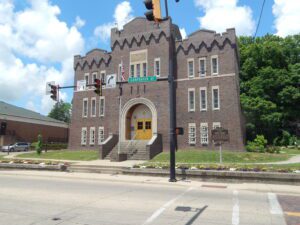
In the first years of the twentieth century, Athens’ citizens formed a new National Guard company. The guardsmen initially held drill at the Campbell Block on Court Street, but soon the Athens Commercial Club began advocating for an armory from the Ohio National Guard. In 1912, the Armory Board approved the request. Plans were drawn up for the armory and the Guard purchased land from the Athens Brick Company at the foot of Shale Hill. Construction began in the spring of 1915 and the Armory opened in December. In March of 1917, the city held a dedication ceremony and parade. Before World War I, the Athens Armory housed Company L and the Machine Gun Company, both part of the 7th Infantry Regiment, Ohio National Guard. (Continued on other side)
Great Miami River Recreational Trail, Taylorsville Metro Park, 2005 U.S. Route 40
Vandalia
, OH
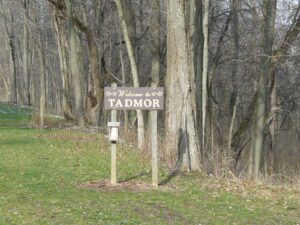
The Village of Tadmor is significant as being the location of one of the most important centers of transportation in early Ohio history. As early as 1809, keelboats were poled up river from Dayton to load and unload freight in the village. By 1837, the Miami and Erie Canal had reached Tadmor, connecting it to the Ohio River in the south and Lake Erie in the north. In the 1830s, the National Road was constructed through Tadmor, connecting it to points east and west. In 1851, the Dayton & Michigan Railroad established freight and passenger service to the growing town. Residents hoped that Tadmor’s strategic location would help it prosper, however, successive flooding on the Great Miami River stifled growth. Tadmor was finally abandoned when a dam constructed by the Miami Conservancy District in 1922 to retain water during flooding made the site uninhabitable.
Intersection of National Road (U.S. 40) and Old National Road
Morristown
, OH
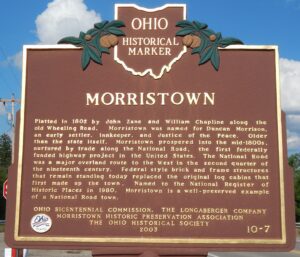
Platted in 1802 by John Zane and William Chapline along the old Wheeling Road, Morristown was named for Duncan Morrison, an early settler, innkeeper, and Justice of the Peace. Older than the state itself, Morristown prospered into the mid-1800s, nurtured by trade along the National Road, the first federally funded highway project in the United States. The National Road was a major overland route to the West in the second quarter of the nineteenth century. Federal style brick and frame structures that remain standing today replaced the original log cabins that first made up the town. Named to the National Register of Historic Places in 1980, Morristown is a well-preserved example of a National Road town.
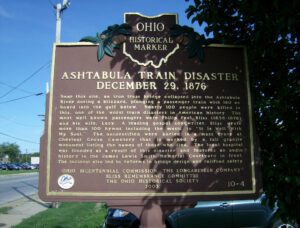
Near this site, an iron truss bridge collapsed into the Ashtabula River during a blizzard, plunging a passenger train with 160 on board into the gulf below. Nearly 100 people were killed in this, one of the worst train disasters in American history. The most well known passengers were Philip Paul Bliss (1838-1876) and his wife, Lucy. A leading gospel songwriter, Bliss wrote more than 100 hymns including the music to “It Is Well With My Soul.” The unidentified were buried in a mass grave at Chestnut Grove Cemetery that is marked by a tall granite monument listing the names of those who died. The local hospital was founded as a result of this disaster and features an audio history in the James Lewis Smith Memorial Courtyard in front. The incident also led to reforms in bridge design and railroad safety.
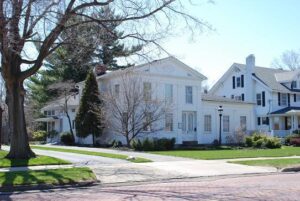
Among the fifty-four buildings that comprise the Mentor Avenue District are examples of Federal, Greek Revival, Early Romanesque Revival, Italianate, Second Empire, Queen Anne, and twentieth century eclectic styles. Renowned master builder Jonathan Goldsmith (1783-1847), whose Federal and Greek Revival designs define the so-called “Western Reserve” style, built at least two of these houses; the Denton-Powers House (ca. 1820) is representative. The Mentor Avenue District was added to the National Register of Historic Places in 1979. The Painesville City Hall, the Sessions House (157 Mentor Avenue) and the Smead House (187 Mentor Avenue) are also listed individually on the National Register.