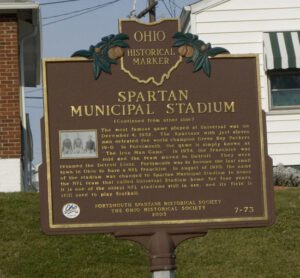
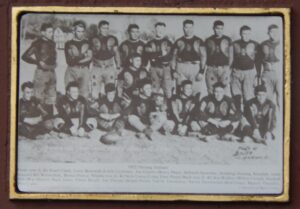
Opened in the fall of 1930, Universal Stadium became the home of the Portsmouth Spartans professional football team. Earlier that summer, the Spartans had just become a member of the National Football League (NFL). Led by a few local businessmen, the Portsmouth National Football League Corporation raised money to help build the permanent stadium for the Spartans. The stadium opened on September 14, 1930 as the Spartans defeated the Newark (New Jersey) Tornadoes for their first NFL victory. Ten days later the Spartans played one of the NFL’ s first night games against the Brooklyn Dodgers. The Portsmouth Times said, “Night football has come to stay, at least in Portsmouth.” From 1930 to 1933, the Spartans compiled a record of 19 wins 2 losses and 4 ties at Universal Stadium. (continued on other side)
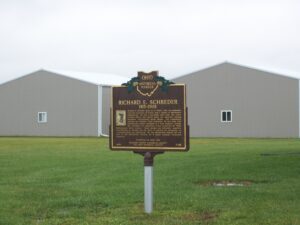
Richard E. Schreder grew up in Toledo, Ohio and graduated from the University of Toledo with a degree in Mechanical Engineering. He was a decorated navy pilot and iconic aviation figure who helped shape the American soaring movement, international glider design, and competitive soaring and piloting flight strategies. He also made high performance gliders available to a wide audience through the affordable kit production of his distinctive HP (High Performance) glider designs. These designs and Schreder’s numerous contributions to aviation and the sport of soaring are recognized as “groundbreaking and pioneering” by the Smithsonian Museum and are part of the Smithsonian National Air & Space Museum’s permanent collection. (continued on other side)
The Oorang Indian football team was founded by LaRue native Walter Lingo (1890-1966), owner of the Oorang Airedale Dog Kennels. The team, comprised of Native American Indians, played in the National Football League (NFL) in 1922-23. The star player and coach was Jim Thorpe (1887-1953), a Sac and Fox Indian. Thorpe gained international fame as a two-time gold medal winner (decathlon and pentathlon) in the 1912 Olympics and was acclaimed as the “World’s Greatest Athlete.” The team gave LaRue the distinction of being the smallest community ever to have an NFL franchise.
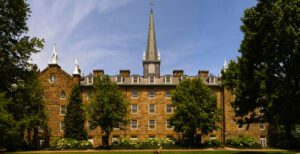
The state’s oldest private institution of higher education, Kenyon College was founded in 1824 in Worthington by Philander Chase, first Episcopal bishop of Ohio, and relocated to Gambier four years later. Both college and village are named for British benefactors, statesman Lord Kenyon and naval hero Lord Gambier. Throughout its history, Kenyon has prepared men and women for leading roles in society, including nineteenth-century graduates Edwin M. Stanton, Abraham Lincoln’s secretary of war, and Rutherford B. Hayes, Ohio governor and U.S. president. In the twentieth century, Kenyon educated such literary luminaries as poet Robert Lowell and novelist E.L. Doctorow. Kenyon has also been an innovator in education-the Advanced Placement Program began as the Kenyon Plan in the 1950s.
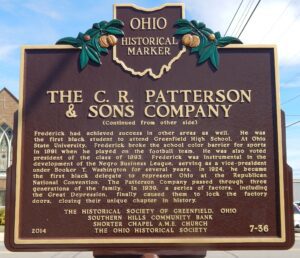
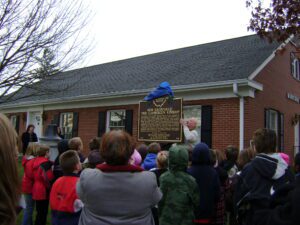
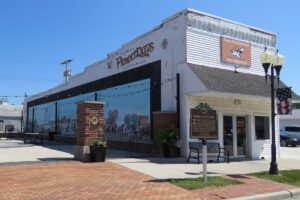
The factory of the C. R. Patterson & Sons Company once stood near here at 138 N. Washington Street. Established in the mid-nineteenth century by the black businessman Charles Richard (C. R.) Patterson and his white partner, J. P. Lowe, the business, originally known as J. P. Lowe & Company, became a successful carriage firm. Patterson became the sole owner in 1893 and changed the name to C. R. Patterson & Sons. After succeeding his father as owner, C. R.’s son, Frederick, became the first known African-American automobile manufacturer. Under his leadership, the company transitioned from building carriages to automobiles, then to trucks and buses to keep up with the changing demands of the transportation industry. (Continued on other side)
The history of New Knoxville provides one of the best examples of chain migration to America. After the Shawnee were removed from what would become Auglaize County, James Knox Lytle, cousin to James Knox Polk, purchased land in Washington Township. Lytle platted a village of 102 lots in 1836, calling it Knoxville to honor his mother’s family. Meanwhile, newly married Wilhelm and Elisabeth Fledderjohann Kuckhermann (later Kuck) immigrated from Ladbergen in northwest Germany. Having missed their boat to St. Louis, the couple lived briefly in Stallostown (Minster) and Bremen (New Bremen). They wrote home, encouraging others to emigrate; in the summer of 1835 the Fledderjohanns (Elisabeth’s family), Meckstroths, and Lutterbecks arrived. The families bought land near the site of Knoxville. (continued on other side)
The Putnam County Pioneer Association was organized September 6, 1873, at a meeting in Kalida, Ohio. Its stated purpose was to “perpetuate the early history of our county.” Members gathered oral histories from early residents and published two volumes of Pioneer Reminiscences in 1878 and 1887. The all-day annual meeting, held every year in September, grew into a larger festival. In 1970, the Kalida Lions Club, with funds generated from the event, purchased the former Kalida Methodist Church at 201 E. Main Street and “sold” it for $10 to the Pioneer Association for use as a museum. The Pioneer Association adopted a revised constitution and changed its name to The Putnam County Historical Society in 1971. It continues to hold its annual meeting during the “Pioneer Days” weekend.
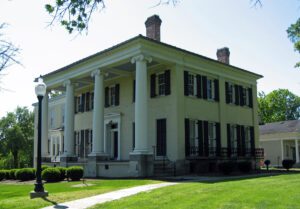
1832 Greek Revival Style. The Kinsman House once served as classrooms for the Dana School of Music, Hiram College Branch. The house is listed on the National Register of Historic Places.