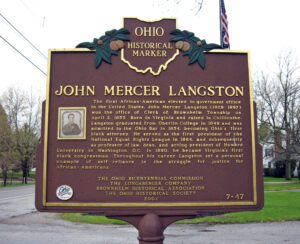
The first African-American elected to government office in the United States, John Mercer Langston (1829-1897) won the office of Clerk of Brownhelm Township on April 2, 1855. Born in Virginia and raised in Chillicothe, Langston graduated from Oberlin College in 1849 and was admitted to the Ohio Bar in 1854, becoming Ohio’s first black attorney. He served as the first president of the National Equal Rights League in 1864, and subsequently as professor of law, dean, and acting president of Howard University in Washington, D.C. In 1890, he became Virginia’s first black congressman. Throughout his career Langston set a personal example of self-reliance in the struggle for justice for African-Americans.
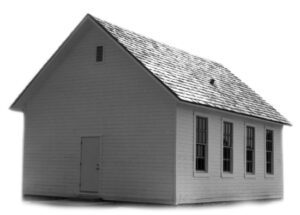
Descendants of slaves, who may have reached Ohio through the Underground Railroad, and other African Americans, formed the community of Flatwoods in the southwest part of Bokescreek Township. This one-room schoolhouse was built circa 1868 for African American children of Flatwoods and remained open until 1923. Remnants of past lessons remain inscribed on the chalkboard. The schoolhouse was threatened with demolition in 1999 and later moved to Veteran’s Park. The Logan County Historical Society owns and maintains the site as a living history museum.
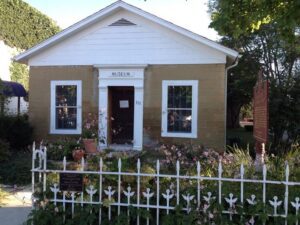
Built by William Stedman in 1816 of local stone, this building served as the Bank of the Alexandrian Society, which printed its own currency. The bank failed in 1817 and 1837. This building has also been used as a store, post office, and interurban railway depot. It was enlarged and opened as a museum during Granville’s Sesquicentennial Celebration in 1955, and was listed on the National Register of Historic Places as part of the Granville Historic District in 1980.
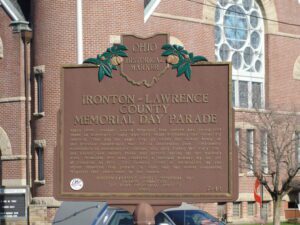
Since 1868, Ironton’s annual Memorial Day parade has recognized those in Lawrence County who died while defending our country’s freedom. This was the same year in which the Grand Army of the Republic established May 30 as Decoration Day. Originally established to commemorate soldiers who died during the Civil War, the parade now honors those who served during all the nation’s wars. Memorial Day was declared a national holiday by an act of Congress in 1971. The Ironton event is recognized as the oldest Memorial Day parade in Ohio and the oldest continuing Memorial Day observance in the nation.
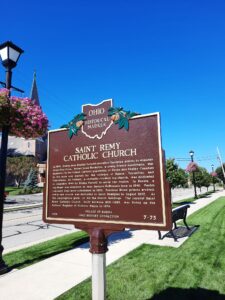
In 1839, Bishop John Baptist Purcell recruited European priests to minister to his Ohio flock. Father Louis Navarron, a young French missionary, was appointed to the French Catholic population of Darke and Shelby Counties in the area now marked by the villages of Russia, Versailles, and Frenchtown. St. Valbert, a centrally-located log church, was dedicated in December 1840 by Bishop Purcell to serve the region. In Russia, a log chapel was dedicated on Jean Jacques DeBrosse’s farm in 1846. Parish boundary lines were established in 1850, Precious Blood priests arrived, and a new church was dedicated to Saint Remigius in August 1852. As the congregation grew, so did the church buildings. The current Saint Remy Catholic Church, built between 1891-1892, was listed on the National Register of Historic Places in 1979.
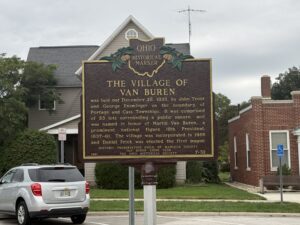
The Village of Van Buren was laid out December 28, 1833, by John Trout and George Ensminger on the boundary of Portage and Cass Townships. It was comprised of 53 lots surrounding a public square, and was named in honor of Martin Van Buren, a prominent national figure (8th President, 1837-41). The village was incorporated in 1866 and Daniel Frick was elected the first mayor.
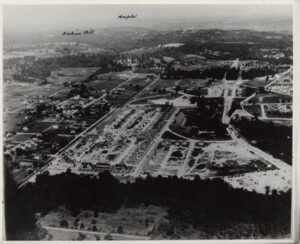
Ground was broken for Mariemont by Mary M. Emery, the village’s founder, on April 23, 1923. This planned community was designed by eminent town planner John Nolen and twenty-five of America’s leading architects. As part of the “garden city movement,” Mariemont was influenced by English models. Mariemont was incorporated July 12, 1941, and was listed on the National Register of Historic Places on July 24, 1979.
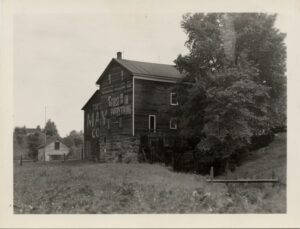
Fowlers Mill (originally Fowler’s Mills) developed around a group of mills built in the 1830s on the Chagrin River. Opportunities from these mills led to Fowlers Mill becoming the commercial center of Munson Township. From the 1830s into the twentieth century, the community expanded with construction of churches, a post office, township hall, stores, hotel, blacksmith shop, schools, and houses built in such styles as Federal, Greek Revival, Italianate, and Queen Anne. This type of community center was common in rural, nineteenth century America, but rarely survives with so much original fabric intact. On Mayfield Road, the Disciple Church was built in 1842. East of the church, the brick central school built in 1913 replaced earlier one-room schoolhouses. The gristmill is the only mill standing in Geauga County. The cemetery contains burials dating from the 1830s. The Fowler’s Mills Historic District was placed on the National Register of Historic Places in 2002.