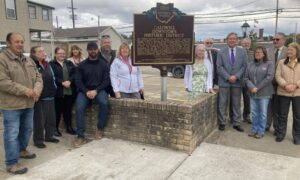
The Caldwell Downtown Historic District is the historic commercial and governmental core of the Village of Caldwell, which was founded in 1857 on farmland owned by Joseph and Samuel Caldwell. Caldwell serves as the county seat of Noble County, the last of Ohio’s 88 counties to be organized. The agricultural community prospered and by 1873 was the second-largest producer of tobacco in Ohio. The Pennsylvania Railroad arrived in 1872, and the development of salt, oil, coal, and natural gas extraction companies followed during the 1880s. Two separate fires in 1897 devastated portions of the north and south quadrants of the district. As a result, Caldwell formed a volunteer fire department and the Village Council introduced legislation prohibiting construction of wood buildings within a block of the public square. (Continued on other side)
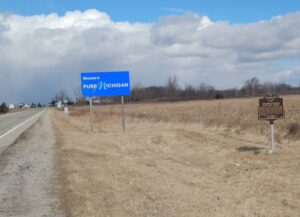
After the War of 1812, the United States Congress proposed two million acres of military bounty land for the Michigan Territory. To survey the land, the meridian had to first be established. U.S. Surveyor General Edward Tiffin created the meridian based on the western line of the Treaty of Detroit (1807). He contracted with Deputy Surveyor Benjamin Hough in April 1815 to begin the survey for $3 per mile. Taking a reading from Polaris (the North Star), Hough, Alexander Holmes, and 11 crew members surveyed the line due north from Fort Defiance. The difficult terrain they encountered temporarily halted all surveys in the territory and ultimately led to the bounty land being transferred to the Illinois and Missouri Territories.
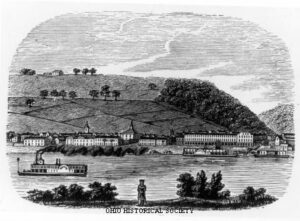
Ripley was incorporated as the village of Staunton in 1812. Its name was changed in 1816 to honor General Eleazer Wheelock Ripley, a hero of the War of 1812. In the years before railroads, Ripley was a principal Ohio River shipping center. Also important were its extensive boat-building, tobacco, pork, and timber industries. Ripley too was the home of saw and planing mills, iron foundries, and a piano factory. Such varied commerce enabled Ripley to remain vibrant throughout the nineteenth century. Although noted as a port, Ripley is best remembered as an abolitionist stronghold. Many of its citizens, including Rev. John Rankin and John P. Parker, served as conductors on the famed “Underground Railroad.” The notoriety of Ripley’s anti-slavery network perhaps eclipsed that of nearby Cincinnati, earning the town a reputation as the “Black Hole of Abolitionism.” (Continued on side two)
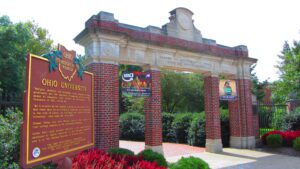
Manasseh Cutler, Rufus Putnam, Winthrop Sargeant, and Benjamin Tupper of the Ohio Company conceived Ohio University, which was encouraged by the Ordinance of 1787 and the Northwest Territorial Legislature in 1799, incorporated as the American Western University in 1802, and chartered by the Ohio State Legislature on February 18, 1804. The university is the first institution of higher learning in the Northwest Territory, second west of the Allegheny Mountains, and the first in the United States to be endowed with land by the government with proceeds used to pay for its operations-revenue from two townships was set aside to support the university. Opened on June 1, 1809, as an academy with three students, Ohio University awarded its first undergraduate degrees in 1815.
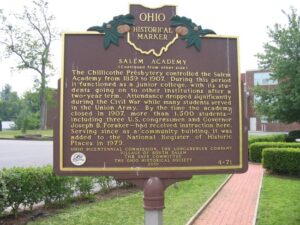
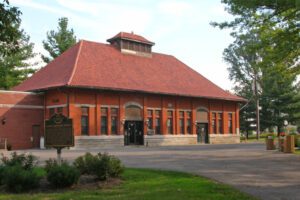
Presbyterian minister Hugh Stewart Fullerton asked his congregation in 1841: “Shall we endeavor to form an academy to provide better educational advantages to the young citizens of this remote community?” Predating the founding of the town of South Salem, the Salem Academy was built and opened in 1842, its stone coming from a quarry south of Greenfield. Its primary purpose was to prepare ministers and teachers for the West. Professor J.A. Lowes served as principal during the “golden age” of the academy from 1848 to 1858. (continued on other side)
Frances Rappaport Horwich was born in Ottawa on July 16, 1907, the daughter of Sam Rappaport, an Austrian immigrant who operated a general store, and Rosa Gratz Rappaport, a Russian immigrant. The youngest of six children, she attended the Ottawa elementary school and graduated from Ottawa High School in 1924. After high school, she attended the University of Chicago where she earned a bachelor’s degree in philosophy and taught first grade for three years. “Miss Frances,” as she was called, then earned a master’s degree from Columbia University in 1933 and a Ph.D. in 1942 from Northwestern University. From 1942 to 1952, she was involved in teaching and education development. The basic education she received in the Ottawa schools enabled her to achieve great skills and abilities. [continued on other side]
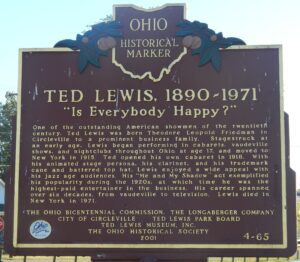
One of the outstanding American showmen of the twentieth century, Ted Lewis was born Theodore Leopold Friedman in Circleville to a prominent business family. Stagestruck at an early age, Lewis began performing in cabarets, vaudeville shows, and nightclubs throughout Ohio at age 17, and moved to New York in 1915. Ted opened his own cabaret in 1918. With his animated stage persona, his clarinet, and his trademark cane and battered top hat, Lewis enjoyed a wide appeal with his jazz age audiences. His “Me and My Shadow” act exemplified his popularity during the 1920s, at which time he was the highest-paid entertainer in the business. His career spanned over six decades, from vaudeville to television. Lewis died in New York in 1971.
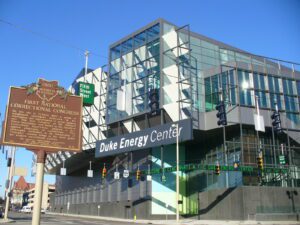
On this site in October of 1870 met a group of enlightened individuals dedicated to the reformation and improvement of penal systems. This first Congress of the National Prison Association, now known as the American Correctional Association, adopted a far-sighted philosophy of corrections. This philosophy, embodied in its Declaration of Principles, remains today as the basic guide for modern correctional systems.