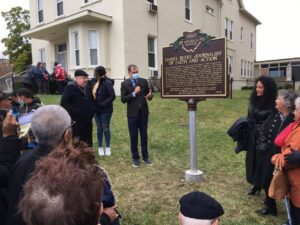
Daniel Arthur Rudd was born into slavery on August 7, 1854, in Bardstown, Kentucky. He became a newspaperman, lecturer, publicist, and tireless advocate for the Roman Catholic Church. After the Civil War Rudd moved to Springfield. Baptized and raised in Catholicism, he joined St. Raphael Parish, where the philosophy of racial equality offered by the church solidified his vision of justice. By 1885 he had established his own weekly newspaper, The Ohio State Tribune. He rebranded it The American Catholic Tribune (ACT) after moving to Cincinnati. Rudd claimed ACT was the only Catholic newspaper owned by an African American. At the height of its popularity in 1892, the publication had a circulation of 10,000. In 1893 Rudd was asked to chair the Afro-American Press Association, representing more than 200 black-owned newspapers.
Legend has it that Mogadore’s first settler, Ariel Bradley, was a spy for George Washington in October, 1776. As a nine year old boy, Ariel crossed British lines on a supposed errand to the nearest grist mill and returned with troop positions and tent counts. In 1801, Ariel left Connecticut to make his new home in what would be Ohio. In 1807, he built a log cabin on a 146 acre plot of farm land that cost $335. Until 1825 the new community had been named Bradleyville, but Ariel did not want the area named after him. Martin Kent was building a residence and a sailor, John Robinson, climbed to the top of the framework, pulled a flask of whiskey from his pocket. Breaking the flask on the last beam of construction, Robinson shouted “Three cheers for Mogador,” which is a large city in Morocco, thusly christening the area Mogadore.
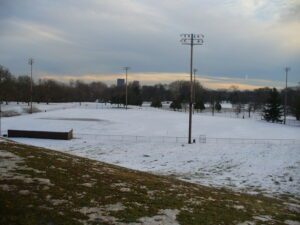
On October 3, 1920 the first game matching two professional teams of the American Professional Football Association, a league that would become the National Football League (NFL), was held on this field within Triangle Park. In that game, the Dayton Triangles defeated the Columbus Panhandles 14-0. The Triangle’s Lou Partlow scored the first touchdown and George “Hobby” Kinderdine kicked the first extra point. Three factories founded by Dayton businessmen Edward Deeds and Charles Kettering sponsored the Dayton Triangles team. The factories were the Dayton Engineering Laboratories Company (DELCO), Dayton Metal Products Company (D.M.P.Co.), and Domestic Engineering Company (DECO), later call Delco-Light. They formed an industrial triangle of plants in downtown Dayton.
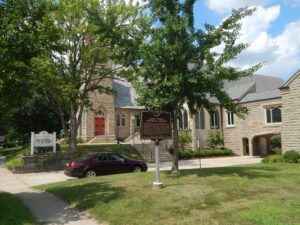
On March 11, 1817, Rev. Roger Searle of Connecticut met with a group of settlers at the home of Zenas Hamilton in Medina Township and founded St. Paul’s Episcopal Church. On April 10, 1817, the congregants cleared land near Weymouth and built a log church, which served as a school, place of worship for other dominations, and meeting house. The congregation eventually moved to Medina to serve the village’s growing population. Around 1883, noted Detroit architect Gordon W. Lloyd designed a new church in the Victorian Gothic style, thereafter described as “incomparably the finest Episcopal church in any country town at the time.” The first service was held on December 19, 1884. St. Paul’s was listed on the National Register of Historic Places in 1982 and is the oldest congregation in Medina County still in existence.
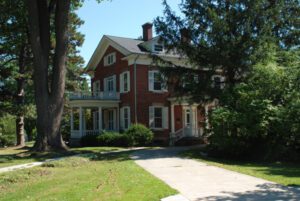
Jabez Lyman Burrell (1806-1900), originally from Massachusetts, built this house in 1852. Burrell made his living as a cattleman and farmer, but devoted much of his time serving the cause of abolitionism, helping slaves, who had escaped the South, get to Sheffield and from there to Lorain and across Lake Erie to Canada. He was also devoted to equal education for all, providing funding to a freedmen’s school in Selma, Alabama, and serving as a trustee of the Oberlin Collegiate Institute, well known for educating African Americans and women. From 1884 to 1934, this was the home of Henry Churchill King (1858-1934), who was the president of Oberlin College from 1902-1927. The Kings added the porches and rear wing and made their home a social center for the college and community. The house is listed on the National Register of Historic Places and is a City of Oberlin Historic Landmark.
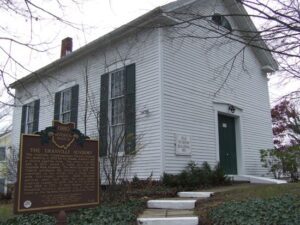
The Granville Congregational Church erected this building in 1833 for its Female Academy and a church meeting room. The school prospered and, in 1837, moved to make way for the Granville Male Academy. The Welsh Congregational Church purchased the structure in 1863 and converted its two stories into a single room with full-height windows. Welsh language services were held here for sixty years. Granville Grange #2230 met in the building from 1923 to 1973. It then became Granville Historical Society’s property and, in 1981, was listed on the National Register of Historic Places.
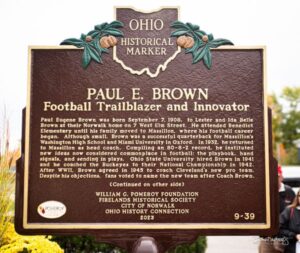
Paul Eugene Brown was born September 7, 1908, to Lester and Ida Belle Brown at their Norwalk home on 7 West Elm Street. He attended Benedict Elementary until his family moved to Massillon, where his football career began. Although small, Brown was a successful quarterback for Massillon’s Washington High School and Miami University in Oxford. In 1932, he returned to Massillon as head coach. Compiling an 80-8-2 record, he instituted new ideas now considered commonplace in football: the playbook, hand signals, and sending in plays. Ohio State University hired Brown in 1941 and he coached the Buckeyes to their National Championship in 1942. After WWII, Brown agreed in 1945 to coach Cleveland’s new pro team. Despite his objections, fans voted to name the new team after Coach Brown. (Continued on other side)
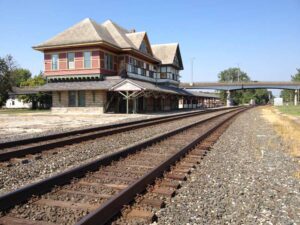
This Depot, dedicated on December 27, 1900, served as division headquarters for the Cleveland, Chicago, Cincinnati, and St. Louis railroad, commonly called the Big Four. Peak passenger usage occurred during and after World War I when 32 trains stopped here daily. Railway Express serviced as many as 20 trains a day into the 1950s, and Galion became a “whistle stop” for presidential campaigns with speeches from the train platform from such candidates as Al Smith in 1928, Franklin D. Roosevelt in 1932, and Dwight D. Eisenhower and Richard Nixon in 1952. In 1929 the New York Central acquired the Big Four, which moved the division headquarters west to Bellefontaine in Logan County. The ticket office remained opened until 1964, but all railroad offices closed in 1969. The Depot was listed on the National Register of Historic Places in 1974.