In 1884 the Ohio General Assembly authorized “the burial of the body of any honorably discharged union soldier, sailor or marine of this state who shall hereafter die without leaving means sufficient to defray funeral expenses.” Permanent government-issued headstones have been provided to veterans since the late 19th century. Between 1884 and the 1930s, Washington Cemetery buried 47 white soldiers (including 15 unknown) and 35 African-American soldiers. These veterans served in the Civil War, the Spanish-American War, and WWI. They are remembered for the sacrifices they made. In the fall of 2001, the cemetery underwent significant renovations, in which students of the Washington Senior High School Research History program aided in identifying the buried soldiers and restoring and replacing the gravestones. Here in Soldiers’ Row, the words of local United States Colored Troops veteran, Albert Bird, echo centuries later: “We have suffered to save the country; we ought to be remembered.”
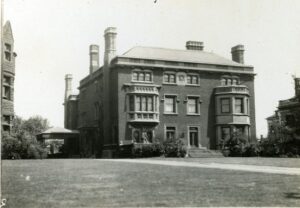
The 43-room Tudor mansion represents a fine example of stately homes in Cleveland at the turn of the century and is the last of the “Millionaire Row” homes that once lined Euclid Avenue. It was designed by Charles F. Schweinfurth, a world-renowned Cleveland architect, in 1905-06 and completed in 1910 at a cost of $1,200,000. Following Samuel Mather’s death in 1931, the building was occupied by the Cleveland Institute of Music until 1940 then by the Cleveland Automobile Club until 1967 when it was purchased by The Cleveland State University. The mansion was entered into the National Register of Historic Places on February 20, 1973.
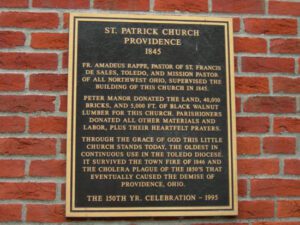
The town of Providence was born, thrived and died with the Miami & Erie Canal. It was platted in 1835 by French trader Peter Manor, swept by fire in 1846, ravaged by cholera in 1854, and finally unincorporated in 1928. Today, only the Irish builders’ St. Patrick’s Church (1845), the oldest in the Toledo Diocese; the cemetery; and Peter Manor’s house (1845) remain. The Providence Dam, built in 1838 to create a water supply for the canal’s remaining 25 miles to Toledo, was rebuilt in 1908. Peter Manor’s mill stands downstream one-half mile at Canal Lock #9, where it was built in 1822, rebuilt in 1846, and operates today as the Isaac Ludwig Historic Mill. The National Historic Register of Historic Places listed this district in 1975, the mill in 1974.
Ohio’s first female county sheriff, Maude Charles Collins (1893-1972) of Vinton County was appointed to finish her husband Fletcher’s term after he was killed in the line of duty in October 1925. In 1926, she ran for the office in her own right on the Democratic ticket and handily beat males in both the primary and general elections. “Sheriff Maude” investigated crimes, answered calls, patrolled roads, and performed the duties of her office, all while raising five children. She gained national attention for solving an intriguing double murder case in 1926, later featured in Master Detective and Startling Detective magazines. In 1927 she was the first woman to deliver inmates to the Ohio State Penitentiary in Columbus. Collins, a pioneering woman in law enforcement, was inducted into the Ohio Women’s Hall of Fame in 2000. She is buried in Hamden Cemetery.
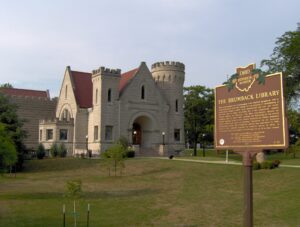
When local banker and businessman John Sanford Brumback left a large bequest to Van Wert County for the purpose of establishing a countywide library in 1897, such institutions did not yet exist, and Ohio had no legal provision for a tax-supported county library system. In response, the Ohio Legislature passed an enabling law in April 1898, marking the beginning of the county library system in the United States. Designed by Toledo architect David L. Stine and built of Bedford limestone in an eclectic Romanesque style, the Brumback Library was dedicated in 1901. Added to the National Register of Historic Places in 1979, it continues to serve as a center of knowledge for all of Van Wert County.
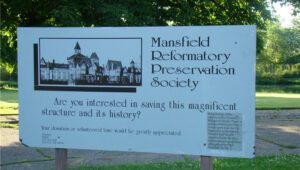
Designed by architect Levi T. Scofield, the Ohio State Reformatory opened its doors in 1896 as a facility to rehabilitate young male offenders through hard work and education. A self-sufficient institution with its own power plant and working farm, the reformatory produced goods in its workshops for other state institutions and provided opportunities for inmates to learn trades. As social attitudes towards crime hardened in the mid-twentieth century, it became a maximum-security facility. The six-tier East Cell Block is the largest known structure of its kind. Considered substandard by the 1970s, The Ohio State Reformatory closed in 1990. It has served since as a setting for several major motion pictures. This Mansfield landmark was added to the National Register of Historic Places in 1983.
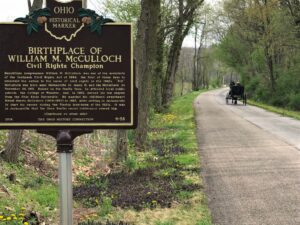
Republican congressman William M. McCulloch was one of the architects of the landmark Civil Rights Act of 1964, the first of three laws to recommit the nation to the cause of civil rights in the 1960s. “Bill” McCulloch was born near Holmesville to James H. and Ida McCulloch on November 24, 1901. Raised on the family farm, he attended local public schools, the College of Wooster, and, in 1925, earned his law degree from the Ohio State University. He married his childhood sweetheart Mabel Harris McCulloch (1904-1990) in 1927, after settling in Jacksonville to start his career during the Florida land-boom of the 1920s. It was in Jacksonville that the Deep South’s racial intolerance seared him. (Continued on other side)