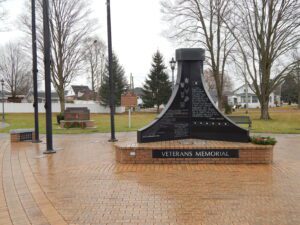
Veteran’s Park, S triangle of OH 66 & Washington Avenue
Piqua
, OH
Local views on the Vietnam War mirrored national attitudes of pride and confusion. Piqua citizens participated in the “Letters for Life” campaign in 1970 for prisoners of war. Piqua Daily Call assistant news editor James W. DeWeese traveled to Paris in a frustrated attempt to deliver the letters to the Hanoi Peace delegation. The state activated the local Ohio National Guard unit in 1970 to help suppress anti-Vietnam student rioting in Columbus. The military conflict came home in 1966 when William Pitsenbarger became the first of eleven men from Piqua to die in Vietnam. In 1967, Piqua High School graduate Air Force Major William J. Baugh was shot down over North Vietnam and taken prisoner. He remained a P.O.W. until 1973.
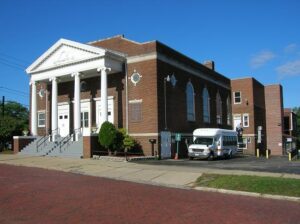
This church, founded in 1866, is the oldest Black congregation in Akron. After worshiping in several locations, the congregation held a fund-raiser to help finance the construction of a permanent home. The person collecting the most money had the privilege of renaming the church. That honor went to Mrs. Belle (Smith) Wesley. Completed in 1928, the current structure is a Neo-Classical Revival style building, featuring a classical pedimented portico, or porch, and four distinctive ionic columns. An education wing was added in 1963 by the late Rev. Dr. E. E. Morgan, Jr. Akron Black architects Herbert L. Wardner and John O. Somerville designed the church, and then a Black contractor, Samuel Plato, completed the structure. The church has long been a vital religious and social focal point for Akron’s Black community. The local chapter of the National Association for the Advancement of Colored People (NAACP) was organized at Wesley Temple. Placed on the National Register of Historic Places 3/19/94.
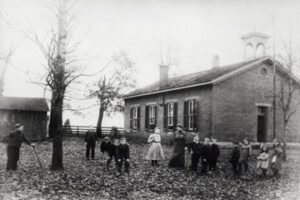
In 1854, Samuel and Rebecca McClellan Collins deeded 1.28 acres to Beavercreek Township, Greene County, for the purpose of building a schoolhouse. The first two schoolhouses were constructed of stone with fireplaces for heat. Collins neighborhood children in first through eighth grade were educated in the present red brick building until 1944, when decreased enrollment forced Xenia Township to close the school. Virgil and Helen Bryson Brantley, great-granddaughter of Samuel and Rebecca Collins, purchased the school property in 1982 and began the restoration of the vandalized and deteriorated schoolhouse. The pony/coal shed and privies were rebuilt on their foundations. (Continued on other side)
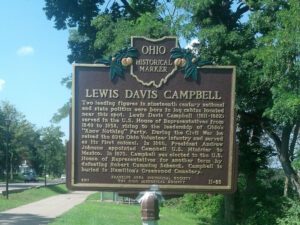
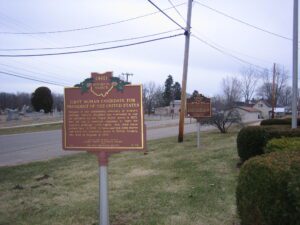
Two leading figures in nineteenth century national and state politics were born in log cabins located near this spot. Lewis Davis Campbell (1811-1882) served in the U.S. House of Representatives from 1849 to 1858, rising to the leadership of Ohio’s “Know Nothing” Party. During the Civil War he raised the 69th Ohio Volunteer Infantry and served as its first colonel. In 1866, President Andrew Johnson appointed Campbell U.S. Minister to Mexico. In 1870, Campbell was elected to the U.S. House of Representatives for another term by defeating Robert Cumming Schenck. Campbell is buried in Hamilton’s Greenwood Cemetery.
Soldier, engineer, and statesman, W.S. Rosecrans was born in Delaware County in 1819 and grew up in Homer. He graduated from West Point in 1842. During the Civil War, Rosecrans commanded the federal Army of the Cumberland. Popular with his troops, who called him “Old Rosy,” he was a cautious commander and, though victorious at, Corinth, Murfreesboro, and Chattanooga, he suffered major defeat at Chickamauga in 1863. A skilled engineer, Rosecrans developed coal properties in western (now West) Virginia before the war and helped design St. Joseph’s Cathedral in Columbus for his brother, Bishop Sylvester Rosecrans. Following the war he served as minister to Mexico and represented California in Congress from 1881 to 1885. He died in 1898 and is interred at Arlington National Cemetery.
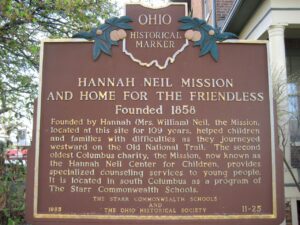
Founded by Hannah (Mrs. William) Neil, the Mission, located at this site for 109 years, helped children and families with difficulties as they journeyed westward on the Old National Trail. The second oldest Columbus charity, the Mission, now known as the Hannah Neil Center for Children, provides specialized counseling services to young people. It is located in south Columbus as a program of The Starr Commonwealth Schools.
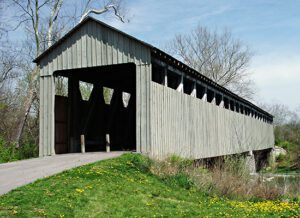
One of the few remaining covered bridges in southwestern Ohio and the only one in Butler County on its original site, this bridge was built in 1868-1869 to give access to a saw and grist mill owned by James B. Pugh on Four Mile (Tallawanda) Creek. The wooden frame three-story mill had a 16-foot overshot water wheel to power it. Pugh’s Mill ceased operation after two decades. The name of the span gradually changed to Black Bridge, likely because there was a white covered bridge downstream near present State Route 73. The Oxford Museum Association assumed stewardship of the Black Bridge in 1976 as part of the American Bicentennial celebration. Placed on the National Register of Historic Places in 1975, it was restored and rededicated in 2000.
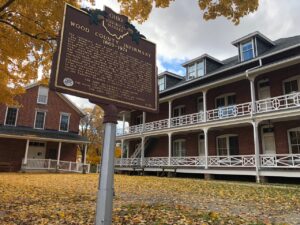
The Infirmary, also known as the poorhouse or simply “The Home,” is one of the last county poorhouse sites in Ohio where nearly all of the original structures still stand. The main building, constructed in 1868 with outbuildings added over the years, served as home for the county’s poor, sick, orphaned, elderly, and mentally ill. The Lunatic House was added in 1885 as a facility for the violently insane. The Infirmary operated as a self-sufficient farm where residents contributed according to their ability. Throughout its 102 years of service, the Infirmary had an average population of eighty residents, swelling to over 140 during the Great Depression of the 1930s. The site closed as a poorhouse in 1971 but reopened in 1975 as the Wood County Historical Center and Museum. The Wood County Infirmary was added to the National Register of Historic Places in 1979.