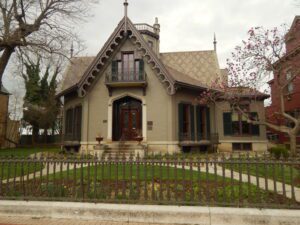
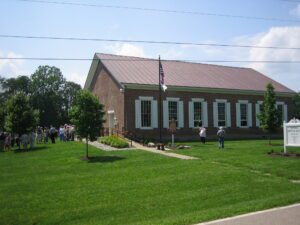
James Elrick, a local carpenter, built the Lane-Hooven House in 1863 for Clark Lane (1823-1907), a Hamilton industrialist and philanthropist. Lane, who first came to the area at age twenty-one as a blacksmith, resided in the house for more than eleven years. In 1866, Lane built the library, also originally an octagon, across the street. In 1868, he conveyed the library to the city. The C. Earl Hooven family resided in the house from 1895 to 1942. In 1943, Bertrand Kahn purchased the residence and presented it to the community for civic and charitable uses. It was donated as a memorial to his father, Lazard Kahn, a Hamilton industrialist and civic leader. The Lane-Hooven House was added to the National Register of Historic Places in 1973. (Continued on other side)
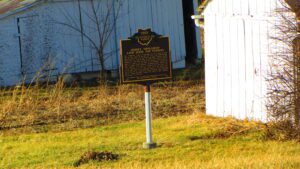
John “Appleseed” Chapman (b. September 26, 1774—d. March 18, 1845) was the first lessee of this 160 acre tract (NW 1/4, S 20, T 20, R 16), when he secured it for 99 years from the Virginia Military District School Lands on April 10, 1815. This $320 lease complied with the Ordinance of 1785 which stipulated that proceeds from the sale or lease of a 36th of all new land in the Northwest Territory be used to support public education. Perrysville author, Rosella Rice, knew Appleseed. In a history of Ashland County, she wrote, “One of his nurseries is near us and I often go to the secluded spot on the quiet banks of the creek [Blackfork]…with sod never broken since the old man did it.” Attributed as Green Township’s first permanent settler, Abram Baughman’s original 160 acres (c. 1807) adjoined this property to the west.
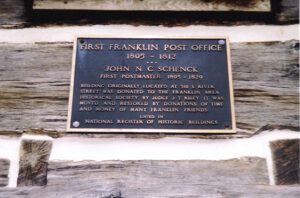
The oldest known structure standing in Franklin, the Old Log Post Office is a reminder of the links the community’s earliest members maintained to the rest of the young state of Ohio and to the United States during the early nineteenth century. John Noble Cumming Schenck, older brother of one of the founders of Franklin, William C. Schenck, established a store here in 1802. In 1805 President Thomas Jefferson appointed John Schenck postmaster of Franklin, a position he held until 1829. Schenck’s store is considered Franklin’s first post office and was one of the first four in Warren County. This building first stood at 310 South River Street and over the years was completely covered by additions and clapboards. They were removed in October 1974 and the house was moved to this location on December 6 of that year. In 1976 the structure was listed on the National Register of Historic Places.
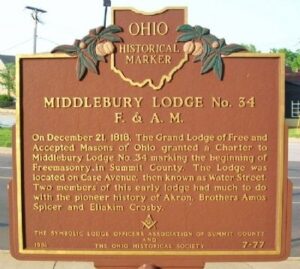
On December 21, 1818, The Grand Lodge of Free and Accepted Masons of Ohio granted a Charter to Middlebury Lodge No. 34 marking the beginning of Freemasonry in Summit County. The Lodge was located on Case Avenue, then known as Water Street. Two members of this early lodge had much to do with the pioneer history of Akron, Brothers Amos Spicer and Eliakim Crosby. [Masonic Emblem]
The Hopewell Associate Reformed Church and Cemetery, now known as Historic Hopewell, was founded in 1808 in a log building that was replaced in 1826 with the present building. It was built by the area’s first settlers, mainly Scotch-Irish who left Kentucky and South Carolina because of their opposition to slavery. The church encouraged worship by African Americans and played an important role in the Underground Railroad. It became the parent church for four “Daughter” Presbyterian congregations: Fairhaven in 1835, Oxford in 1837, College Corner in 1849, and Morning Sun in 1876. Reverend Alexander Porter, the first pastor, was committed to education and constructed a school near the Hopewell Spring that still produces clear water. “Old Hopewell” was completely refurbished in 1880, but by 1915 the membership declined and regular services discontinued. Today Hopewell holds Sunday services in the summer and is maintained by a generous and devoted group of volunteers.
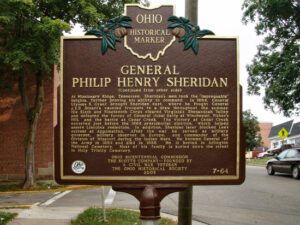
Philip Sheridan was most likely born in County Cavan, Ireland in 1831, but records do not indicate his actual birthplace. His family moved to Somerset when Philip was a child and lived down the avenue from this site. His family later owned the house across the street. His military interest was inspired by “Muster” day and frequent visits from a young West Pointer named William T. Sherman. Sheridan graduated from the United States Military Academy in 1853 and served on the Western Frontier Indian campaigns prior to the Civil War. In 1862, Sheridan became Colonel of the Second Michigan Calvary. At Stones River, Tennessee, he commanded a Division of the Twentieth Corps and stubbornly held General William S. Rosecrans’ right flank, distinguishing himself in battle. (continued on other side)
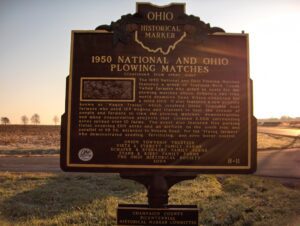
Benson Road and the North Urbana Lisbon Road (SR 54) in Champaign County was the site of the 1950 National and Ohio Plowing Matches and the National Association of Soil Conservation Districts Field Days. The three-day event drew a crowd of nearly 75,000 and was headquartered in the woods of the Edwin (Ned) Kirby farm located a quarter mile north on Benson Road. The National Association of Soil Conservation Districts sponsored the National and Ohio Plowing Matches. The first national matches were held in Mitchellville, Iowa in 1939 and continued until halted by the start of World War II. They resumed in 1945. Ohio’s 1950 Champaign County-Union Township National Plowing Matches was the first “National” to be held outside Iowa. (continued on other side)
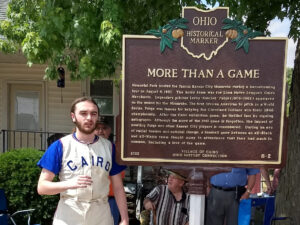
Memorial Park hosted the famous Kansas City Monarchs during a barnstorming tour on August 4, 1961. The home team was the Lima Metro League’s Cairo Merchants. Legendary pitcher Leroy “Satchel” Paige (1906-1982) appeared on the mound for the Monarchs. The first African American to pitch a World Series, Paige was famous for helping the Cleveland Indians win their 1948 championship. After the Cairo exhibition game, he thrilled fans by signing autographs. Although the score of the 1961 game is forgotten, the impact of meeting Paige and other Kansas City players is remembered. During an era of racial tension and national change, a baseball game between an all-Black and all-White team taught many in attendance that they had much in common, including a love of the game.