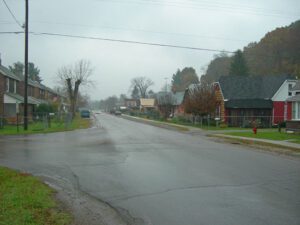
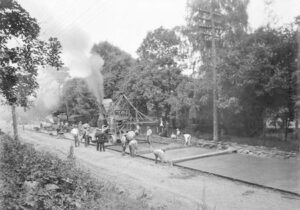
Originally known as Hocking Furnace, Haydenville was founded by and named for Columbus industrialist Peter Hayden (1806-1888), who energetically developed the coal, iron, sandstone, and fire clay deposits found in abundance in this area. Here he operated an iron furnace, coal mines and sandstone quarries, shipping products on the Hocking Canal and, later, the Hocking Valley Railroad he helped build. The incorporation of the Haydenville Mining and Manufacturing Company in 1882 initiated the manufacture of brick and ceramic tile from fire clay. Business boomed in the late 19th century as cities paved their streets with brick and fireproof construction became popular in the wake of widely publicized and tragic fires.
Colonel Ebenezer Zane, one of the founders of Wheeling, laid out the village that became Bridgeport in 1806 on the site of Fort Kirkwood (1789). Originally named Canton, it acquired its present name after the bridge to Wheeling Island was built. The arrival of the National Road in 1818 made the growing town a major portal into the state of Ohio for westbound emigrants, adding to its importance as a port for Ohio River traffic. With the advent of railroads and, later, transcontinental highways, Bridgeport continues to serve as Ohio’s “Gateway to the West.”
The SW corner of N Market Street and W Emmitt Street/US 23
Waverly
, OH
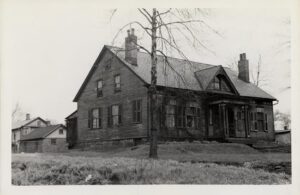
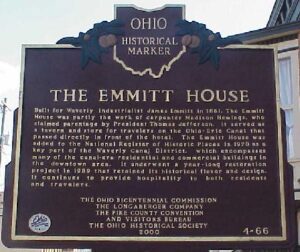
Built for Waverly industrialist James Emmitt in 1861, The Emmitt House was partly the work of carpenter Madison Hemings, who claimed parentage by President Thomas Jefferson. It served as a tavern and store for travelers on the Ohio-Erie Canal that passed directly in front of the hotel. The Emmitt House was added to the National Register of Historic Places in 1978 as a key part of the Waverly Canal District, which encompasses many of the canal-era residential and commercial buildings in the downtown area. It underwent a year-long restoration project in 1989 that retained its historical flavor and design. It continues to provide hospitality to both residents and travelers.
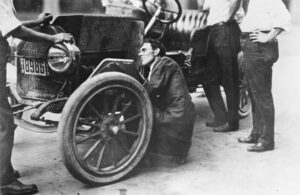
Charles F. “Boss” Kettering was a prolific inventor. While at National Cash Register, he invented the first electric cash register. Kettering founded the Dayton Engineering Laboratories Company (Delco) in 1909 and developed the electric self-starter for automobiles, first used in 1912 Cadillacs. He also developed no-knock Ethyl gasoline, lacquer car finishes, four-wheel brakes, safety glass, and high-compression engines; made significant improvements to diesel engines that led to their use in locomotives, trucks, and buses; and collaborated with Thomas Midgley, Jr. in the development of the refrigerant Freon. Kettering served as President of the Society of Automotive Engineers in 1918, co-founded the Engineers’ Club of Dayton (1914), and was director of research at General Motors Corporation from 1920 to 1947. His interest in medical and scientific research led to the founding of the Kettering Foundation and the Sloan-Kettering Institute for Cancer Research.
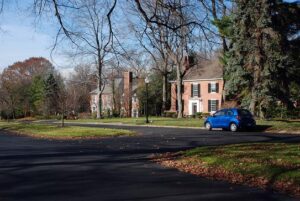
Youngstown’s earliest automobile suburb, Forest Glen Estates was developed in the 1920s during a period of change in urban transportation patterns and rapid expansion in the regional steel economy. A composite of design work by leading northeastern Ohio landscape and residential architects, the park-like suburb integrates period revival architecture into the natural landscape and blends gracefully with adjacent Mill Creek Park. Gently curving streets with low curbs and landscaped islands were a novel departure from traditional grid patterns. Attached garages and walkways that connect to driveways rather than the street reflect the influence of the personal automobile in the suburban landscape during this era. In 1998, the Forest Glen Estates Historic District was listed on the National Register of Historic Places.
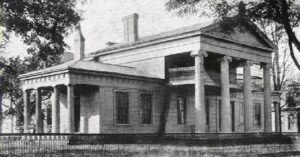
Built in 1842 in the Greek Revival Architectural Style for Alfred Avery from designs by Minard Lefever, the house subsequently served as a home for the Spelman (1845-1873), Downer and Cole families (1873-1902), the Phi Gamma Delta (1902-1930) and Kappa Sigma (1930-1956) Fraternities. This house was bequeathed to the Licking County Historical Society By Robbins Hunter Jr. (1905-1979) as a museum of the 19th Century. National Register of Historic Places.
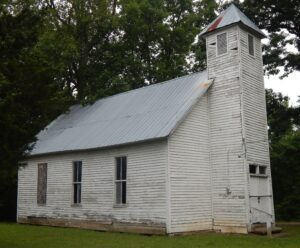
The present structure for the Macedonia Missionary Baptist Church was built in 1849 on Macedonia Ridge north of Burlington, an abolitionist sanctuary for escaped and freed slaves since 1799. It was built by the existing Baptist congregation and a group of 37 freed slaves who had arrived in Burlington from Virginia. The Baptist congregation in Macedonia had organized in 1811-1813 and practiced their faith in their homes and later in a small building with a bell tower made of sticks. The 1849 church was the religious and social focal point for the black community and became the “Mother Church” for approximately eight Baptist churches that exist in Ohio and West Virginia. The Macedonia Missionary Baptist Church was listed on the National Register of Historic Places in 1978.