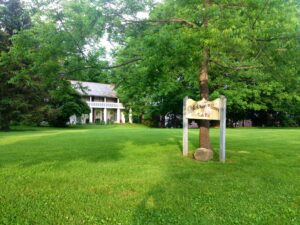
Robert Caldwell and his family, from Chester County, Pennsylvania, moved to the Northwest Territory in 1795. In 1809, they bought and cleared land along Duck Creek in what became Olive Township, Morgan County (in 1819). In 1832 Robert’s son, Samuel and his wife Sarah Brownrigg Caldwell built the “Ball-Caldwell” house. Samuel Caldwell advocated for the formation of Noble County, established in 1851. In the contest to determine the site of the county seat, Caldwell promised a donation of land if it would be used for that purpose, which is was in 1857. In gratitute, the commissioners named the county seat “Caldwell.”
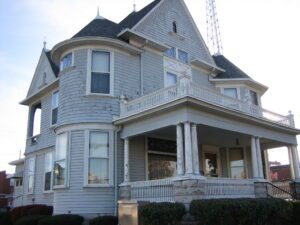
The museum of the Mercer County Historical Society, the Riley Home represents six generations of the Riley family in the county. The first Riley to arrive here was Captain James Riley, who surveyed the area in 1819, after it was opened to American settlement following the Treaty of Saint Marys in 1818. Captain Riley was elected to the Ohio General Assembly in 1823. Captain Riley’s son, James Watson Riley platted Celina in 1834, was Mercer County’s Clerk of Courts, and then represented the area in the Ohio General Assembly beginning in 1843. (Continued on other side.)
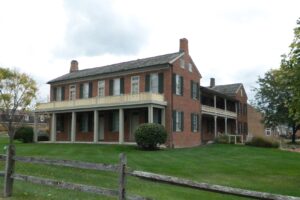
David Snively built the Federal-style Pennsylvania House in 1839 along the newly constructed National Road. This tavern and inn was an important stopover for livestock drovers and pioneers traveling by foot, on horseback, or in Conestoga wagons during the westward expansion of the United States in the nineteenth century. Dr. Isaac K. Funk, of Funk & Wagnalls fame, lived in the house in the 1840s while his father served as its tavern keeper. Closed as an inn after the Civil War, it then served as a doctor’s clinic, boarding house, and secondhand shop before falling into total disrepair. The Lagonda Chapter of the Daughters of the American Revolution saved it from demolition and has owned and operated it as a museum since 1941. The Pennsylvania House was put on the National Register of Historic Places in 1972.
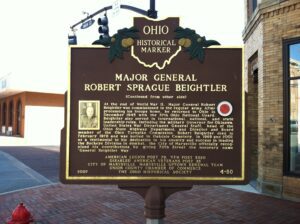
Robert Sprague Beightler was born in 1892 in Marysville. A graduate of Marysville High School, he began his career as a soldier in 1911, when he enlisted as a private in Marysville’s guard unit, Company E, Fourth Ohio Infantry Regiment. He served in Mexico from 1916-1917, World War I from 1917-1919, and World War II from 1940-1945. From his stint with the Ohio Infantry, he rose in rank to command the famous 37th Ohio National Guard Buckeye Division as Major General during WWII. Beightler was one of the most successful National Guard Generals and the only National Guard General to lead his troops through both training and combat in WWII. He was with his troops through 700 days of fighting in the South Pacific Theater. Fighting occurred on Bougainville Island and in the islands of New Georgia and the Philippines. (Continued on other side)
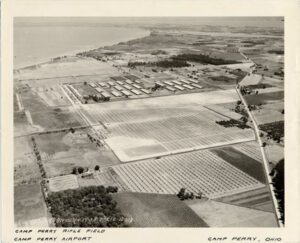
In an effort to improve the marksmanship of Ohio soldiers, Adjutant General Ammon B. Critchfield established Camp Perry, an Ohio National Guard Military Training site on the shore of Lake Erie in 1906. Camp Perry was named after Commodore Oliver Hazard Perry, who defeated British forces in the Battle of Lake Erie during the War of 1812. This particular location was ideal for shooting ranges because varying-length ranges were able to share a common firing line, and shooting practice could take place on all ranges, without the added risk of stray bullets. (continued on other side)
Main Street, across from the Deersville United Methodist Church
Deersville
, OH
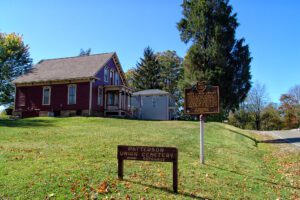
Mary Leonore Jobe was born on January 29, 1878, near Tappan, Harrison County, Ohio. She earned a bachelor’s degree from Scio College and master’s degree from Columbia University. While studying, she began a life-long career of exploration and natural history investigation. She first explored areas of British Columbia, Canada in 1905 and in 1916 started Camp Mystic, a summer camp in Connecticut for girls. She married explorer Carl E. Akeley in 1924 and completed an expedition to Africa when Carl died in the Belgian Congo in 1926. Honors include the naming of Mount Jobe in Canada to recognize her achievements and Belgium awarding her the Cross of the Knight, Order of the Crown, for her work in the Belgian Congo. She is known for her books and contributions to the American Museum of Natural History in New York. She died on July 19, 1966, and is buried in Deersville.
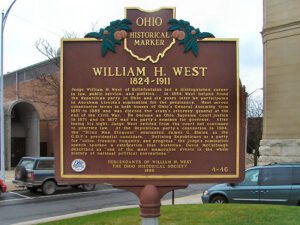
Judge William H. West of Bellefontaine led a distinguished career in law, public service, and politics. In 1854 West helped found the Republican party in Ohio and six years later he participated in Abraham Lincoln’s nomination for the presidency. West served consecutive terms in both houses of Ohio’s General Assembly from 1857 to 1865 and was elected the state’s attorney general at the end of the Civil War. He became an Ohio Supreme Court justice in 1871 and in 1877 was his party’s nominee for governor. After losing his sight, Judge West retired from the court but continued to practice law. At the Republican party’s convention in 1884, the “Blind Man Eloquent” nominated James G. Blaine as the G.O.P.’s presidential candidate. Defining Republicans as a party for “union, freedom, humanity, and progress,” the judge’s nomination speech sparked a celebration that historian David McCullough described as “one of the most memorable events in the whole history of national political conventions.”
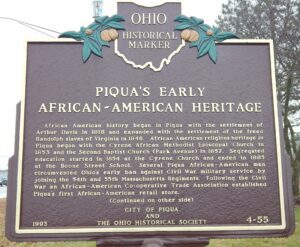
African-American history began in Piqua with the settlement of Arthur Davis in 1818 and expanded with the settlement of the freed Randolph slaves of Virginia in 1846. African-American religious heritage in Piqua began with the Cyrene African Methodist Episcopal Church in 1853 and the Second Baptist Church (Park Avenue) in 1857. Segregated education started in 1854 at the Cyrene Church and ended in 1885 at the Boone Street School. Several Piqua African-American men circumvented Ohio’s early ban against Civil War military service by joining the 54th and 55th Massachusetts Regiments. Following the Civil War an African-American Co-operative Trade Association established Piqua’s first African-American retail store. Continued on/from other side)