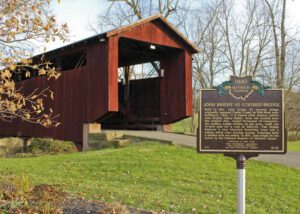
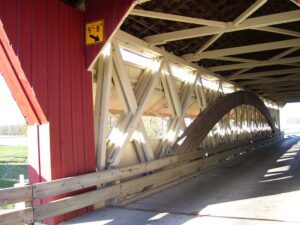
Built in 1881, John Bright #2 covered bridge originally spanned Poplar Creek on Bish Road near Baltimore, Ohio. It is named after pioneer settler John Bright, whose family farm was located near the original site. August Borneman of Lancaster, the leading bridge builder in the area, built the 70-foot span for a cost of $927.50. The bridge features a rare inverted bowstring truss and a unique metal sway bracing system. Sometime later a wooden arch was added. In 1975, John Bright #2 was listed on the National Register of Historic Places. (Continued on other side)
Constructed in 1873, the Bigelow Bridge spans approximately 100 feet across Little Darby Creek. Reuben Partridge built the superstructure at a cost of $12.50 per linear foot ($1,500). Bercupile & Snell built the masonry foundation at a cost of $7.00 per perch (a perch is approximately 25 cubic feet). Partridge built bridges throughout Union County and the surrounding area from 1866 until his death in 1900. The covered bridge is named for Eliphas Bigelow, an early resident of Union County, who built the nearby Bigelow House on the south side of Post Road (SR 161) in 1846. Union County Engineer employees rehabilitated the bridge from 1989 to 1991 by installing a new support system. The Partridge trusses currently carry only the weight of the original bridge. The rehabilitation project received the 1992 Engineered Timber Bridge Award from the National Forest Products Association.
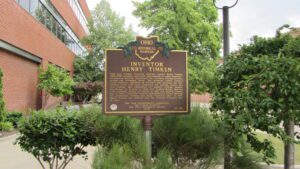
Born near Bremen, Germany, carriage builder Henry Timken (1831-1909) designed significant improvements in roller bearings–fundamental machine components that minimize friction between moving and stationary parts. His patented (1898) tapered roller bearings improved on standard ball bearings by controlling heavy side loads generated by steered axles, and thus became key components of modern vehicle design. Established in St. Louis in 1899, the Timken Roller Bearing Axle Company moved to Canton in 1901 and quickly became one of Ohio’s industrial leaders, manufacturing roller bearings for automotive, railroad and many industrial uses. In 1998, Henry Timken was inducted into the National Inventors Hall of Fame.
One of Ohio’s earliest proponents of women’s rights, Frances Dana Gage (1808-1884) was born in Marietta and married McConnelsville attorney James L. Gage in 1829. She immersed herself in the major social issues of the day – temperance, abolition, and universal suffrage – while raising eight children. At a women’s rights convention in 1850, Gage gained national attention by proposing that the words “white” and “men” be removed from Ohio’s constitution. She later served as the editor of an Ohio agricultural journal, as an educator for newly emancipated African Americans, and wrote children’s tales under the pen name “Aunt Fanny.” An enormously influential woman, Gage led the way for Ohio’s next generation of social activists.
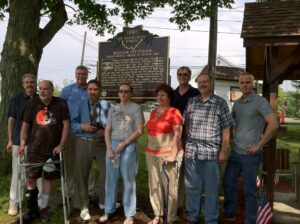
The General at Union Station in Chattanooga, Tennessee (circa 1907). Born in Knoxville in 1840 and reared at a farm in New Somerset, William Pittenger mustered into the 2nd Ohio Volunteer Infantry, under a 90-day enlistment, in 1861. He fought at the First Battle of Bull Run and was the war correspondent for the Steubenville Herald. After reenlisting, he participated in the ill-fated Andrews Raid of 1862. While attempting to disrupt enemy supply lines, the raiders stole the Confederate locomotive “The General.” After being chased north, they were captured. (Continued on other side)
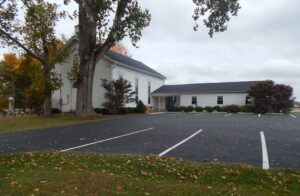
The comingling of faiths in an area settled predominantly by Quakers helps explain the origins of Jonah’s Run Baptist Church. Ministered to by a Baptist preacher, the children and neighbors of Daniel Collett (1752-1835), an Episcopalian and private in the Revolutionary War, and his wife Mary Haines Collett (1753-1826), a Quaker from Virginia, became Baptists and started the church in 1838. Levi Lukens (1767-1860), a Quaker from Pennsylvania by way of Virginia, purchased the land where the church stands in 1812 and sold it in 1839 to a founder of the congregation. Like local Quaker meetinghouses, the church had separate entrances for men and women and a partition between the two that divided the sanctuary. The congregation’s sons and daughters lived their faith. Howard McCune (1852-1923) was the Clinton Baptist Association’s moderator and president of the Ohio Baptist Convention’s state board. Anne Cossum (1894-1977) was a missionary in China from 1920-1927.
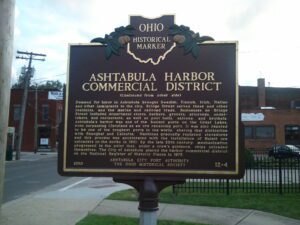
When the Pittsburgh, Youngstown and Ashtabula Railroad was finished in 1873, Ashtabula’s harbor became a direct route to ship iron ore to the booming steel mills of Youngstown and Pittsburgh. On the west side of the Ashtabula River, a brush-filled gulley became Bridge Street. New buildings and bridges attest to the harbor’s importance as a commercial and shipping hub from the late 19th through mid 20th centuries. Fires destroyed wood-frame buildings on the block closest to the river. A fire in 1886 nearly cleared the north side of Bridge Street. Another fire swept over the south side in 1900. Fire resistant brick buildings replaced frame structures and over the course of rebuilding, the level of the street rose approximately eight feet. In 1889, a swing-span bridge replaced the original pontoon bridge over the river. A bascule lift (draw) bridge replaced the swing bridge in 1925.
During the 9-month Hocking Valley Coal Strike beginning in June 1884, tensions between the Columbus & Hocking Coal and Iron Company and striking miners led to violence and destruction. Starting October 11, 1884, unknown men pushed burning mine cars into six mines located around New Straitsville to protest being replaced by “scab” workers. Mine operators attempted to plug all fissures to no avail. As years passed, ground collapsed under buildings and roadbeds, and mine gases seeped into schools and homes. Residents were evicted and homes demolished. Potatoes baked in the heated soil and roses bloomed in the winter. At times, the fire soared 100 feet in the air and could be seen for five miles. (Continued on other side).