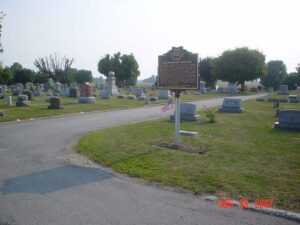
The Bloomingburg Presbyterian Church and cemetery were established in the northwest corner of the current cemetery grounds on March 7, 1818. Several years later it became a center for anti-slavery activity. The Reverend William Dickey, who presided over the church and other members, devoted their lives to the anti-slavery cause not only in voice but also in abolitionist activity. By the mid-1800s, their work, as well as the fact that Bloomingburg had become home to a vibrant African American community, led to the town becoming the area center for the Underground Railroad, which helped transport many fugitive slaves to freedom in the north. Six soldiers from the American Revolutionary War, nineteen from the War of 1812, and over 100 from the Civil War and Spanish-American War are buried in the Bloomingburg Cemetery, including Henry Casey, who was awarded the Congressional Medal of Honor for his valor at Vicksburg.
Originally called St. Clairsville and platted in 1801, Decatur was named for early 19th century naval hero Stephen Decatur. It is among the oldest villages in Brown County, which before 1817 was a part of Adams County. Among its notable early residents were Nathaniel Beasley (1774-1835), the first surveyor of Adams County, and Sarah Boone Montgomery (1763-1848), a heroine of the border wars in Kentucky. Decatur and Byrd Township supported at least four known stations on the Underground Railroad. Many area residents helped conduct escaping slaves northward to freedom.
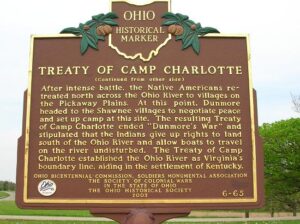
In an effort to maintain peace with Native Americans, the British imposed the Proclamation Line of 1763, which prohibited colonial settlement west of the Appalachian Mountains. Some settlers did not recognize British authority and continued to move westward. Virginia Governor Lord Dunmore, realizing that peace with Native Americans was improbable, amassed troops and headed west, camping at the Hocking River to meet with a unit commanded by Andrew Lewis. En route, Lewis’s troops were attacked on October 10, 1774 at present day Point Pleasant, West Virginia, by a force of Delaware and Shawnee led by Cornstalk.
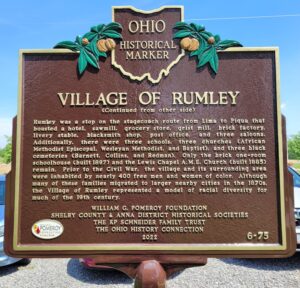
The Temple of Rumley Church is of one of two remaining buildings in what once was Rumley, a thriving African American community in Shelby County. On May 19, 1837, the village was surveyed for Amos Evans, who built his hewed log dwelling and store. Brothers Joel and George Goings (aka. Goens), freed black men from Monongalia County, Virginia, purchased 80 acres of land that same year. They settled with their families near Rumley in Van Buren Township along with other free men and women of color, including former slaves. Joel Goings erected the first brick house in 1841, using bricks from his own brickyard. By 1846, the Rumley community stretched over 7,000 acres and included the Collins, Redman, Williams, Davis, Lett, and Brown families. (Continued on other side)
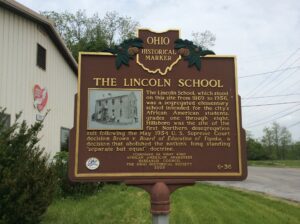
The Lincoln School, which stood on this site from 1869 to 1956, was a segregated elementary school intended for the city’s African American students, grades one through eight. Hillsboro was the site of the first Northern desegregation suit following the May 1954 U.S. Supreme Court decision Brown v. Board of Education of Topeka, a decision that abolished the nation’s long standing “separate but equal” doctrine. (Continued on other side)
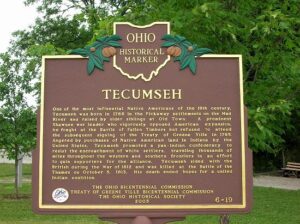
One of the most influential Native Americans of the 19th century, Tecumseh was born in 1768 in the Pickaway settlements on the Mad River and raised by older siblings at Old Town. A prominent Shawnee war leader who vigorously opposed American expansion, he fought at the Battle of Fallen Timbers but refused to attend the subsequent signing of the Treaty of Greene Ville in 1795. Angered by purchases of Native American land in Indiana by the United States, Tecumseh promoted a pan-Indian confederacy to resist the encroachment of white settlers, traveling thousands of miles throughout the western and southern frontiers in an effort to gain supporters for the alliance. Tecumseh sided with the British during the War of 1812 and was killed at the Battle of the Thames on October 5, 1813. His death ended hopes for a united Indian coalition.
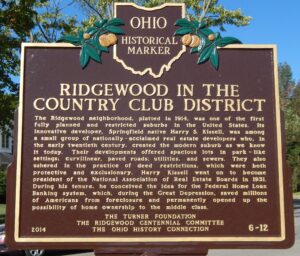
The Ridgewood neighborhood, platted in 1914, was one of the first fully planned and restricted suburbs in the United States. Its innovative developer, Springfield native Harry S. Kissell, was among a small group of nationally-acclaimed real estate developers who, in the early twentieth century, created the modern suburb as we know it today. Their developments offered spacious lots in park-like settings; curvilinear, paved roads; utilities, and sewers. They also ushered in the practice of deed restrictions, which were both protective and exclusionary. Harry Kissell went on to become president of the National Association of Real Estate Boards in 1931. During his tenure, he conceived the idea for the Federal Home Loan Banking system, which, during the Great Depression, saved millioins of Americans from foreclosure and permanently opened up the possibility of home ownership to the middle class.
Seba Bronson Jr. left Columbia Township in early 1810 and followed the Rocky River to an area one and a half miles north of here. He built a cabin and planted a crop and thus started what became known as the village of Hardscrabble in Liverpool Township. The village was centered around the Columbia/Grafton Road area, and the township is the oldest continuously inhabited township in Medina County. The Potawatami Indians occupied this area and camped annually along the Rocky River. For five silver dollars, they showed Seba and a partner a hidden salt springs which they sought to exploit. Other men also scrabbled to own it and Justus Warner succeeded. Seba was turned out. Warner operated the Liverpool Salt Works beginning in 1811. The first industry in the county, salt was a necessity and eagerly sought by setters in the area.