

, OH
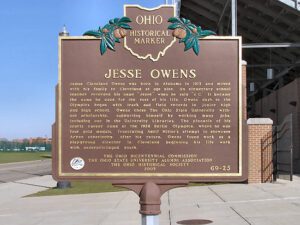
James Cleveland Owens was born in Alabama in 1913 and moved with his family to Cleveland at age nine. An elementary school teacher recorded his name “Jesse” when he said “J.C.” It became the name he used for the rest of his life. Owens’ dash to the Olympics began with track and field records in junior high and high school. Owens chose The Ohio State University without scholarship, supporting himself by working many jobs, including one in the University Libraries. The pinnacle of his sports career came at the 1936 Berlin Olympics, where he won four gold medals, frustrating Adolf Hitler’s attempt to showcase Aryan superiority. After his return, Owens found work as a playground director in Cleveland beginning his life work with underprivileged youth.
, OH
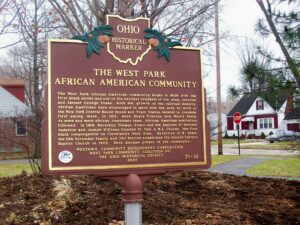
The West Park African American community began in 1809 with the first black settler and one of the earliest residents of the area, inventor and farmer George Peake. With the growth of the railroad industry, African Americans were encouraged to move into the area to work at the New York Central Round House and Train Station located in Linndale. First among these, in 1912, were Beary Frierson and Henry Sharp. As more and more African Americans came, African American institutions followed. In 1919, Reverend Thomas Evans and the families of Herndon Anderson and Joseph Williams founded St. Paul A.M.E. Church, the first black congregation on Cleveland’s West Side. Reverend D.R. Shaw, the Ebb Strowder family and Iler Burrow established the Second Calvary Baptist Church in 1923. Both became pillars of the community.

, OH
Ella Nora Phillips Myers Stewart was one of the first practicing Black women pharmacists in the United States. After she married William Stewart in 1920, the couple settled in Youngstown, then moved to Toledo where they opened Stewart’s Pharmacy in 1922. Having broken professional barriers, Ella Stewart became a tireless civil rights champion. Advocating for Black women she was active in the Enterprise Charity Club and was a 1937 charter member of Beta Lambda and Toledo Alumnae chapters of Delta Sigma Theta Sorority. She served on the National Association of Colored Women Clubs, the Women’s Advisory Committee of U.S. Department of Labor, and Pan-Pacific Southeast Asia Women’s Association. Toledo’s Ella P. Stewart Academy for Girls was named in her honor in 1961. She was inducted into the Ohio Women’s Hall of Fame in 1978.
, OH
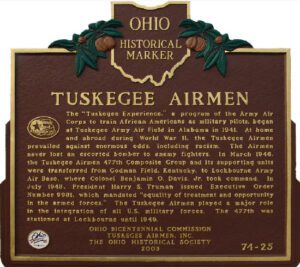
The “Tuskegee Experiment,” a program of the Army Air Corps to train African Americans as military pilots, began at Tuskegee Army Air Field in Alabama in 1941. At home and abroad during World War II, the Tuskegee Airmen prevailed against enormous odds, including racism. The Airmen never lost an escorted bomber to enemy fighters. In March 1946, the Tuskegee Airmen 477th Composite Group and its supporting units were transferred from Godman Field, Kentucky, to Lockbourne Army Air Base, where Colonel Benjamin O. Davis, Jr. took command. In July 1948, President Harry S. Truman issued Executive Order Number 9981, which mandated “equality of treatment and opportunity in the armed forces.” The Tuskegee Airmen played a major role in the integration of all U.S. military forces. The 477th was stationed at Lockbourne until 1949.
, OH
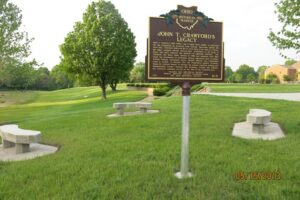
John T. Crawford (1813-1880), was a white Union soldier. In gratitude for the kindnesses he received from African-Americans during the Civil War, Crawford willed his 18 1/2-acre farm to be used as a “home, for aged, indigent worthy colored men, preference to be given to those who have suffered the miseries of American Slavery.” The Crawford Old Men’s Home opened in 1888 and operated until 1964 under the trusteeship of prominent African-Americans such as lawyer William Parham, newspaper editor Wendell Dabney, and Ambassador Jesse D. Locker. It merged with the Progressive Benefit Society’s Home for Colored Women to become the Lincoln Crawford Nursing and Rehabilitation Center. Pleasant Hill Academy, College Hill Library, and Crawford Commons are all on the site of the Crawford farm.
, OH
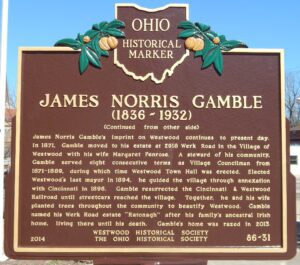
James Norris Gamble, entrepreneur, industrialist, philanthropist and civic leader, is best known for inventing Procter & Gamble’s Ivory Soap, the “soap that floats,” in 1878. Applying a scientific approach, Gamble transformed P&G into a nationally recognized corporate leader and creator of consumer products for a rapidly growing America. Beyond P&G, Gamble financed early efforts to educate freed southern slaves as an original sponsor of the Freedmen’s Aid Society. Later, he underwrote civil rights leader Mary McLeod Bethune’s work to educate poor African American women. In Cincinnati, Gamble’s philanthropy included endowment of Christ Hospital and the founding of its Institute of Medical Research. Gamble funded completion of University of Cincinnati’s Nippert Stadium in 1924 as a tribute to his late grandson.
, OH
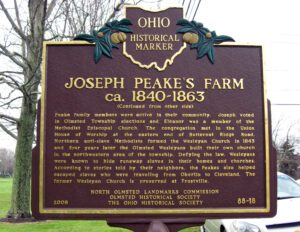
Joseph Peake was born in Pennsylvania in 1792 and came to Ohio in 1809 with his parents and brother. They were the first African Americans to settle permanently in the Cleveland area. He was the son of George Peake, a runaway slave from Maryland, who fought on the British side at the Battle of Quebec in 1759 during the French and Indian War. A man with some means and talent, George Peake invented a stone hand mill for grinding corn, a labor-saving device that endeared the Peakes to their neighbors in western Cuyahoga County. Joseph Peake and his wife Eleanor, an African American from Delaware, bought land in the 1840s on the Mastick Plank Road and built a home near this marker. [Continued on other side]
, OH
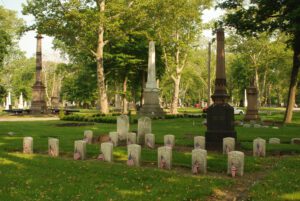
Howard Daniels, who lived from 1815-1863, was a noted architect and landscape gardener. Over the course of his life, he designed six Ohio and New York cemeteries, including Woodland that began in 1852 when he laid out 20 of its 60 acres into fashionable “rural cemetery” style. Later acreage in the cemetery adapted his curvilinear design. “As beautifully prepared for a burial place as fancy and taste could desire,” Woodland was dedicated on June 14, 1853, and became Cleveland’s primary cemetery. An ornate gatehouse, chapel, and fountains came later. Generations of Clevelanders, pioneering and prominent, as well as veterans onward from the War of 1812, are buried here. For more than a century, Woodland, in its original and newly platted sections, has embraced people from every race, the rich and poor, natives and immigrants, and the famous and obscure. It has truly become a community cemetery. [continued on other side]