

, OH
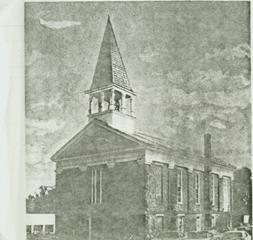
This site has long served the religious, education, and public interests of the residents of Mechanicsburg. A local Methodist congregation built its first church here in 1820, and the townspeople also used the structure as its village school. The Methodists replaced their original structure in 1837, using brick as the main building material. As the Methodist congregation grew, however, it was determined that a larger, more permanent structure was needed. As a result, the Mechanicsburg First Methodist Church was built here in 1858, and it served the congregation until 1894 when an African American based Second Baptist congregation purchased the building at a cost of $2,850. Besides religion and education, the site was also used as Mechanicsburg’s first cemetery. That cemetery lasted until the Maple Grove Cemetery was established and burials at this site were relocated there. [continued on other side]
, OH
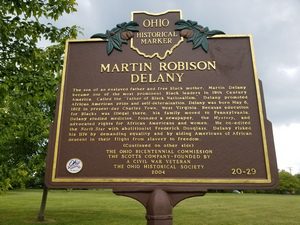
The son of an enslaved father and free Black mother, Martin Delany became one of the most prominent Black leaders in 19th Century America. Called the “Father of Black Nationalism,” Delany promoted African American pride and self-determination. Delany was born May 6, 1812 in present-day Charles Town, West Virginia. Because education for Blacks was illegal there, his family moved to Pennsylvania. Delany studied medicine, founded a newspaper, the “Mystery,” and advocated rights for African Americans and women. He co-edited the “North Star” with abolitionist Frederick Douglass. Delany risked his life by demanding equality and by aiding Americans of African descent in their fight from slavery to freedom. (Continued on other side)
, OH
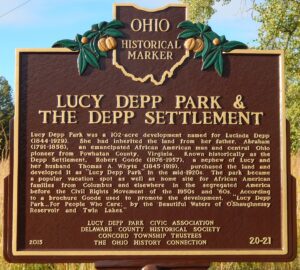
Lucy Depp Park was a 102-acre development named for Lucinda Depp (1844-1929). She had inherited the land from her father, Abraham (1791-1858), an emancipated African American man and central Ohio pioneer from Powhattan County, Virginia. Known historically as the Depp Settlement, Robert Goode (1876-1957), a nephew of Lucy and her husband Thomas A. Whyte (1845-1919), purchased the land and developed it as “Lucy Depp Park” in the mid-1920s. The park became a popular vacation spot as well as home site for African American families from Columbus and elsewhere in the segregated America before the Civil Rights movement of the 1950s and 60s. According to a brochure Goode used to promote the development, “Lucy Depp Park…For People Who Care; by the Beautiful Waters of O’Shaughnessy Resevoir and Twin Lakes.”
, OH
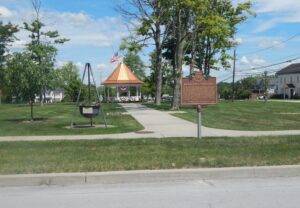
In 1798, Judge Samuel Hinckley of Northampton, Massachusetts, drew the 72nd draft in the land lottery held by the Connecticut Land Company and received 15,305 acres in Township 4, Range 1, for which he paid $12,903.23, less than one dollar per acre. The area had been inhabited for many years by trappers, missionaries, and Native Americans. One of the earliest settlers was James McMullen, who acquired the first 160-acre parcel from Hinckley in 1801. Brookfield Township became the crown jewel of Hinckley’s holdings. Hinckley named Brookfield after a city in England and set aside land for the village green and the cemetery stating that they were for public use forever. During the mid-1820s the Overland Stage Line had a run through Brookfield, linking it to Salem, Warren, and Youngstown in Ohio and Erie, Pennsylvania and Dunkirk, New York. (Continued on other side)
, OH
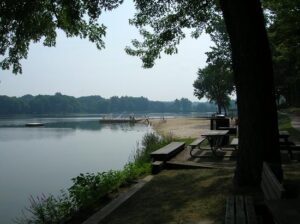
Silver Lake was previously known as Wetmore’s Pond, named for Judge William Wetmore, an agent for the Connecticut Land Company. In 1808, Wetmore built a cabin overlooking the spring-fed lake, which was then a part of Portage County. Local lore records his friendship and conscientious dealings with the Native Americans, likely Seneca, who inhabited a populous village between the lake and the Cuyahoga River. The tribe left the area to join the British during the War of 1812, but later sided with the United States.
, OH
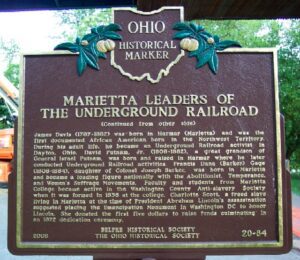
People living in Marietta and along the Muskingum River shared a history of slavery opposition. Manasseh Cutler, from Massachusetts and an Ohio Land Company agent, helped draft the Ordinance of 1787 that prohibited slavery in the Northwest Territory. General Rufus Putnam, Captain Jonathan Stone, and other Ohio Land Company Revolutionary War veterans, founded Marietta at the mouth of the Muskingum River in 1788 bringing with them their anti-slavery sentiments. A proposal to legalize slavery in the proposed state of Ohio was vetoed largely due to the efforts of Marietta’s Ephraim Cutler and General Putnam at the 1802 Ohio Constitutional Convention. These conditions were precursors toward the formation of the Underground Railroad as fugitive slaves crossed the Ohio River seeking freedom. From 1812 through 1861, large numbers of fugitive slaves fleeing toward Canada, were aided by descendants of early settlers who operated Underground Railroad Stations along the Muskingum River. (Continued on other side)
, OH
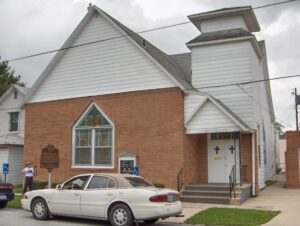
In spite of small numbers and being welcomed by the mostly white congregation of First Methodist Episcopal Church, African Americans in Findlay in the 1880s wanted to express their faith in ways that best reflected their freedoms and traditions. By the mid-1880s, the congregation was meeting in members’ homes and the Odd Fellows Hall, but began fund raising to build their own church in 1885. The congregation was admitted to the North Ohio Conference of the Third Episcopal District of the African Methodist Church in 1885, one of the first churches to be so admitted. The building on Liberty Street was well underway by the end of 1887 on a lot donated by Judge D. J. Cory. The original twenty foot by forty foot building cost $2,000 and immediately became a focal point for religion and social events for Findlay’s African American community. (Continued on other side)
, OH
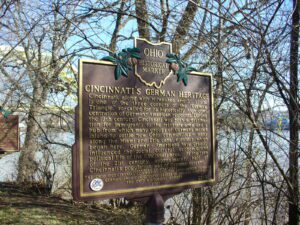
Cincinnati, along with Milwaukee and St. Louis, is one of the three corners of the “German Triangle,” so-called for its historically high concentration of German-American residents. During the 19th century, Cincinnati was both a destination for immigrants to the tri-state area and a hub from which many groups of Germans moved inland to settle new Ohio communities-many along the Miami and Erie canal corridor which began here. German-Americans have greatly influenced the social, cultural, economic and political life of the Cincinnati area. At the turn of the 21st century, approximately half of Cincinnati’s population was of German descent. (Continued on other side)