

, OH
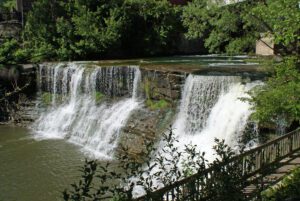
The Chagrin River was named for Francois Seguin, a Frenchman who traded with Native Americans in Northeast Ohio circa 1742. The “High Falls” of the Chagrin River primarily attracted settlers from New England (circa 1833) seeking a location with ample waterpower. By the mid-nineteenth century an axe factory, a foundry, 2 flour mills, 4 woolen mills, 2 sawmills, 3 paper mills, and a woodenware factory had been built along the riverbanks in Chagrin Falls. The “High Falls” provided a power source for a gristmill, built in 1836 at this location. Today, only one factory remains in operation in the Village of Chagrin Falls.
, OH
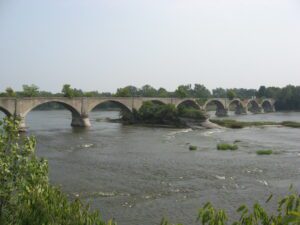
The Lima and Toledo Traction Company Bridge was construted in 1907 by the National Bridge Company of Indianapolis, and it was considered to be a revolutionary type of bridge construction. The Old Electric Bridge, as it was called, was built of steel reinforced concrete and filled with earth. In fact, for this period some considered the bridge to be the longest such railroad bridge in the world. Twelve spans of Roman aqueduct architectural design anchor the 1220-foot bridge in solid river bedrock. The bridge linked Lucas and Wood counties and connected a busy Toledo with points south by means of an electric trolley. This Interurban Bridge was placed on the National Register of Historic Places in 1972.
, OH
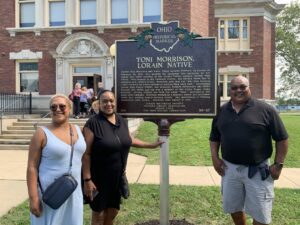
Author Toni Morrison was born, Chloe Ardelia Wofford, in Lorain on February 18, 1931. Her passion for language was nurtured by her family and while working at the Lorain Public Library during high school. Then housed in the Carnegie Center, the library hired her to reshelve and catalog books. Morrison said that she “was slow because I kept reading the books instead of putting them back fast.” Graduating Lorain High School (1949), she attended Howard University (BA 1953), Cornell (MA 1955), and she was a member of the Alpha Kappa Alpha sorority. During college she took the name “Toni,” shortening her saint name Anthony. Morrison worked as a literary editor and professor while also writing award-winning novels. She maintained a lifelong connection with Lorain. Morrison died August 5, 2019.
, OH
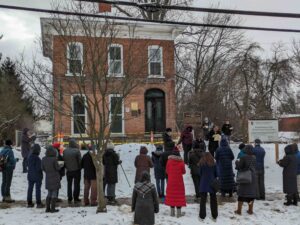
The Wilson Bruce Evans House, 33 East Vine Street, is a rare example of a residence built and occupied by an African American abolitionist and Underground Railroad operative. Free-born in North Carolina, Wilson Bruce Evans (1824-1898) moved to Oberlin in 1854. A skilled cabinetmaker, he opened a carpentry shop with his brother, Henry (1817-1886). Together they completed the original house by 1856. At the center of Oberlin’s interracial antislavery politics, Evans defied the Fugitive Slave Act of 1850, and was indicted for his part in the 1858 Oberlin-Wellington Rescue. During the Civil War, Evans enlisted in the predominantly white 178th O.V.I., serving August 1864-June 1865. The Wilson Bruce Evans House was added to the National Register of Historic Places in 1980, and named a National Historic Landmark in 1997. (Continued on the other side)

, OH
Near this site in Over-The-Rhine was one of the original Kroger Grocery & Baking Company stores, where Bernard H. Kroger began serving the Over-the-Rhine area in 1902. Kroger was 23 years old when he opened his first store, The Great Western Tea Company, at 66 East Pearl Street near the Cincinnati Riverfront in July of 1883. By 1902, when the company was incorporated as the Kroger Grocery & Baking Company, Kroger operated 40 stores. By 1908, the company had grown to a chain of 136 stores in Cincinnati, Dayton, Columbus, and Northern Kentucky, and began making deliveries to customers with 200 mule-drawn wagons. Kroger was the first to combine meats and groceries under one roof and the first grocery company to operate its own bakery. Currently called the Kroger Co., the grocer is a major contributor to the local economy.
, OH
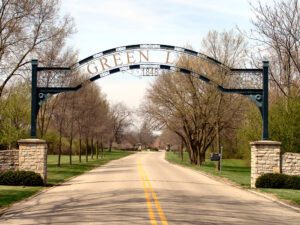
Landscape architect Howard Daniels designed the original portion of Green Lawn Cemetery in 1848. Noted Columbus architect Frank Packard designed Green Lawn’s Chapel mausoleum, the Hayden family mausoleum, and the Packard mausoleum. Spanning over 360 acres, the cemetery’s wooded setting provides a habitat for a variety of birds and other wildlife. The Chapel contains stunning stained glass windows and mosaic artwork by Tiffany & Company of New York. The monuments, obelisks, and memorials throughout the cemetery represent a wealth of artwork and a history of Columbus. As one of the oldest and largest cemeteries in Ohio, Green Lawn is the resting-place of many noted individuals who have made significant contributions to Columbus, Franklin County and the nation.

, OH
The Hines Farm Blues Club started on this site in 1949 as a party in Frank and Sarah Hines’s basement. The Club grew to become one of Ohio’s premiere blues and rhythm & blues venues until closing in 1976. A virtual “Who’s Who of African-American Artists” played here, first in a picnic shelter in the woods and then in the main building, erected in 1956. “Mr. Luke’s Outdoor Pavilion” that doubled as a skating rink was the last major addition. Holding as many as a thousand fans, Count Basie and his entire orchestra marked its opening with a performance under the stars in August 1961. Bobo Jenkins, Little Esther Phillips, B.B. King, Jimmy Reed, Buddy Lamp, and John Lee Hooker were among the musical greats who played Hines Farm. Important local blues artists Big Jack Reynolds, Curtis Grant, and the Griswold Brothers were regulars as well. (continued on other side)
, OH
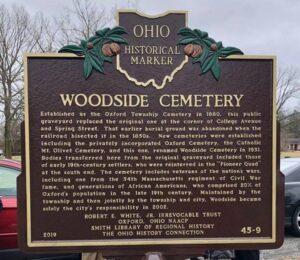
Established as the Oxford Township Cemetery in 1880, this public graveyard replaced the original one at the corner of College Avenue and Spring Street. That earlier burial ground was abandoned when the railroad bisected it in the 1850s. New cemeteries were established including the privately incorporated Oxford Cemetery, the Catholic Mt. Olivet Cemetery, and this one, renamed Woodside Cemetery in 1931. Bodies transferred here from the original graveyard included those of early 19th-century settlers, who were reinterred in the “Pioneer Quad” at the south end. The cemetery includes veterans of the nation’s wars, including one from the 54th Massachusetts regiment of Civil War fame, and generations of African Americans, who comprised 20% of Oxford’s population in the late 19th century. Maintained by the township and then jointly by the township and city, Woodside became solely the city’s responsibility in 2002.