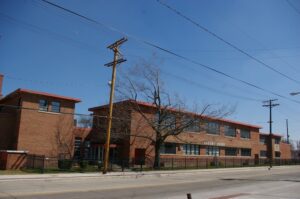
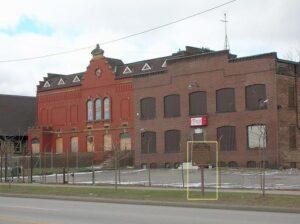
Karamu House, Incorporated was established in 1915 as the Playhouse Settlement, one of Cleveland’s many settlement houses for migrant and immigrant communities. Initiated by the Men’s Club of the Second Presbyterian Church, in 1915 Oberlin College and University of Chicago social work graduates, Russell and Rowena Woodham Jellliffe were hired as the founding directors. Originally located at 2239 East 38th Street, the Playhouse Settlement offered children’s theater and other social, recreational, and educational activities. It soon developed a partnership with the Dumas Dramatic Club, a local African American theater company that later became known as the Gilpin Players. (continued on other side)
John Malvin (1795-1880) was an operative on the Underground Railroad and an ardent member of anti-slavery and abolitionist causes. Born in Dumfries, Virginia of a free mother and enslaved father, Malvin was apprenticed at an early age to learn carpentry and taught himself to read and write. In 1827, he moved to Cincinnati where he became an ordained preacher and an activist in the cause of freedom. In 1831, with his wife Harriet, he moved to Cleveland where he became a charter member of the First Baptist Church, a sawmill operator, and captain and owner of the canal boat Auburn. (continued on other side)
801 E. Pete Rose Way, Bicentennial Commons at Sawyer Point
Cincinnati
, OH
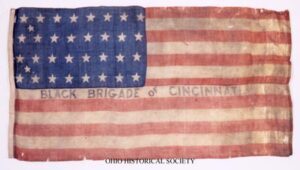
Following the success of Confederate forces in eastern Kentucky and General John Hunt Morgan’s raids there in 1862, Cincinnatians believed that Southern invasion was imminent. Anxious officials ordered Cincinnati citizens to form home guards, but black men willing to volunteer were rebuffed when they attempted to join a defense force. Instead, police serving as provost guards rounded up many and marched them by bayonet to build fortifications in Kentucky. Reacting to the shameful treatment of the blacks eager to support the Union, the commander of the Department of Ohio dispatched Major General Lewis Wallace to command the civilians and to liberate black men forced into service. (continued on other side)
Garrett Augustus Morgan was an African American businessman and prolific inventor of devices that made people’s lives safer and more convenient. Born on March 4, 1877 in Claysville, the Black segregated section of Paris, Kentucky, Morgan migrated north first to Cincinnati and then Cleveland in 1895. He lived and worked in this house at 5204 Harlem Avenue. In 1906, Morgan started the G.A. Morgan Hair Refining Company to market the hair straightener he had invented. The following year he opened a sewing machine repair shop. In 1908, he and his wife Mary opened Morgan’s Cut Rate Ladies Clothing Store. (continued on other side)
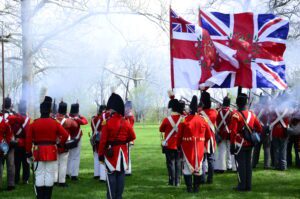
Near this site, in the War of 1812, stood the British encampment during the First Siege of Fort Meigs from May 1-9, 1813. This marker honors members of the 41st Regiment of Foot who died during the engagement. Killed in action on May 5, 1813 were Privates James Barkley, Richard Booth, William Carpmail, Samuel Cartledge, John Cox, Benjamin Dorman, John Dyer, Edward Graves, and Patrick Russell. Private Edward Billing died of wounds from battle May 6 and Private John Chamberlane expired May 20.
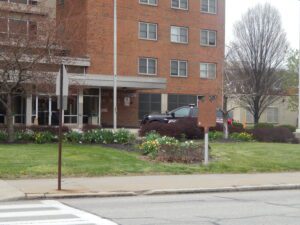
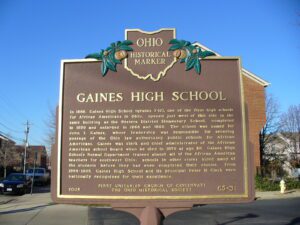
In 1866, Gaines High School (grades 7-12), one of the first high schools for African Americans in Ohio, opened just west of this site in the same building as the Western District Elementary School, completed in 1859 and enlarged in 1866 and 1868. The school was named for John I. Gaines, whose leadership was responsible for securing passage of the Ohio law authorizing public schools for African Americans. Gaines was clerk and chief administrator of the African American school board when he died in 1859 at age 38. Gaines High School’s Normal Department trained almost all of the African American teachers for southwest Ohio; schools in other states hired many of the students before they had even completed their studies. From 1866-1886, Gaines High School and its principal Peter H. Clark were nationally recognized for their excellence.
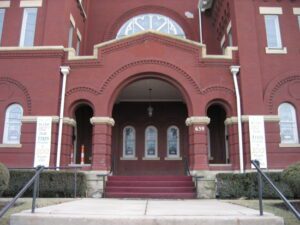
Organized in 1823 as Bethel African Methodist Episcopal Church, St. Paul A.M.E. Church is the oldest congregation of African descent in Columbus. The church, founded by Moses Freeman and 13 other members from the Town Street Church, was originally located on the east side of Lazelle Street. Several buildings were erected to meet the needs of the growing congregation. The present edifice, located at 639 E. Long Street, was completed in 1906. St. Paul has several outreach ministries, including The Prison Ministry, Alzheimer Ministry, Karen’s House, Community Development Corporation, Health Concerns Committee, St. Paul Tutorial and Enrichment Program (STEP), St. Paul Scholarship Program, St. Paul Drama Ministry, Jam’N Jefferson Park Festival, and Church Without Walls.
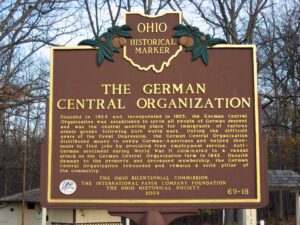
Founded in 1924 and incorporated in 1925, the German Central Organization was established to serve all people of German descent and was the central meeting place for immigrants of various ethnic groups following both world wars. During the difficult years of the Great Depression, the German Central Organization distributed money to needy German-Americans and helped thousands to find jobs by providing free employment service. Anti-German sentiment during World War II culminated in a vandal attack on the German Central Organization farm in 1942. Despite damage to the property and decreased membership, the German Central Organization rebounded and remains a solid pillar of the community.