United Colored American Cemetery is among the earliest in situ African American cemeteries in Hamilton County. The 11.6 acres in Madisonville were purchased by the United Colored American Association (UCAA) after the legislated closure of their earlier Avondale cemetery. Many Avondale burials and headstones were moved prior to the new cemetery’s dedication on May 30, 1883. Designed by Adolph Strauch, United Colored American Cemetery features the looping roads and picturesque elements typical of his designs at Spring Grove and Eden Park. After the dissolution of the UCAA, Cincinnati mayor Charles P. Taft asked Union Baptist Church to take ownership and maintenance of the cemetery. Union Baptist assumed ownership in 1968 and burials continued until 2019. United Colored American Cemetery was listed on the National Register of Historic Places in 2022.
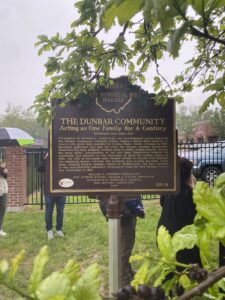
Dunbar, or Corsica Hollow, was an African American neighborhood on the western edge of Madisonville. Its streets and lots were laid out in 1886 after Mahlon and Anna Leonard subdivided their 10-acre tract near Duck Creek and sold lots to African Americans. Many early Dunbar residents were from the South; some born there prior to emancipation. Prominent early citizens included Harriet Deatherage, Elihu Parks, Gandison Embry, Thomas Duett, and James Murphy. Dunbar was home to the New Mission Missionary Baptist Church, founded in 1907. Originally meeting in a one-room building, the extant congregation relocated to Ravenna Street in 1963. By the late 1920s, Dunbar had about forty houses, a grocery run by Henry Lowman, and a hair salon run by Flora Hector. (Continued on other side)
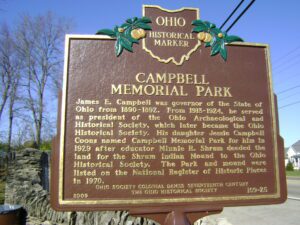
James E. Campbell was governor of the State of Ohio from 1890-1892. From 1913-1924, he served as president of the Ohio Archaeological and Historical Society, which later became the Ohio Historical Society. His daughter Jessie Campbell Coons named Campbell Memorial Park for him in 1929 after educator Minnie R. Shrum deeded the land for the Shrum Indian Mound to the Ohio Historical Society. The park and mound were listed on the National Register of Historic Places in 1970.
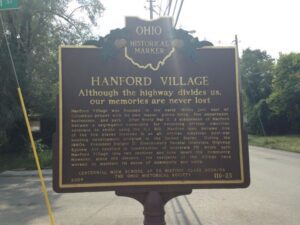
Hanford Village was founded in the early 1900s just east of Columbus proper with its own mayor, police force, fire department, businesses, and park. After World War II, a subdivision of Hanford became a segregated community for returning African American veterans to settle using the G.I. Bill. Hanford then became one of the few places involved in an all African American post-war housing development program in the United States. During the 1960s, President Dwight D. Eisenhower’s Federal Interstate Highway System Act resulted in construction of Interstate 70 which split Hanford Village into two sections and tore apart the community. However, since the division, the residents of the village have worked to maintain its sense of community and unity.
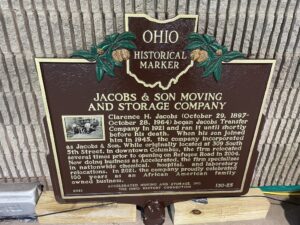
Clarence H. Jacobs (October 29, 1897?October 28, 1964) began Jacobs Transfer Company in 1921 and ran it until shortly before his death. When his son joined him in 1945, the company incorporated as Jacobs & Son. While originally located at 309 South 5th Street, in downtown Columbus, the firm relocated several times prior to opening on Refugee Road in 2004. Now doing business as Accelerated, the firm specializes in nationwide chemical, hospital, and laboratory relocations. In 2021, the company proudly celebrated 100 years as an African American family owned business.
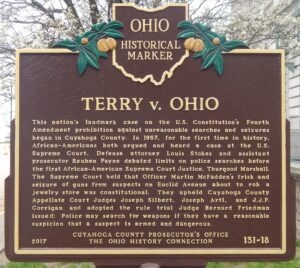
This nation’s landmark case on the U.S. Constitution’s Fourth Amendment prohibition against unreasonable searches and seizures began in Cuyahoga County. In 1967, for the first time in history, African-Americans both argued and heard a case at the U.S. Supreme Court. Defense attorney Louis Stokes and assistant prosecutor Reuben Payne debated limits on police searches before the first African-American Supreme Court Justice, Thurgood Marshall. The Supreme Court held that Officer Martin McFadden’s frisk and seizure of guns from suspects on Euclid Avenue about to rob a jewelry store was constitutional. They upheld Cuyahoga County Appellate Court Judges Joseph Silbert, Joseph Artl, and J.J.P. Corrigan and adopted the rule trial Judge Bernard Friedman issued: Police may search for weapons if they have a reasonable suspicion that a suspect is armed and dangerous.
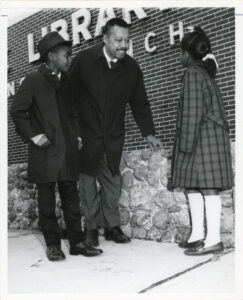
On November 19, 1968, the Columbus Metropolitan Library dedicated the first public library in the nation named after Dr. Martin Luther King Jr. After King’s assassination on April 4, 1968, the East Side Community Council requested that the new library being planned for the King-Lincoln Bronzeville community bear his name. The King family had both family and civic ties to Columbus and were honored by the tribute. More than 1,000 people gathered outside 1600 E. Long Street to hear Martin Luther King Sr. deliver the November dedication speech. Continuing the King family tradition, Martin Luther King III cut the ribbon to open a new branch building at 1487 E. Long Street on October 18, 2018. The Martin Luther King Branch was the first Columbus public library to bear an individual’s name.
Bethel A.M.E. Church was the first African American church in Worthington. Black residents joined Worthington’s established churches as early as 1847 or worshipped together in their homes. Peter Banks with D.H. Taborn, Charles Kiner, J.T. Horton, and James Birkhead organized the A.M.E. congregation in 1896. Rapid growth moved their meetings to the Worthington Town Hall by 1897. A lot was purchased from Millie Alston on September 24, 1897, and a house relocated to serve as Bethel Chapel. Local carpenter Chester Hard constructed a new building that was dedicated as St. John A.M.E. in 1914. The church has served as the religious and social hub of Worthington’s Black community for more than a century. While St. John A.M.E. Church retains their original location, worship services moved to 7700 Crosswoods Drive in 2004.