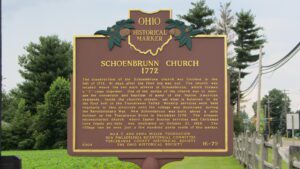
In December 1772, Brother David Zeisberger and his followers began the construction of Schoenbrunn schoolhouse. The school was built in the Tuscarawas Valley on land given to Zeisberger in the spring of 1771 by the Delaware Native Americans as a Moravian mission to the Delaware. With the land, Zeisberger laid out the town of Schoenbrunn or “Beautiful Spring.” The school served Delaware Indian children, who were taught from special textbooks prepared in the Delaware and German languages by Zeisberger. John Heckewelder, who taught at the school, is recognized as the first schoolteacher in Tuscarawas County. The present reconstructed schoolhouse was dedicated on July 29, 1928 on the 155th anniversary of the completion of the school’s construction. The village can be seen just a few hundred yards south of this marker.
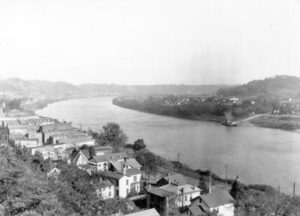
The Ohio River begins at the confluence of the Allegheny and Monongahela rivers in Pittsburgh, Pennsylvania, and flows 981 miles to join the Mississippi River at Cairo, Illinois. The Iroquois called the river “Oyo” or “Ohio,” which the French translated as “La Belle Riviere,” the Beautiful River. It was an important transportation route for countless generations of Native Americans and, beginning in the 1780s, for Euro-American settlers. It was the main route to the opening West and the principal outlet for the region’s growing farm output. Congress first acted to improve navigation in 1824 and, later, by canalizing the river with a series of locks and dams beginning in 1878. River commerce has increased with industrialization, moving up to 150 million tons annually.
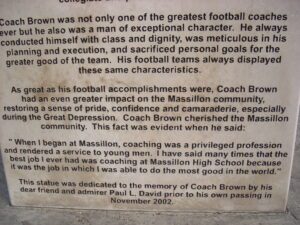
Paul E. Brown, born September 7, 1908 in Norwalk, Ohio, and raised in Massillon, is a member of the Professional Football Hall of Fame and was one of the greatest coaches in the history of football at all levels. From 1932 until 1940, he led Massillon High School to a record of 80-8-2. He coached Ohio State to the 1942 national collegiate championship, and joined the professional football ranks in 1946 as coach of the new franchise in Cleveland. He coached his namesake Cleveland Browns to seven league championships in 17 seasons.
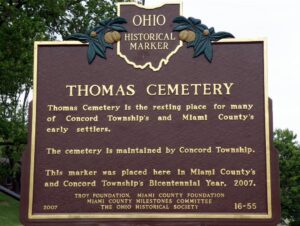
Thomas Cemetery is the resting place for many of Concord Township’s and Miami County’s early settlers. The cemetery is maintained by Concord Township. This marker was placed here in Miami County’s and Concord Township’s Bicentennial Year, 2007.
Joseph Carter Corbin’s work in the Reconstruction-era south after the Civil War created many educational opportunities for African Americans. Corbin (1833-1911) was a professor, administrator, journalist, linguist, and musician. Born in Chillicothe, Ohio to free African American parents, he earned his bachelor’s degree and two masters’ degrees from Ohio University, in 1853, 1856, and 1889, respectively. In 1872, Corbin and his wife Mary moved to Arkansas where he served as the state superintendent of public education. In 1875, Corbin was appointed principal of Branch Normal College, which became the University of Arkansas at Pine Bluff. In 1898, he co-founded and became president of the Arkansas Teachers Association. He was also a leader in the Prince Hall Masons, an African American Masonic order. He served as a secretary and Grand Master of the lodge’s Arkansas chapter.
Near this location stood the settlement of African American families known as “The Lett Settlement.” The Lett Settlement was a self-sustaining community of mixed race families, including the Caliman, Guy, and Lett families. The families had formed ties through marriage and common background during the mid-1700s in Virginia and Maryland. These early African American pioneer families came to Ohio as “free people of color,” and began acquiring land in Meigs Township, Muskingum County, and surrounding townships in adjacent counties during the 1820s. They were soon joined by the Brown, Clifford, Earley, Simpson, Tate, and Pointer families. The families of the Lett Settlement were land owners and tax payers in Ohio before the Civil War and challenged the State of Ohio for the right to vote and for access to education during the 1840s, 1850s, and 1860s. (Continued on other side)
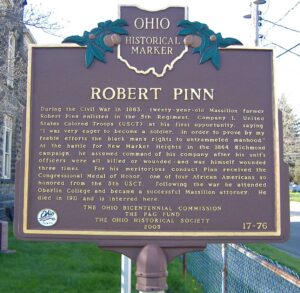
During the Civil War in 1863, twenty-year-old Massillon farmer Robert Pinn enlisted in the 5th Regiment, Company I, United States Colored Troops (USCT) at his first opportunity, saying, “I was very eager to become a soldier, in order to prove by my feeble efforts the black man’s rights to untrammeled manhood.” At the battle for New Market Heights in the 1864 Richmond campaign, he assumed command of his company after his unit’s officers were all killed or wounded – and was himself wounded three times. For his meritorious conduct Pinn received the Congressional Medal of Honor, one of four African Americans so honored from the 5th USCT. Following the war he attended Oberlin College and became a successful Massillon attorney. He died in 1911 and is interred here.
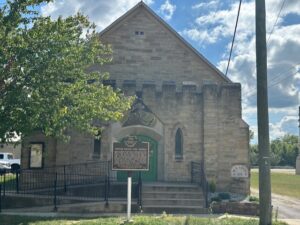
Wayman Chapel was dedicated in 1874 as part of Ohio’s Third District of the African Methodist Episcopal Church. The first Black church in Knox County, it began in 1870 under the guidance of Rev. James A. Ralls. The congregation met in local homes and church basements until completing their red brick church at 102 West Ohio Avenue in 1876. Additions made 1947-1948 included an upgraded facade. For more than a century, Wayman Chapel provided an educational, cultural, and spiritual hub for its members as well as the wider Black community of Mt. Vernon.