

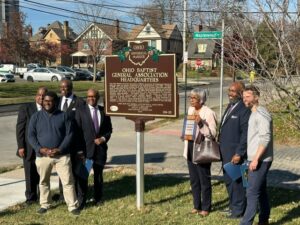
, OH
The Ohio Baptist General Association (OBGA) acquired 48 Parkwood Avenue in 1954 and used the former residence as its headquarters until 1996. Formed in 1896, the Association includes more than forty African American churches, many formed prior to the Civil War. Baptist general associations nationwide became an important voice during the 1960s Civil Rights Movement as they addressed the wrongs of racial violence and discrimination in business, housing, and education. The OGBA fought for the ideals of justice and freedom with its strongly-held Baptist beliefs. “America with her wealth as a great nation,“ OGBA President Wilber A. Page declared in 1957, “is well able to face integration and give a democracy to all her citizens.” The former Association Headquarters was listed in the National Register of Historic Places on December 3, 2020.
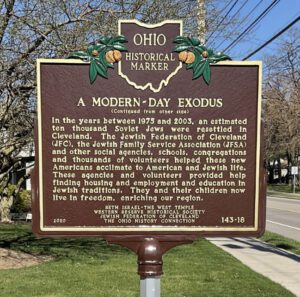
, OH
Here in 1963 congregants of Beth Israel-The West Temple, led by Louis Rosenblum, Herb Caron, and Rabbi Daniel Litt, founded the Cleveland Committee (later Council) on Soviet Anti-Semitism, the first American organization created to advocate for freedom for Soviet Jews. In 1970 this work led to the formation of the Union of Councils for Soviet Jews (UCSJ) under the leadership of Louis Rosenblum. The UCSJ, whose national office was located here 1970-1973, became the largest independent Soviet Jewry organization in the world. By the turn of the 21st century, the efforts begun here helped 1.6 million Jews leave the former Soviet Union. (Continued on other side)
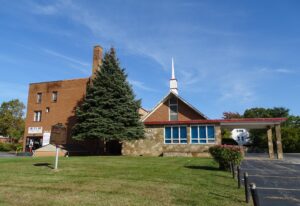
, OH
“…on Sunday morning, especially in the African American community, you could go down the street and hear The Wings Over Jordan just coming from everybody’s house….” Glenn Brackens, 2017. Upholding the sanctity of traditional African American spirituals, believing in the power of radio to uplift listeners, and recognizing his choir’s rich talent, Rev. Glenn T. Settle (1894-1967), pastor of Gethsemane Baptist Church, originated the “Negro Hour” on Cleveland’s WGAR in 1937. The Sunday morning radio show featured the choir’s moving renditions of spirituals and was originally directed by James Tate (1918-1986). Williette Firmbanks Thompson (1910-1992) was assistant director and a soloist (Continued on other side)
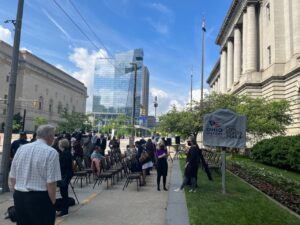
, OH
Carl Stokes was born in Cleveland on June 21, 1927. Recognized for his trailblazing service as a public official, Stokes is one of the few American politicians whose career spanned all three branches of state government. Over 30 years, he served 3 terms as an Ohio legislator (1963-1967), 2 terms as Cleveland’s mayor (1967-1971), and 8 years as a municipal court judge (1983-1994). In 1972, he became the first Black anchorman for a television station in New York City. After a decade working in television, Stokes returned to Cleveland to work as an attorney for the United Auto Workers. In 1994, President Bill Clinton appointed him U.S. Ambassador to the Republic of Seychelles. While serving as Ambassador, he was diagnosed with cancer. Carl Stokes died, in Cleveland, on April 3, 1996.
, OH
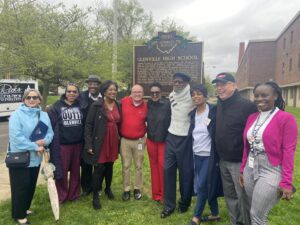
Invited to speak at three Cleveland high schools, Dr. Martin Luther King Jr. delivered his powerful “Rise Up!” speech to students at Glenville High School on April 26, 1967. It signaled King’s opening drive to elect African Americans to prominent government positions in northern cities. Encouraging students to “develop a sense of somebodiness,” King challenged them to “work passionately and unrelentingly for first-class citizenship.” Recognizing the fear of racial unrest in the city, King underscored the significance of nonviolence. “Our power lies in our ability to say non-violently that we’re not going to take it any longer,” he asserted. Making Carl Stokes’ mayoral bid the focus of his push for Black voters to elect Black leaders, King urged Glenville’s students to join civil rights organizations and community action programs.
, OH
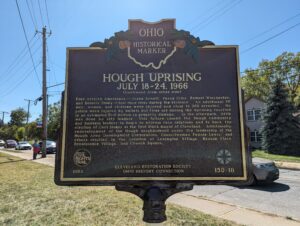
Civil unrest rocked the Hough neighborhood for five nights during the summer of 1966.When the white owners of the Seventy-Niners Cafe refused to serve a Black customer a glass of water, a sign bearing a racial epithet subsequently appeared outside the bar. Decades of institutionalized racial practices that had caused Hough’s substandard and overcrowded housing, high unemployment, economic exploitation, lack of access to quality education, and systemic police harassment sparked an urban uprising in response on July 18. Angry crowds gathered outside the bar only to be confronted by the owners brandishing firearms. When the police belatedly responded, tensions escalated into targeted firebombing, looting, and vandalism. On Tuesday night, July 19, Cleveland’s Mayor Ralph Locher requested that the Ohio National Guard restore order. (Continued on other side)
, OH
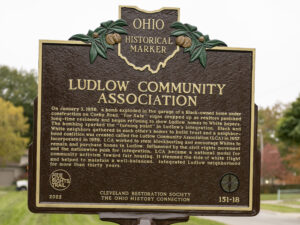
Ludlow, a neighborhood straddling Shaker Heights and Cleveland, was developed in 1905 by Otis and Mantis Van Sweringen. By 1920, they imposed restrictive deed covenants that racially excluded Black home ownership in the community. In 1948, the Supreme Court ruled in Shelley v. Kraemer that such covenants violated the Equal Protection Clause of the Fourteenth Amendment. As a result, affluent African American professionals began to buy homes in Ludlow, seeking the suburban atmosphere and good schools for their families. While illegal, the Van Sweringen Company continued to require prospective African American buyers to gain approval from neighbors before they could purchase homes. Subsequently, the idea of African American families moving into Ludlow created white flight as realtors perpetuated unfounded fears that property values would decline in order to “blockbust” and purchase properties at depressed prices.
, OH
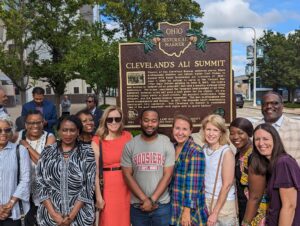
Players of the Cleveland Browns gathered eleven Black professional athletes and future mayor Carl Stokes to discuss with boxer Muhammad Ali (January 17, 1942-June 3, 2016) his refusal to serve in the Vietnam War. After their private meeting on June 4, 1967, the twelve men decided to “support Ali on principle” and held a lengthy national press conference. The boxer, considered the “greatest heavyweight of all time,” garnered national scorn and paid a high price for his stance. Ali was arrested, found guilty of draft evasion, his passport confiscated, titles stripped, and U.S. boxing licenses suspended. The men in attendance also faced condemnation and threats. In 1971, the Supreme Court unanimously overturned Ali’s conviction. The Cleveland Ali Summit is considered “one of the most important civil rights acts in sports history.”