

, OH
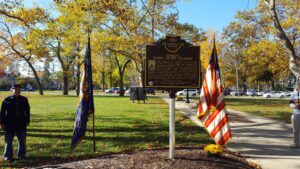
Quincy Adams Gillmore, considered one of the greatest military engineers and artillerists of the Civil War, was born to Quartus Gillmore and Elizabeth Reid Gillmore at this location in 1825. He attended Norwalk Academy and taught high school in Elyria before embarking on a military career. Graduating first in his class at West Point in 1849, he entered the Corps of Engineers. In August 1861, he served in the Union’s Port Royal expedition in South Carolina and later in the reduction of Fort Pulaski, which defended the water approach to Savannah, Georgia. The fort, considered impregnable to artillery, fell to Gillmore’s rifled cannon on April 11, 1862, after a two-day bombardment. His success effectively ended the use of large masonry fortifications. (Continued on other side)

, OH
In 1918, Charles Young made a desperate attempt to convince the U.S. Army that he was fit for duty. The Army’s highest-ranking Black officer, he had been medically retired and not given a command during World War I. To demonstrate his fitness, he rode 497 miles from his home in Wilberforce, Ohio, to Washington, D.C. Leaving on June 6 he made the journey in 17 days, 16 on horseback and 1 resting. Averaging 31 miles each day, he rode 45 minutes and walked 15 minutes every hour. Upon his arrival, Young met with Secretary of War Newton Baker. Pressured by the Black press and the White House, Baker hedged. He recalled Young to active duty a year later and assigned him to Camp Grant, Illinois, just five days before the end of the war.
, OH
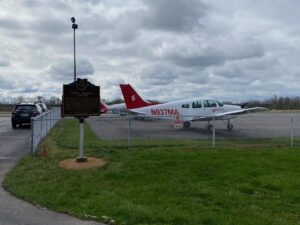
Lewis Albert Jackson (December 29, 1912-January 8, 1994) was an African American aviator remembered for training Tuskegee Airmen during World War II. As a teenager in Indiana, he began flight lessons and soloed in 1932, flying his own Waco 10. Jackson spent 1932-1937 barnstorming to save money for college while earning his Transport Pilot’s License. He re-rated to a Commercial License with Instructor Rating in 1939, and then completed advanced acrobatic training at Coffey School of Aeronautics. In late 1940, he was appointed Director of Training in the Army Air Force 66th Flight Training Detachment at Tuskegee Institute. After the war he moved to Ohio and served as an FAA Flight Examiner from 1947 to 1960. The Lewis A. Jackson Greene County Regional Airport was posthumously renamed to honor this true aviation pioneer.
, OH
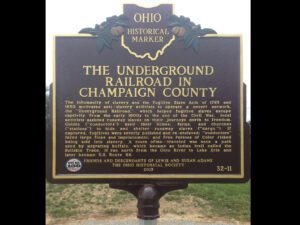
The inhumanity of slavery and the Fugitive Slave Acts of 1793 and 1850 motivated anti-slavery activists to operate a covert network, the “Underground Railroad,” which helped fugitive slaves escape captivity. From the early 1800s to the end of the Civil War, local activists assisted runaway slaves on their journeys north to freedom. Guides (“conductors”) used their homes, farms, and churches (“stations”) to hide and shelter runaway slaves (“cargo.”) If captured, fugitives were severely punished and re-enslaved; “conductors” faced large fines and imprisonment, and Free Persons of Color risked being sold into slavery. A route often-traveled was once a path used by migrating buffalo, which became an Indian trail called the Bullskin Trace. It ran north from the Ohio River to Lake Erie and later became U.S. Route 68.
, OH
On May 1, 1950, the Akron Community Service Center and Urban League building opened to the public. The Center was a gathering place for African Americans of the community, where they addressed workplace, education, and other issues dividing the city. Directors included the late George W. Thompson, Raymond Brown, and Vernon L. Odom. The Center provided space for meetings, classes and receptions and had a swimming pool and gymnasium. The Center also hosted talent shows, which included the musicians who became Ruby and the Romantics. The group scored a #1 hit in 1963 with “Our Day Will Come.”
, OH
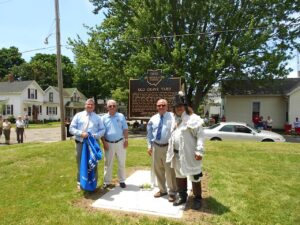
In 1805, a burial ground was dedicated to Champaign County at the intersection of Ward and Kenton Streets, which was then at Urbana’s town limits. It remained open until 1856. Among those interred there was Elizabeth Kenton, eight-year-old daughter of Simon Kenton. When she died in 1810, Kenton, the county jailer, was forbidden from crossing out of the town limits due to his unpaid debts. After following the funeral procession as far as he could, he watched Elizabeth’s burial from across the street. Also buried there were unknown soldiers from the War of 1812; Captain Arthur Thomas and son, who were killed by Native Americans in August 1813; four Bell children, who died in the tornado of March 22, 1830; and numerous early settlers of Champaign County. Many, but not all, were reinterred and rest in Oak Dale Cemetery.
, OH
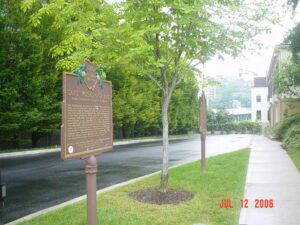
The first African American artist to achieve international acclaim, painter Robert S. Duncanson (1821-1872) was born in New York and settled in Cincinnati in 1840. He pursued his artistic career during a time of tremendous racial prejudice and was acknowledged as the “best landscape painter in the West.” Arts patron Nicholas Longworth commissioned murals from Duncanson around 1850 for his home Belmont, now the Taft Museum of Art; these paintings are regarded as one of the finest pre-Civil War domestic decoration schemes in the United States. Sponsored by anti-slavery groups, he traveled widely during the 1860s in Europe. Duncanson rose above oppression to create expressions of African American cultural identity, leading the way for other people of color to pursue careers in the arts.
, OH
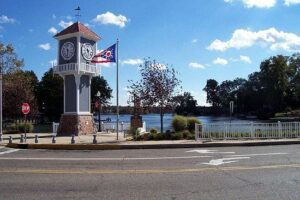
The land on which Coventry Township is situated was ceded in 1785 to the United States by the Delaware, Chippewa, Ottawa, and Wyandot tribes under the Treaty of Fort McIntosh. The area was a choice location for Native Americans, settlers, and fur traders due to the abundant bodies of water and proximity to the Portage Path, a land connection between the Tuscarawas and Cuyahoga rivers and Lake Erie. In 1788, Coventry Township was initially part of Washington County, the first county formed in the Ohio Territory. After Moses Warren finished a survey in 1797, a succession of county splits located Coventry Township in Jefferson County, Trumbull County, Portage County, and, finally, Summit County in 1840. The township originally encompassed Summit Lake and the lands south to the southern line of the Western Reserve (Green-New Franklin lines). Daniel Haines was the first resident to settle in Coventry Township in 1806.