

, OH
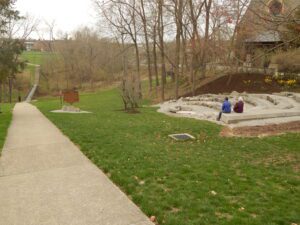
In what was called the “Freedom Summer” of 1964, more than 800 volunteers, most of them college students, gathered at the Western College for Women (now Western Campus of Miami University) to prepare for African-American voter registration in the South. Three of the volunteers – James Chaney of Mississippi, and Andrew Goodman and Michael Schwerner of New York – disappeared on June 21, 1964, in rural Mississippi mere days after leaving Oxford, Ohio. Their bodies were discovered forty-four days later, buried in an earthen dam. Ku Klux Klan members were later convicted on federal conspiracy charges. Erected in 1999, this outdoor amphitheater is a memorial to the slain activists, other volunteers, and ideals of the Freedom Summer movement.
, OH
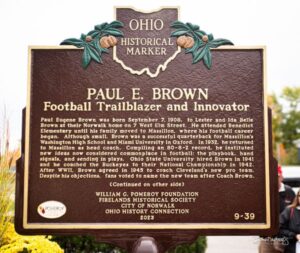
Paul Eugene Brown was born September 7, 1908, to Lester and Ida Belle Brown at their Norwalk home on 7 West Elm Street. He attended Benedict Elementary until his family moved to Massillon, where his football career began. Although small, Brown was a successful quarterback for Massillon’s Washington High School and Miami University in Oxford. In 1932, he returned to Massillon as head coach. Compiling an 80-8-2 record, he instituted new ideas now considered commonplace in football: the playbook, hand signals, and sending in plays. Ohio State University hired Brown in 1941 and he coached the Buckeyes to their National Championship in 1942. After WWII, Brown agreed in 1945 to coach Cleveland’s new pro team. Despite his objections, fans voted to name the new team after Coach Brown. (Continued on other side)
, OH
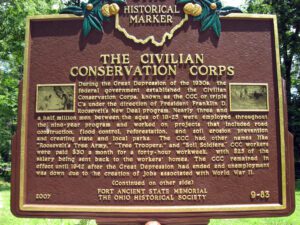
During the Great Depression of the 1930s, the federal government established the Civilian Conservation Corps, known as the CCC or triple C’s under the direction of President Franklin D. Roosevelt’s New Deal program. Nearly three and a half million men between the ages of 18-25 were employed throughout the nine-year program and worked on projects that included road construction, flood control, reforestation, and soil erosion prevention and creating state and local parks. The CCC had other names like “Roosevelt’s Tree Army,” “Tree Troopers,” and “Soil Soldiers.” CCC workers were paid $30 a month for a forty-hour workweek, with $25 of the salary being sent back to the workers’ homes. The CCC remained in effect until 1942 after the Great Depression had ended and unemployment was down due to the creation of jobs associated with World War II.
, OH
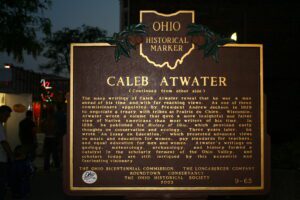
Born in North Adams, Massachusetts on December 23, 1778, Caleb Atwater graduated from Williams College in 1804. He moved to Circleville in about 1814 where he organized the city’s first school board and served as postmaster and prosecuting attorney. His life and work as a teacher, minister, lawyer, legislator, and scholar greatly influenced early 19th-century Ohio. Upon arriving in Circleville, he became interested in local history and the nearby earthworks and in 1820 published his book Descriptions of the Antiquities Discovered in the State of Ohio and Other Western States, the first compilation of prehistoric remains in the Ohio and Mississippi valleys. Elected to the Ohio State Legislature in 1821, Atwater fervently supported canal construction. He also chaired Ohio’s first board of school commissioners and was instrumental in passage of Ohio’s Public School Law. For this, he has been called the “Father of Ohio’s Common Schools.” (continued on other side)
, OH
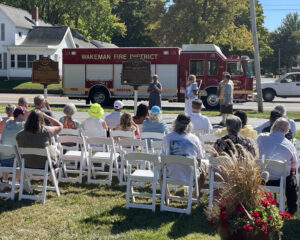
When inventor and entrepreneur Garrett Augustus Morgan sold his Traffic Signal patent to General Electric in 1923, he used the $40,000 to purchase a 121-acre farm in Huron County in 1924. Advertising “a village of our own,” Morgan established the Wakeman Country Club — one of Ohio’s early African American recreation clubs — and offered 247 lots for $60 each in “Wakeman Heights.” Located near the intersection of State Route 60 and Chenango Road, the development provided country pleasures to Blacks excluded from the Country Club lifestyle. Club membership, included in the purchase of a lot, offered fishing, hunting, swimming, and horseback riding. A restaurant, dance hall, and amphitheater provided cultural and boxing events. The club waned during World War II and no buildings from the once-thriving Wakeman Country Club remain.
, OH
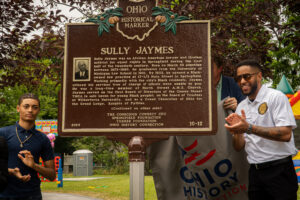
Sully Jaymes was an African American lawyer and tireless activist for equal rights in Springfield during the first half of the twentieth century. Born on March 30 sometime between 1875-1880, he graduated from the University of Michigan Law School in 1901. By 1903, he opened a Black-owned law practice at 17-1/2 Main Street in Springfield. Working primarily with the city’s Black residents, Jaymes offered his services free of charge if clients were unable to pay. He was a long-time member of North Street A.M.E. Church. Jaymes served on the first Board of Directors of the Center Street YMCA (a safe-haven for young Black people), on the Board of Trustees at Wilberforce University, and as a Grand Chancellor of Ohio for the Grand Lodge, Knights of Pythias. (Continued on other side)
, OH
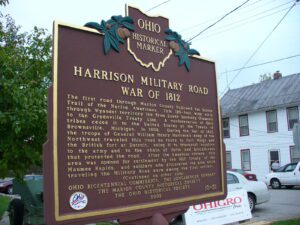
The first road through Marion County followed the Scioto Trail of the Native Americans. This 120-foot wide strip through Wyandot territory led from Lower Sandusky (Fremont) to the Greenville Treaty Line. A confederation of Ohio tribes ceded it to the United States at the Treaty of Brownsville, Michigan, in 1808. During the War of 1812, the troops of General William Henry Harrison’s Army of the Northwest traveled this road en route to Fort Meigs and the British fort at Detroit, using it to transport supplies to the army and to the chain of forts and blockhouses that protected the road. After the American victory, this area was opened for settlement by the 1817 Treaty of the Maumee Rapids, and soldiers who discovered the area while traveling the Military Road were among the first settlers. (continued on other side)
, OH
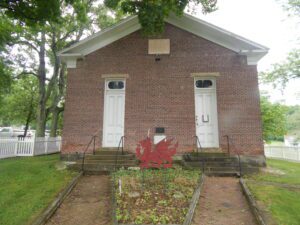
In 1972 a group of Welsh-Americans chartered the Welsh-American Heritage Museum to preserve Welsh history and culture, and to preserve the Welsh Congregational Church. The old brick church was where songs of praises rang, as the Welsh gathered and sang beloved hymns of their homeland in four-part harmony. The church is a link in a long, unbroken chain of memories and still serves the community as a center of Welsh-American activities and a keeper of the community’s heritage. The red dragon and daffodil are symbols of Wales.