

, OH
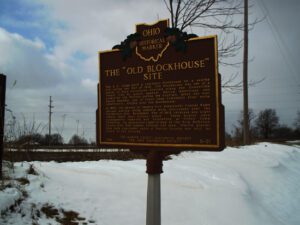
The U.S. Army built a two-story blockhouse on a nearby hill during the War of 1812. The blockhouse was one of a series of such structures erected along the Greenville Treaty line to guard against Native Americans who supported the British during the conflict. After the war, Daniel Markley, one of Green Camp Township’s first white inhabitants, settled near the blockhouse. In 1963, the graves of twenty-five prehistoric Glacial Kame Indians and six white settlers were discovered near the blockhouse site. Seventeen War of 1812 veterans and eight others were also buried there. These bodies were subsequently removed and reinterred at Green Camp Cemetery. An abandoned right-of-way of the Erie Railroad, Dayton line, also passes through the area. Prairie grasses that once dominated parts of Marion County can still be found in the vicinity.
, OH
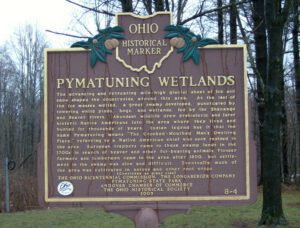
The advancing and retreating mile-high glacial sheet of ice and snow shaped the countryside around this area. As the last of the ice masses melted, a great swamp developed, punctuated by towering white pines, bogs, and wetlands, fed by the Shenango and Beaver rivers. Abundant wildlife drew prehistoric and later historic Native Americans into the area where they lived and hunted for thousands of years. Indian legend has it that the name Pymatuning means “The Crooked-Mouthed Man’s Dwelling Place,” referring to a Native American chief who once resided in the area. European trappers came to these swamp lands in the 1700s in search of beaver and other fur-bearing animals. Pioneer farmers and lumbermen came to the area after 1800, but settlement in the swamp was slow and difficult. Eventually much of the area was cultivated in onions and other root crops. (continued on other side)
, OH
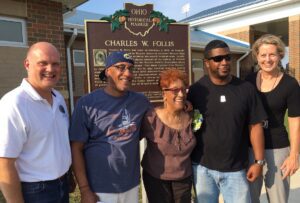
Charles W. Follis was born on February 3, 1879, in Virginia. His family moved to Wooster where he attended Wooster High School and helped establish the school’s football team. In 1901, Follis enrolled and played baseball at the College of Wooster and played football for the Wooster Athletic Association where he earned the nickname “The Black Cyclone from Wooster.” In 1904, Follis signed a contract to play football with Shelby Athletic Club, making him the first African-American professional football player. Follis faced discrimination on and off the field leading to many injuries. After a career-ending injury in 1906, Follis played baseball for the Cuban Giants of Long Island. He died of pneumonia in 1910 at the age of 31 and is buried in Wooster Cemetery.

, OH
In 1918, Charles Young made a desperate attempt to convince the U.S. Army that he was fit for duty. The Army’s highest-ranking Black officer, he had been medically retired and not given a command during World War I. To demonstrate his fitness, he rode 497 miles from his home in Wilberforce, Ohio, to Washington, D.C. Leaving on June 6 he made the journey in 17 days, 16 on horseback and 1 resting. Averaging 31 miles each day, he rode 45 minutes and walked 15 minutes every hour. Upon his arrival, Young met with Secretary of War Newton Baker. Pressured by the Black press and the White House, Baker hedged. He recalled Young to active duty a year later and assigned him to Camp Grant, Illinois, just five days before the end of the war.
, OH
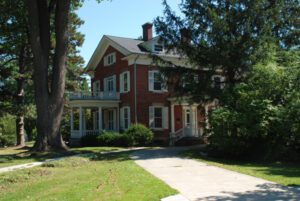
Jabez Lyman Burrell (1806-1900), originally from Massachusetts, built this house in 1852. Burrell made his living as a cattleman and farmer, but devoted much of his time serving the cause of abolitionism, helping slaves, who had escaped the South, get to Sheffield and from there to Lorain and across Lake Erie to Canada. He was also devoted to equal education for all, providing funding to a freedmen’s school in Selma, Alabama, and serving as a trustee of the Oberlin Collegiate Institute, well known for educating African Americans and women. From 1884 to 1934, this was the home of Henry Churchill King (1858-1934), who was the president of Oberlin College from 1902-1927. The Kings added the porches and rear wing and made their home a social center for the college and community. The house is listed on the National Register of Historic Places and is a City of Oberlin Historic Landmark.
, OH
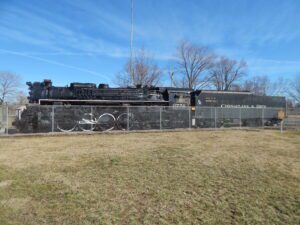
Granville T. Woods was a pivotal African American inventor during the late 19th and early 20th centuries. Woods’ invention of the telegraph device that enabled railway companies to know the location of each of their trains. This new technology greatly enhanced train scheduling and reduced the frequency of fatal collisions throughout the railway industry. From 1878 through 1880 Woods was a railroad locomotive engineer employeed by the Springfield, Jackson and Pomeroy Railroad Company and later by the Dayton and Southeastern Railroad. With frequent stops in Washington Courthouse and extensive leisure time, Woods learned telegraphy from a local telegraph operator. (Continued on other side)
, OH
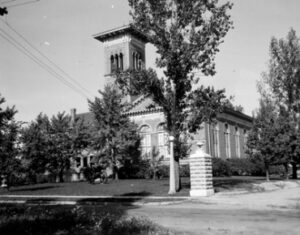
At the turn of the twentieth century, increased enrollment in the Combined Normal and Industrial Department at Wilberforce University (which later became Central State University) spurred construction of new teaching and dormitory facilities. Galloway Hall, which included an auditorium and a tower with chimes and a clock, was completed in 1906. Many famous personalities performed in Galloway Hall’s auditorium, including the renown opera singer Leontyne Price; Robert McFerrin, the first African American male lead with the New York Metropolitan Opera; actors Ruby Dee and Ossie Davis; comedian and civil rights activist Dick Gregory; and composer and conductor Duke Ellington. Noted authors and intellectuals addressed audiences there, including historian John Hope Franklin; writer, poet, actor, and playwright Maya Angelou; Lerone Bennett, author, historian, and editor of EBONY Magazine; and writer and essayist James Baldwin. (continued on other side)
, OH
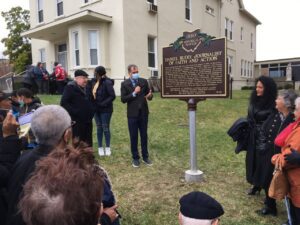
Daniel Arthur Rudd was born into slavery on August 7, 1854, in Bardstown, Kentucky. He became a newspaperman, lecturer, publicist, and tireless advocate for the Roman Catholic Church. After the Civil War Rudd moved to Springfield. Baptized and raised in Catholicism, he joined St. Raphael Parish, where the philosophy of racial equality offered by the church solidified his vision of justice. By 1885 he had established his own weekly newspaper, The Ohio State Tribune. He rebranded it The American Catholic Tribune (ACT) after moving to Cincinnati. Rudd claimed ACT was the only Catholic newspaper owned by an African American. At the height of its popularity in 1892, the publication had a circulation of 10,000. In 1893 Rudd was asked to chair the Afro-American Press Association, representing more than 200 black-owned newspapers.