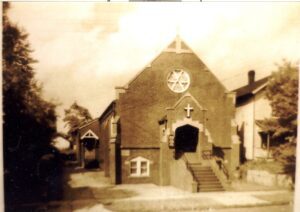
St. Augustine Episcopal Chapel was founded by Lenora Evans Berry, an African American woman, in 1907. A lifelong Baptist, her mission was the development of the Episcopal Church for African Americans in Youngstown. Mrs. Berry’s husband, bricklayer Thomas D. Berry, the son of master builder P. Ross Berry, became the church’s first senior warden and treasurer. The congregation met in St. John’s Parish until they were able to obtain property on Parmalee Avenue. In 1912, Reverend John Ogburn was officially called to vicar. In 1920, work began on plans for a new church. The structure was designed by Charles F. Owsley and construction began after more than six hundred individuals from the community attended the laying of the church’s corner stone on September 11, 1921. St. Augustine Chapel is the oldest African American church and congregation in Youngstown still in its original location and structure.
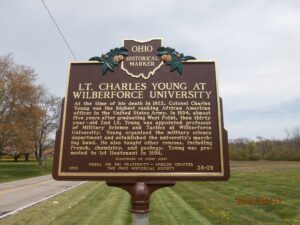
At the time of his death in 1922, Colonel Charles Young was the highest ranking African American officer in the United States Army. In 1894, almost five years after graduating West Point, then thirty year-old 2nd Lt. Young was appointed professor of Military Science and Tactics at Wilberforce University. Young organized the military science department and established the university’s marching band. He also taught other courses, including French, chemistry, and geology. Young was promoted to 1st lieutenant in 1896. (Continued other side)
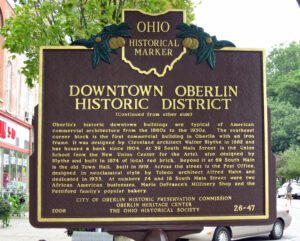
The intersection of Main and College streets has been the center of Oberlin since the town and college were founded in 1833. The first downtown buildings were made of wood and were destroyed by a series of spectacular fires. The first college building, Oberlin Hall, stood on the southwest corner of College and Main and included recitation rooms, a dining hall, chapel, offices, and lodging. In 1887, Akron architect Frank Weary designed the large brick building at numbers 5 to 13 West College. Number 23 West College (Gibson Block) once housed a silent movie theater on the second floor. East College Street’s historic buildings include the Apollo Theater, which showed Oberlin’s first talking movie on May 11, 1928. From 1897 to 1929, an interurban streetcar line connected Oberlin’s downtown to Cleveland. Oberlin’s downtown historic district was placed on the National Register of Historic Places in 2003.
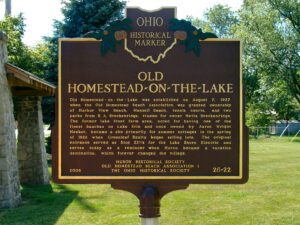
Old Homestead-on-the-Lake was established on August 7, 1927, when the Old Homestead Beach Association was granted ownership of Harbor View Beach, Mansell Beach, tennis courts, and two parks from R. A. Breckenridge, trustee for owner Metta Breckenridge. The former lake front farm area, noted for having one of the finest beaches on Lake Erie and once owned by Aaron Wright Meeker, became a site primarily for summer cottages in the spring of 1922 when Greenleaf Realty began selling lots. The original entrance served as Stop 22 1/2 for the Lake Shore Electric and serves today as a reminder when Huron became a vacation destination, which forever changed the village.
In 1833, John Randolph from Roanoke, Virginia, died leaving three wills that requested that all of his slaves be set free and that land be purchased for them. Although contested for thirteen years by his family, the slaves were freed and the executor of the wills, Randolph’s cousin Judge William Leigh purchased about 2,000 acres of farm land in Mercer County, Ohio. Traveling by wagon train, the freed slaves, 383 in all, reached their destination in 1846, but were forced to turn back by earlier established white settlers. They turned around and ended up north of Piqua where they purchased land and developed the Village of Rossville. Later some moved on to other places in Miami County and well as Shelby County. In Rossville, they established an African Baptist Church in 1869, cemetery in 1866, and public black school in 1872.
Virginia Hamilton was an author who was born in Yellow Springs in 1934, living and writing here for much of her life. She referred to her works as “Liberation Literature.” focusing on the struggles and journeys of African Americans. Hamilton published more than forty books in a variety of genres, including realistic novels, science fiction, picture books, folktales and mysteries. Some of her most beloved titles include The House of Dies Drear, M.C. Higgins the Great, Her Stories and The People Could Fly. Her books have had a profound influence on the study of race throughout American history, the achievements of African Americans, and the ramifications of racism. Hamilton received numerous awards for her writing before passing away in 2002. Her work is enshrined at the Library of Congress in Washington, D.C.
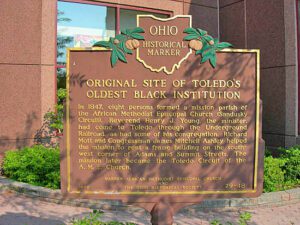
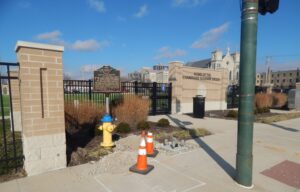
In 1847, eight persons formed a mission parish of the African Methodist Episcopal Church (Sandusky Circuit). Reverend Henry J. Young, the minister, had come to Toledo through the Underground Railroad, as had some of his congregation. Richard Mott and Congressman James Mitchell Ashley helped the mission to rent a frame building on the southwest corner of Adams and Summit streets. The mission later became the Toledo Circuit of the A.M.E. Church.
Known by the trade name Henderson’s Printing, the business was a mainstay of Dayton’s African American community for almost 60 years and became a printer of choice for everything from advertising materials, office forms, and a community publications called “housewife savers.” John William Henderson Sr. (1913–1991) purchased his first printing press and founded the business in 1941, bringing to it experience as an instructor of journalism and printing at Wilberforce University. The business’s first location was the family home at 421 Kearney St. After several moves, the business settled at 301 Washington Street in 1958.