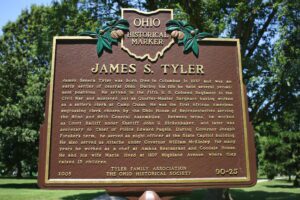
James Seneca Tyler was born free in Columbus in 1837 and was an early settler of central Ohio. During his life he held several prominent positions. He served in the Fifth U.S. Colored Regiment in the Civil War and mustered out as Quarter-Master Sergeant having worked as a sutler’s clerk at Camp Chase. He was the first African American engrossing clerk chosen by the Ohio House of Representatives serving the 62nd and 66th General Assemblies. Between terms, he worked as Court Bailiff under Sheriff John U. Rickenbaker, and later was secretary to Chief of Police Edward Pagels. During Governor Joseph Foraker’s term, he served as night officer at the State Capitol building. He also served as Attache under Governor William McKinley. For many years he worked as a chef at Ambos Restaurant and Goodale House. He and his wife Maria lived at 1107 Highland Avenue where they raised 13 children.
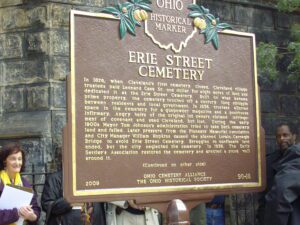
In 1826, when Cleveland’s first cemetery closed, Cleveland village trustees paid Leonard Case Sr. one dollar for eight acres of land and dedicated it as the Erie Street Cemetery. Built on what became prime property, the cemetery touched off a century long struggle between residents and local government. In 1836, trustees allotted space in the cemetery for a gunpowder magazine and a poorhouse infirmary. Angry heirs of the original lot owners claimed infringement of covenant and sued Cleveland, but lost. During the early 1900s Mayor Tom Johnson’s administration tried to take back cemetery land and failed. Later pressure from the Pioneers’ Memorial Association and City Manager William Hopkins caused the planned Lorain Carnegie Bridge to avoid Erie Street Cemetery. Struggles to confiscate land ended, but the city neglected the cemetery. In 1939, The Early Settler’s Association restored the cemetery and erected a stone wall around it. (continued on other side)
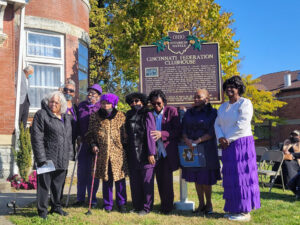
“Lifting As We Climb”: The Cincinnati Federation of Colored Women’s Clubs (CFCWC) was organized May 6, 1904, during a meeting called by Mary Fletcher Ross at the Allen Temple A.M.E. Church. Gathering together eight existing African-American women’s clubs, the CFCWC sought to unite in their work promoting “the betterment of the community.” At a time when both government and private philanthropies overlooked the needs of Black Americans, CFCWC members helped to organize the city’s first kindergartens for Black children, taught in Cincinnati African-American public schools –including the Walnut Hills Douglass and Stowe schools—and raised money for the Home of Aged Colored Women. Since 1904, the Cincinnati Federation of Colored Women’s Clubs has ensured the civic and constitutional rights of all African Americans while meeting the needs of their city.
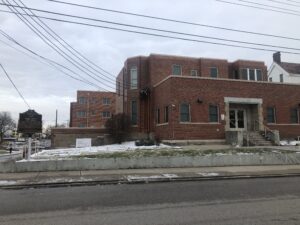
In 1911 local doctors founded the St. Clair Hospital. The home adjacent to the hospital served as a residence home and training school for nurses. In 1940, the hospital was converted into a convalescent home. In 1948, Mr. and Mrs. William J. Garrett, an African-American couple, transformed the facility into a hotel. The Hotel St. Clair, which closed in 1976, accommodated African Americans who were not permitted to stay in white hotels. It also served as a social gathering place for members of Columbus’ black community.
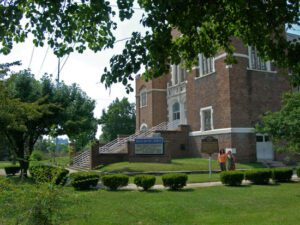
The Shiloh Baptist Church was completed in 1923. Founded in 1869, Shiloh is the third oldest African-American church in Columbus and is a descendent of the Second Baptist Church. The church is located in the Mt. Vernon neighborhood, which is adjacent to the central businesses of Columbus and Interstate 71. The dominant physical presence of Shiloh Baptist Church shows its importance as a religious and social institution for more than one hundred years in the Mt. Vernon area.
Walnut Hills has been home to a significant middle- and working-class Black community since the 1850s. In 1931, African American entrepreneur Horace Sudduth bought 1004 Chapel Street and then the row of buildings across Monfort, naming them the Manse Hotel and Annex. Throughout the 1940s, hotel dinner parties could move to the Federation of Colored Women’s Clubs house next door for dancing. A large addition to the Manse in 1950 created its own ballroom, 24-hour coffee shop, upgraded Sweetbriar Restaurant, and more guest rooms. It appeared in the Negro Motorist’s Green Book between 1940-1963, providing local, transient, and residential guests both catered meetings and top entertainment during the last decades of segregation. It closed in the late 1960s when the economic need for a first-class segregated hotel disappeared in the age of Black Power.
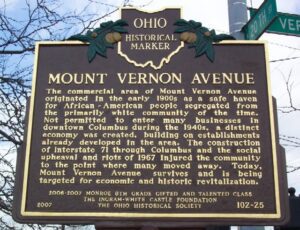
The commercial area of Mount Vernon Avenue originated in the early 1900s as a safe haven for African-American people segregated from the primarily white community of the time. Not permitted to enter many businesses in downtown Columbus during the 1940s, a distinct economy was created, building on establishments already developed in the area. The construction of Interstate 71 through Columbus and the social upheaval and riots of 1967 injured the community to the point where many moved away. Today, Mount Vernon Avenue survives and is being targeted for economic and historic revitalization.
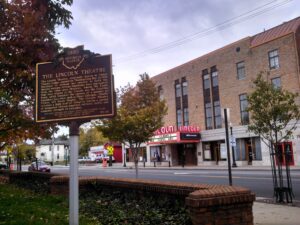
The Lincoln Theatre, originally known as Ogden Theatre Lodge, opened on Thanksgiving Day in 1929. Developer Al Jackson was spurred to build the theatre because African-Americans were segregated from the other area theatres. Among the bands that have played at the Lincoln was the Eckstine Band, which launched the careers of a number of legendary jazz stars such as Dizzy Gillespie, Charlie Parker, and Sarah Vaughn. The Lincoln Theatre retained a high level of integrity during a period of unequaled African-American cultural, social, and economic strength in Columbus.