NE corner of S. Main Street and Zoar Road / Bayou Street
South Lebanon
, OH
Deerfield was laid out around 1795 and in 1802 Major Benjamin Stites, his son Benjamin, Jr., and John Gano officially recorded the village’s plat. A part of the great tide of Americans moving into the Northwest Territory (and Ohio after 1803), Deerfield’s early inhabitants included Revolutionary war veteran Ephraim Kibbey as well as Andrew Lytle, Nathan Kelly, William Snook, and War of 1812 veteran David Sutton. Deerfield was so called because it was a settlement in Deerfield Township, Hamilton County in the 1790s. (Continued on other side)
The center of African-American culture in Akron during the mid-20th century, Howard Street was home to many of the city’s black-owned business and entertainment establishments, and provided an atmosphere in which minority-owned businesses could thrive. Attracted to the vitality of the neighborhood, entrepreneur George Mathews (1887-1982) established a barbershop here in 1920 and in 1925 opened the adjoining Mathews Hotel. The hotel quickly became the anchor of the Howard Street district. Mathews’ success allowed him to endow a scholarship fund at the University of Akron in 1964.
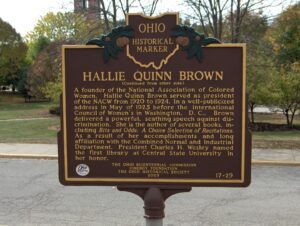
Hallie Quinn Brown (c. 1850) was born in Pittsburgh, Pennsylvania to former slaves. She and her family moved to Wilberforce, Ohio in 1870, where she received a Bachelor of Science degree from Wilberforce University in 1873. Brown taught school in the South until her appointment as professor of elocution at Wilberforce University in 1893. A gifted elocutionist and author, Brown received national and international acclaim not only for her recitals and written works, but also for her passionate belief in civil rights and African American culture. (Continued on other side)
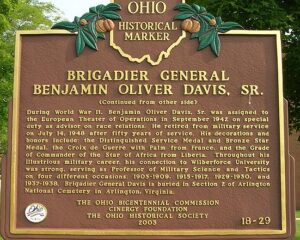
Benjamin Oliver Davis, Sr. (July 1, 1877 – November 26, 1970), the nation’s first African American general in the Regular Army, was born in Washington, D.C. Davis first served as a temporary first lieutenant of the 8th U.S. Volunteer Infantry during the Spanish-American War. Following that conflict, he enlisted as a private in the 9th U.S. Cavalry, serving in the Philippine Insurrection where he began to rise in rank. Davis was promoted to first lieutenant in 1905, captain in 1915, lieutenant colonel in 1920, colonel in 1930, and brigadier general in 1941. His military career took him around the world. In 1909, he was detailed as Military Attache to Monrovia, Liberia. During World War I, Davis was stationed in the Philippines. In 1938, he took command of the New York’s African American 396th National Guard Infantry, later known as the 369th Coast Artillery (Antiaircraft) Regiment. (Continued on other side)
In April 1784, the Continental Congress adopted the Report of Government for the Western Territory, a broad plan drafted primarily by Thomas Jefferson for organizing the United States’ new western lands that were ceded by the states and purchased from Native Americans. One of the most far-reaching legislative acts in American history, the resulting Land Ordinance of 1785, passed on May 20th, established the public land system by which all federal land was surveyed and distributed. The Ordinance established a rectilinear survey system that divided land into townships of six miles square aligned by north-south and east-west baselines, and set aside certain lands for Revolutionary War veterans and for public schools.
The Snowden Family Band was an acclaimed African-American stringband who performed in and around Knox County for nearly seventy years, from the 1850s into the 1920s. Buried in Morris Chapel Cemetery are Thomas Snowden (1803-1856), his wife Ellen Cooper Snowden (1817-1894), and their nine children: Oliver, Sophia, Mary, Ben, Lew, Phebe, Martha, Elsie, and Annie. Born into slavery in Maryland, Thomas and Ellen separately relocated to Knox County and to freedom during the 1820s. They married in 1834. In the 1850s, the six surviving children formed a band under Ellen’s direction. Talented musicians, the Snowden Family performed banjo and fiddle music for public events and at their homestead near Mount Vernon. Many believe that the song “Dixie,” attributed to minstrel Daniel Decatur Emmett (1815-1904), originated with the Snowden Family Band.
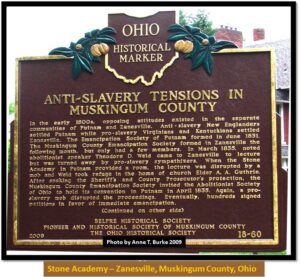
In the early 1800s, opposing attitudes existed in the separate communities of Putnam and Zanesville. Anti-slavery New Englanders settled Putnam while pro-slavery Virginians and Kentuckians settled Zanesville. The Emancipation Society of Putnam formed in June 1831. The Muskingum County Emancipation Society formed in Zanesville the following month, but only had a few members. In March 1835, noted abolitionist speaker Theodore D. Weld came to Zanesville to lecture but was turned away by pro-slavery sympathizers. When the Stone Academy in Putnam provided a room, the lecture was disrupted by a mob and Weld took refuge in the home of church Elder A.A. Guthrie. After seeking the Sheriff’s and County Prosecutor’s protection, the Muskingum County Emancipation Society invited the Abolitionist Society of Ohio to hold its convention in Putnam in April 1835. Again, a pro-slavery mob disrupted the proceedings. Eventually, hundreds signed petitions in favor of immediate emancipation. [continued on other side]
James Edwin Campbell was born on September 28, 1867, in the Kerr’s Run area of Pomeroy to James and Letha Campbell. He graduated from Pomeroy High School with the class of 1884. After graduation, Campbell taught in various parts of Meigs County. Campbell achieved notoriety as an African American poet, editor, author of short stories, and educator. He began his writing in 1887 with the work Driftings and Gleanings. During the 1880s and 1890s, he wrote regularly for daily newspapers in Chicago and was employed on the literary staff of the Chicago Times-Herald. His dialect poetry attracted wide-spread popularity and he published a collection of his best works, Echoes From the Cabin and Elsewhere. Campbell was installed as the first president of the West Virginia Colored Institute (West Virginia State University), serving in the capacity from 1891 to 1894. James Edwin Campbell died in Pomeroy on January 26, 1896.