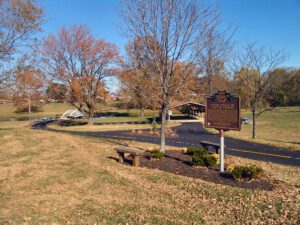
Clinton County was a major center of activity for the Shawnee, Miami, and Delaware Indians. Early traces and trails developed as Indians traveled from village to village; gathered flint, salt and gold; traded furs, mica, and feldspar; and hunted bear, deer, otters, raccoons, foxes, wild cats, turkeys, and other wildlife. Trails throughout the county connected to other trails and villages in Ohio such as Lower Shawnee Town (now Portsmouth), Hurricane Tom’s Town (now Piketon), Chillicothe, Old Town (near Xenia), and Miami Town (now Dayton). Major trails or traces in Clinton County included the Bullskin, Wayne, Chillicothe, Delaware, Fort Ancient, Kanawha, Kenton and Todds Fork Traces. These routes were the avenues the first white settlers followed. (continued on other side)
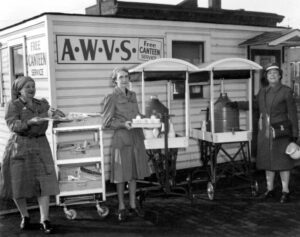
The Lima Chapter of the American Women’s Voluntary Services Organization established a community-based, free canteen during World War II for troops traveling on the Pennsylvania Railroad and adjacent Baltimore & Ohio-Nickel Plate Railroads. Meeting as many as forty trains a day, the ladies served 2.5 million troops between 1942-1945. Food, coffee, and other items were donated to the canteen from a twelve county area. The “AWVS” disbanded in 1945, but succeeding volunteers continued to provide service throughout the Korean Conflict and Viet Nam War. Lima’s “Servicemen’s Free Canteen” was the longest, continuously operated service canteen in the United States. An estimated four million soldiers, sailors, and marines were served between 1942-1970.
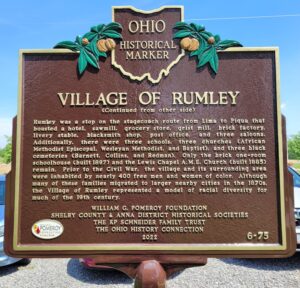
The Temple of Rumley Church is of one of two remaining buildings in what once was Rumley, a thriving African American community in Shelby County. On May 19, 1837, the village was surveyed for Amos Evans, who built his hewed log dwelling and store. Brothers Joel and George Goings (aka. Goens), freed black men from Monongalia County, Virginia, purchased 80 acres of land that same year. They settled with their families near Rumley in Van Buren Township along with other free men and women of color, including former slaves. Joel Goings erected the first brick house in 1841, using bricks from his own brickyard. By 1846, the Rumley community stretched over 7,000 acres and included the Collins, Redman, Williams, Davis, Lett, and Brown families. (Continued on other side)
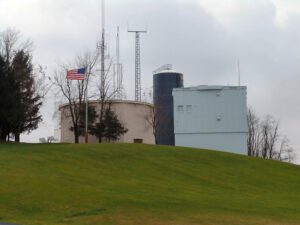
Campbell Hill is named for Charles D. Campbell of Bellefontaine, who owned this land from 1898 to 1937. A marble stone marker atop the hill, set in 1900 by the U.S. Coast and Geodetic Survey, marks it as the highest point in Ohio at an elevation of 1549.09 feet. In 1951, the federal government established the 664th Aircraft Control and Warning (AC&W) Squadron here as part of the North American Air Defense Command (NORAD). Its military and civilian operators used sophisticated radar and computer equipment to locate and identify aircraft as friendly or suspicious, and relayed information to a central site in Battle Creek, Michigan. This Cold War site operated until 1969. It was converted to civilian use as a vocational education center in 1974.
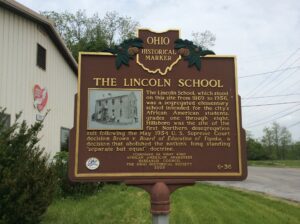
The Lincoln School, which stood on this site from 1869 to 1956, was a segregated elementary school intended for the city’s African American students, grades one through eight. Hillsboro was the site of the first Northern desegregation suit following the May 1954 U.S. Supreme Court decision Brown v. Board of Education of Topeka, a decision that abolished the nation’s long standing “separate but equal” doctrine. (Continued on other side)
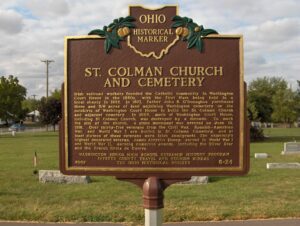
Irish railroad workers founded the Catholic community in Washington Court House in the 1850s, with the first Mass being held in a local shanty in 1852. In 1871, Father John B. O’Donoghue purchased three and 5/8 acres of land adjoining Washington cemetery on the outskirts of Washington Court House to build the St. Colman Church and adjacent cemetery. In 1885, much of Washington Court House, including St. Colman Church, was destroyed by a tornado. To mark the site of the church, a stone monument was erected on June 19, 1916. Over thirty-five veterans from the Civil War, Spanish-American War, and World War I are buried in St. Colman Cemetery, and at least sixteen of these veterans were Irish immigrants. The cemetery’s highest decorated veteran, James Aloysius Ducey, served in World War I and World War II, earning numerous awards, including the Silver Star and the French Croix de Guerre.
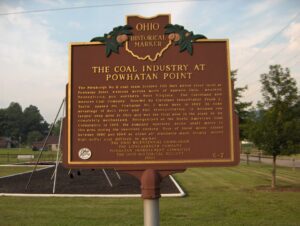
The Pittsburgh No. 8 coal seam, located 100 feet below river level at Powhatan Point, extends across much of eastern Ohio, western Pennsylvania, and northern West Virginia. The Cleveland and Western Coal Company, founded by Cleveland industrialist Frank E. Taplin, opened the Powhatan No. 1 mine here in 1922 to take advantage of both river and rail transportation. It became the largest deep mine in Ohio and was the first mine in the state to be completely mechanized. Reorganized as the North American Coal Corporation in 1925, the company operated seven shaft mines in this area during the twentieth century. Four of these mines closed between 1980 and 1984 as clean air standards made locally mined high-sulfur coal difficult to market.
Lucasville Cemetery was originally established as the Lucas Family burying ground, with Susannah Lucas as the first recorded burial on May 4, 1809. Susannah’s husband, Captain William Lucas, a Revolutionary War veteran, is interred here along with the first wife of Governor Robert Lucas, Eliza “Betsy” Brown Lucas. By 1816, the cemetery was used as a public burying ground. Hand carved monuments inscribed with poetry can be found in the old section. Recognized as one of the oldest cemeteries in southern Ohio, Lucasville Cemetery has interred veterans of the Revolutionary War, War of 1812, Civil War, Spanish-American War, World Wars I and II, Korea, and Vietnam.