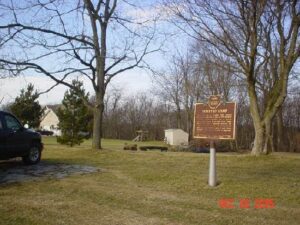
Near this site scout Peter Navarre built in 1807 a log cabin close by an Ottawa Indian Village of 60 whitewashed cabins. Here he maintained friendly relations between white settlers and Chief Autokee. The 1833 Treaty of Maumee gave 320 acres of this region to the Indians who later sold the isle for $1,000. Presque Isle is now at the heart of Port of Toledo activity.
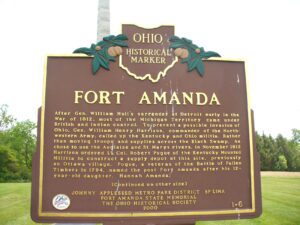
Fort Amanda State Memorial, OH 198, 1/4 mile S of Ft. Amanda Road, Lima
Lima
, OH
After Gen. William Hull’s surrender at Detroit early in the War of 1812, most of the Michigan Territory came under British and Indian control. To prevent a possible invasion of Ohio, Gen. William Henry Harrison, commander of the Northwestern Army, called up the Kentucky and Ohio militia. Rather than moving troops and supplies across the Black Swamp, he chose to use the Auglaize and St. Marys rivers. In November 1812 Harrison ordered Lt. Col. Robert Pogue of the Kentucky Mounted Militia to construct a supply depot at this site, previously an Ottawa village. Pogue, a veteran of the Battle of Fallen Timbers in 1794, named the post Fort Amanda after his 12-year-old daughter, Hannah Amanda. (continued on other side)
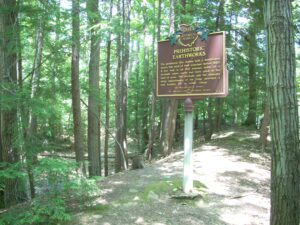
The prehistoric Erie Indians built a fortification across this neck of land sometime before 1650. A low wall is all that remains today of a stockade where earth had been piled at the base of posts. The stockade and the naturally steep embankments of the ridge provided a safe location for an Indian village.
You are standing on the famous portage, carrying-place between the Cuyahoga and Tuscarawas rivers. The two streams and the portage across the watershed formed an early route between Lake Erie and the Ohio River. First the Indians, then French and English traders and trappers, and finally American settlers and travelers carried their canoes and packs across this narrow strip of land in passing, by way of the rivers, between northern and southern Ohio. The portage was a part of the defined boundaries in the treaties with the Indians made at Fort McIntosh (1785), Fort Harmar (1789), and Green Ville (1795). Use of the portage was discontinued in 1827 when the Ohio and Erie Canal was built along the old trail. Today, modern Akron streets–Portage Path and Manchester Road–follow the approximate route of the original portage.
Near this site in October 1786 General Benjamin Logan with an army of 700 Kentucky volunteers camped on their way to destroy seven Indian towns in the Mad River Valley. During the night a renegade deserted the camp to warn the Indians. The army burned 200 cabins and 15,000 bushels of corn before returning. Later this site became an important survey point.
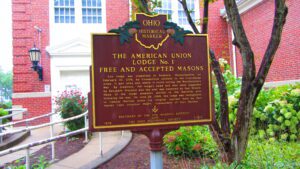
The lodge was organized in Roxbury, Massachusetts, on February 10, 1776, by Connecticut soldiers in the Continental Army. It met when and where it could during the Revolutionary War. By tradition, the lodge’s name and seal were suggested by Benjamin Franklin and the seal was engraved by Paul Revere. Many of the lodge members settled in the Marietta area following the war. On June 28, 1790, the lodge was reorganized in Campus Martius under its original warrant held by Past Master Capt. Jonathan Heart, commandant of Fort Harmer.
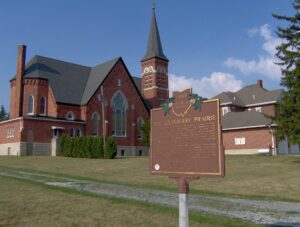
The Cranberry Prairie, southwest of this marker, is a part of Ohio’s natural history. The place was named for the cranberries that grew in a swamp here prior to drainage of the area. The Cranberry Prairie was created by centuries of peat accumulation in a late Ice Age lake that formed at the base of St. John’s Moraine. Paleo-Indian or Early Archaic peoples probably killed the elk whose skeleton was dug up here in 1981. This elk was dated at approximately 7400 B.C. By the 1860s, immigrant German farmers had begun transforming the swamp into fertile farmland. “Wild Bill” Simison, a legendary inhabitant, lived in the swamp and settlers respected him for his knowledge of the area. By the turn of the nineteenth century, Granville Township School #7, St. Francis Catholic Church, and Bertke’s Store stood at the edge of the Cranberry Prairie.
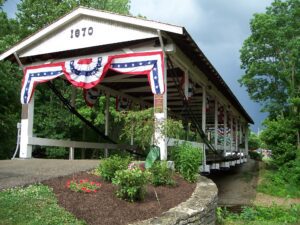
Restored in 1963, the Germantown Covered Bridge on East Center Street, spanning Little Twin Creek, was 93 years old and is reputed to be the only existing covered bridge of its kind in the world. For 41 years this unique inverted bow string truss covered bridge spanned Little Twin Creek on the Dayton Pike in Germantown, Ohio. In 1911 it was removed to its present location where it has been restored and beautified as a link with Ohio’s early history. It is a symbol of individual initiative in America’s early history.