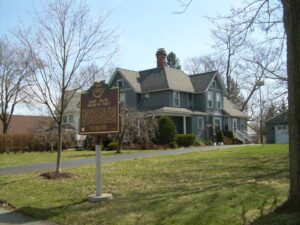
Harold Hart Crane was born at this site on July 21, 1899, to Grace Hart Crane and Clarence A. Crane, the inventor of Lifesaver Candies, and lived here until the age of three. “A born poet,” according to e.e. cummings, Crane dropped out of high school in 1916 and moved from Cleveland to New York City to focus on a literary career. Mainly self-educated, Crane drew his influence from the writings of Walt Whitman and Emily Dickinson. His major work, The Bridge (1930), uses the Brooklyn Bridge as the perfect metaphor to celebrate contemporary urban life. Uniquely lyrical in structure and full of imagery, it is considered one of the three major poetic sequences of the first half of the twentieth century along with T.S. Eliot’s The Waste Land and William Carlos Williams’ Paterson. Crane died on April 26, 1932.
Myron T. Herrick, Governor of Ohio from 1904 to 1906, was born in Huntington Township in 1854 and lived here until age 12. A respected Cleveland attorney and businessman, Herrick was a friend and confidant to Senator Mark Hanna and Presidents McKinley, Taft, and Harding. His public service career culminated in two appointments as ambassador to France, from 1912 through the outbreak of World War I in 1914, and again from 1921 until his death in 1929. Enormously popular with the French people, Herrick escorted Charles Lindbergh in Paris after his historic 1927 transatlantic flight.
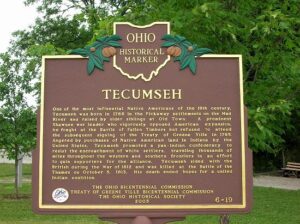
One of the most influential Native Americans of the 19th century, Tecumseh was born in 1768 in the Pickaway settlements on the Mad River and raised by older siblings at Old Town. A prominent Shawnee war leader who vigorously opposed American expansion, he fought at the Battle of Fallen Timbers but refused to attend the subsequent signing of the Treaty of Greene Ville in 1795. Angered by purchases of Native American land in Indiana by the United States, Tecumseh promoted a pan-Indian confederacy to resist the encroachment of white settlers, traveling thousands of miles throughout the western and southern frontiers in an effort to gain supporters for the alliance. Tecumseh sided with the British during the War of 1812 and was killed at the Battle of the Thames on October 5, 1813. His death ended hopes for a united Indian coalition.
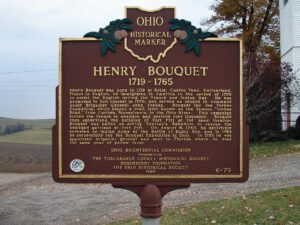
Desperately trying to protect their homeland, the Delaware Indian Nation who lived here in the Tuscarawas Valley, joined the French against the English during the French and Indian War, 1754-1763. After the French defeat, the Delawares, dissatisfied with the treaty terms, joined an Indian Confederacy to attack the English in early 1763. Known as Pontiac’s Rebellion, the uprising was lead by Ottawa chief Pontiac. In response, the English commander, General Jeffrey Amherst, ordered Colonel Henry Bouquet to mount a 1,500-man expedition to subdue the Confederacy in Ohio. The Army arrived at this location on October 13, 1764. The camp, known as Camp 14, was located in this valley between the two small streams on the side of the hill. Proceeding on to the Delaware town of modern-day Coshocton, Bouquet negotiated a surrender with the Delaware, Shawnee, and Wyandot who then relinquished over two hundred white prisoners.
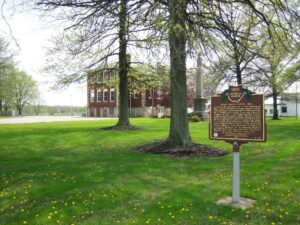
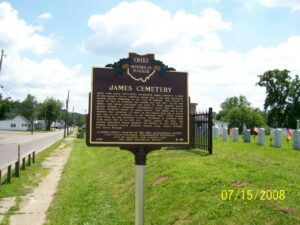
Major John James (1772-1854) established James Cemetery in 1828 on and around a Native American mound that is the only significant ancient mound remaining in the city of Jackson. The mound is about 70 feet in diameter and nearly six feet tall. In the late 1800s, this mound comprised one point of three ancient mound groups forming a triangular configuration along East Broadway Street, formerly known as James Street. One group was a few hundred feet northeast of here on the Watson farm and a second was just to the northwest on the Warnicke farm. These mounds were built by the Hopewell Culture, prominent in southern Ohio from about 100 BC to 400 AD. Major James, his wife, and several immediate family members are buried on the mound including Jackson County pioneers Andrew Long, Daniel Hoffman, and David Mitchell.
In the early 1770s, Chief White Eyes (Koquechagachton) of the Delaware tribe founded White Eyes Town approximately two miles southeast of this marker on a plain near present day West Lafayette. A friend of the Moravian leader David Zeisberger, White Eyes was an ardent supporter of Moravian missionary efforts and kept the Delawares neutral during the American Revolutionary War. White Eyes’s dream was to bring his people under the influence of Christianity. He also hoped to establish a fourteenth state for the Indian nations, which would join the other thirteen. White Eyes died at the height of his career in November 1778 near Pittsburgh. The cause of his death remains open to question.
In the mid-1700s, France found its influence waning among midwestern tribes as it contested for Native American trade and military alliances with Great Britain. Shortly after Miami chief Memeskia (also known as Old Britain or La Demoiselle) moved his village to Pickawillany, British traders were given permission to establish a small post in the village, which was deep in the territory claimed by France. When French demands to evacuate the post failed, Charles Langlade led a party of 250 Ottawa and Ojibwe warriors and French Canadians in a surprise attack on the Miami village on June 21, 1752. The trading post was destroyed, British traders were taken to Detroit as prisoners, and Memeskia was executed. Pickawillany was completely abandoned soon after. As a prelude to the French and Indian War, the Battle of Pickawillany fueled land claim and trading right conflicts between France and Britain.
John Chapman (1774 – 1845) leased these three acres to the north and west from William Botts Hedges on April 29, 1828. He paid Hedges by cultivating 1,000 apple trees on the site over the next ten years. Apples provided an important food source. Cut and dried for sauces in the winter, they could be pressed into cider or “apple jack” at a time when water often carried disease. The Hedges Nursery profited the Shanesville area by shipping apples to the major trading posts at Piqua and Ft. Wayne. During his lifetime, Chapman proved an able businessman who established profitable orchards in Ohio, Pennsylvania, and Indiana. In 2009, American Forests, the Johnny Appleseed Foundation, the Museum at Urbana University, and the Village of Rockford planted two “Rambo” apple trees at the Hedges Nursery site.