Following the establishment of the public land system in 1785, the Continental Congress appointed a committee, chaired by James Monroe, to establish government in the new territory north and west of the Ohio River. Drafted prior to the Constitution of the United States, the Ordinance of 1787 provided the mechanism by which prospective states would enter the Union on an equal basis with existing states. It also prohibited slavery in the new territory and pledged good faith in dealing with Native American tribes. According to this plan, the Northwest Territory became the states of Ohio, Indiana, Illinois, Michigan, Wisconsin, and part of Minnesota in due course.
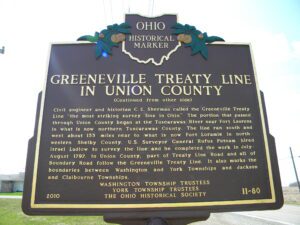
The Treaty of Greeneville created the Greeneville Treaty Line. It was the boundary between lands in the original possession of the Indians and those they ceded to the United States, which were south and east of the boundary. Major General “Mad” Anthony Wayne negotiated the treaty with the tribes his army defeated at the Battle of Fallen Timbers on August 20, 1794. Leaders of 12 tribes, including Wyandots, Delawares, Shawnees, Ottawas, and Miamis, signed the Treaty of Greeneville on August 3, 1795 with General Wayne, William Henry Harrison, and other representatives of the United States. Treaties that followed Greeneville up to the Treaty with the Miamis in 1818 extinguished the various tribes’ original claims and created Indian reservations on the lands northwest of the Greeneville Treaty Line, making it obsolete. (Continued on other side)
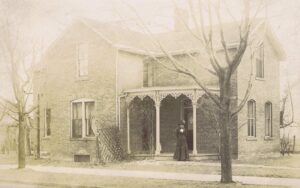
Generations of the Barker family lived in the house that stood at 89 Wood Street from 1875 to 1973. George W. Barker (1836-1913) was born enslaved in Virginia, emancipated age 13, and settled in Mansfield by 1870. He worked as a well-known chef in downtown hotels. In December 1873, Barker married Dayton-native Harriet J. Hurley (1840-1925). The next April, he purchased a corner plot in Snyder’s Subdivision for $450. Completed by 1875, his original brick house sheltered Barker, his wife, and his mother-in-law, Eliza Hurley (1815-1885). The Barker’s children — Sumner (1875-1890) and Sarah Daisy (1877-1973) — were born there. The Barker family were one of Mansfield’s historic Black families and members of the First Congregational Church. Their house once included a decorative wooden porch, numerous outbuildings, and served as an important community gathering place.
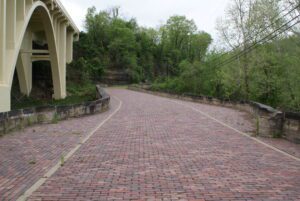
The first Blaine Hill Bridge was constructed in 1828 as part of the National Road, the nation’s first federally funded highway. This three-arch S-shaped structure, 345 feet in length, spans Wheeling Creek (a tributary of the Ohio River) and is the longest original “S” bridge in existence on the old National Road. At a gradient of approximately 6.3 percent from east to west, it significantly eased, for the first time, the arduous 500-foot western climb out of the valley. Crumbling and in poor condition, it was saved from demolition in 1999 and in 2001 was designated Ohio’s official Bicentennial Bridge. Now tucked between the 1933 U.S. 40 viaduct and Interstate 70, it illustrates the earliest of Ohio’s three eras in national highway transportation.
Major General William Sooy Smith was born in Tarlton on July 22, 1830. He attended Ohio University and supported himself throughout his college undergraduate career, graduating in 1849. He then entered the United States Military Academy at West Point to pursue engineering and graduated 6th in the class of 1853. In 1857, Smith established the private engineering firm Parkinson & Smith and made the first surveys for the international bridge across the Niagara River near Niagara Falls. At the outbreak of the Civil War, Smith joined the 13th Ohio Infantry, winning the commission of colonel in June 1861. After early victories in western Virginia, he was promoted to brigadier general in April 1862 for his gallant and meritorious service at the Battle of Shilo. (continued on other side)
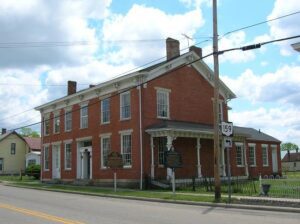
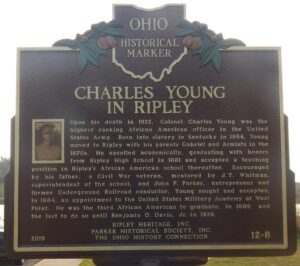
Charles Young in Ripley. Upon his death in 1922, Colonel Charles Young was the highest ranking African American officer in the United States Army. Born into slavery in Kentucky in 1864, Young moved to Ripley with his parents Gabriel and Arminta in the 1870s. He excelled academically, graduating with honors from Ripley High School in 1881 and accepted a teaching position in Ripley’s African American school thereafter. Encouraged by his father, a Civil War veteran, mentored by J. T. Whitman, superintendent of the school, and John P. Parker, entrepreneur and former Underground Railroad conductor, Young sought and accepted, in 1884, an appointment to the United States Military Academy at West Point. He was the third African American to graduate, in 1889, and the last to do so until Benjamin O. Davis, Jr. in 1936.
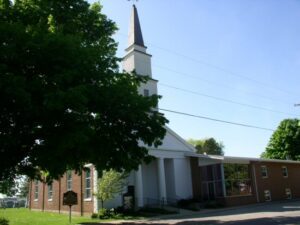
The founders of what would become the Kings Creek Baptist Church first met on June 29, 1805 in the log home of local residents James and Ann Turner. The Baptist congregation continued to meet in people’s homes until 1816 when Taylortown founder John Taylor donated an acre of land to establish a burying site and a meetinghouse. Constructed of logs, this meetinghouse is considered to be the third Baptist church built in Ohio and the Northwest Territory. The original structure was replaced by a more substantial brick building in 1832, and the present Kings Creek Baptist Church was built on the original foundation in 1849. The church features classic Greek design and a grand steeple inspired by the work of the English architect Sir Christopher Wren. An educational wing was added in 1969. (continued on other side)
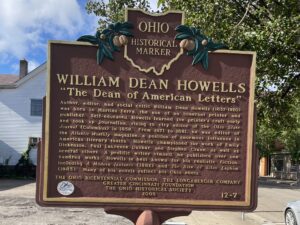
Author, editor, and social critic William Dean Howells (1837-1920) was born in Martins Ferry, the son of an itinerant printer and publisher. Self-educated, Howells learned the printer’s craft early and took up journalism, rising to city editor of the Ohio State Journal (Columbus) in 1858. From 1871 to 1881, he was editor of the Atlantic Monthly magazine, a position of enormous influence in American literary tastes. Howells championed the work of Emily Dickenson, Paul Laurence Dunbar, and Stephen Crane, as well as several others. A prolific writer himself, he published over one hundred works. Howells is best known for his realistic fiction, including A Modern Instance (1882) and The Rise of Silas Lapham (1885). Many of his novels reflect his Ohio roots.