The Scioto Salts Licks, located in and around Jackson, is an area where naturally occurring salt water, known as brine, flowed to the surface as a salt-water spring. It is known that the spring existed since the Pleistocene Ice Age because numerous bones, probably including those of mammoth and ground sloth, were excavated there. Native Americans obtained salt here for at least 8,000 years and did so until 1795 when the Treaty of Greenville separated the Native American and European populations. Early pioneer settlers utilized the licks in the second half of the eighteenth and first half of the nineteenth centuries, constructing salt furnaces that extended for four miles up and down Salt Lick Creek. Salt was a precious and necessary commodity, and the early settlers in the area profited from its trade.
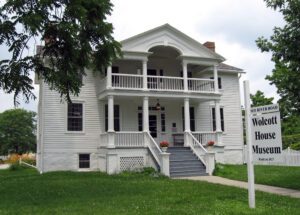
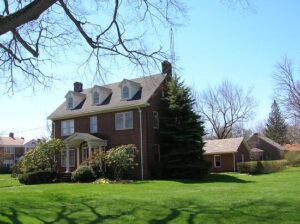
This federal style house was built in 1827 by James A. Wolcott who migrated to Ohio in 1818 from Connecticut. Of distinguished parentage, Wolcott was a leading merchant, shipbuilder, judge and politician. Here he and his wife, Mary Wells, daughter of scout William Wells and Sweet Breeze, Indian Chief Little Turtle’s daughter, made their home a center of frontier activity. This house stands as a tangible symbol of this Maumee pioneer, a Registered National Historic Place.
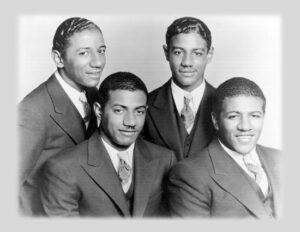
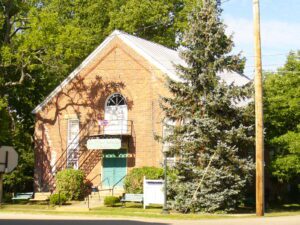
Born in Piqua, Ohio, the Mills Brothers grew up and attended school in Bellefontaine. The brothers — John, Jr., Herbert, Harry, and Donald Mills — were the first African-American vocal group to perform on a national radio broadcast and achieve commercial success. Enjoying worldwide fame throughout their career, the Mills Brothers popularized such hits as “Tiger Rag,” “Paper Doll,” and “You Always Hurt the One You Love.” After the death of John, Jr. in 1936, the remaining brothers were joined by their father, John, Sr. In all, the Mills Brothers recorded over 1,200 songs.
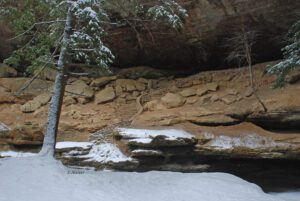
This recess cave was named for the “old man” Richard Rowe, a recluse who made the cave his home in the 1800s and is a part of scenic Hocking Hills State Park. Hocking comes from the Wyandot Indian word “hockinghocking,” referring to the Hocking River’s bottle-shaped gorge near Lancaster. Streams and percolating groundwater carved the hollows and caves in this area from layers of sandstone bedrock that vary in hardness. The hollow’s moist, cool climate preserves more typically northern tree species such as eastern hemlock trees and Canada yew, which have persisted since the glaciers retreated 15,000 years ago.
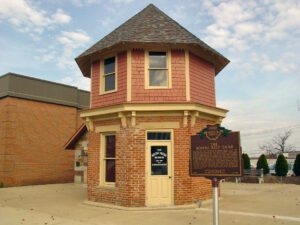
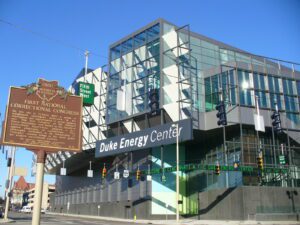
On this site in October of 1870 met a group of enlightened individuals dedicated to the reformation and improvement of penal systems. This first Congress of the National Prison Association, now known as the American Correctional Association, adopted a far-sighted philosophy of corrections. This philosophy, embodied in its Declaration of Principles, remains today as the basic guide for modern correctional systems.
Administration Building built in 1931. Chapter House built in 1962. Commemorating American Red Cross Centennial, 1881-1981.
Early Western Reserve burial grounds, 1804-1848. Grave sites of 12 Revolutionary War veterans and Mary Chesney, member of pioneer Warren family and for whom local D.A.R. chapter was named.
This historic village was a hub for early Ohio industry and travel. The natural geography of the area provided ideal conditions for the establishment of a variety of mills. Col. Robert Patterson, an ancestor of the founder of National Cash Register in Dayton, John Patterson, chose Clifton for the site of a woolen mill, which furnished material for the American army during the War of 1812. Davis Mill, established in 1802 and in operation today as Clifton Mill, produced meal and flour for Civil War troops. A major stop on the stagecoach trail, “The Accommodation Line,” which ran from Springfield to Cincinnati from 1827 to 1840, the village bustled with the commotion of travelers. The once flourishing industry of Clifton faded as railroad traffic bypassed the village and manufacturers left the area.
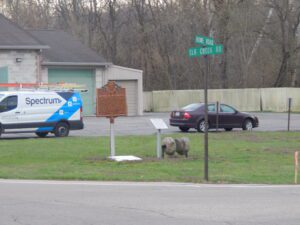
4401 Elk Creek Road (intersection of Howe & Elk Roads)
Middletown
, OH
The village of Miltonville, located along the banks of Elk Creek, was platted in 1816 by George Bennett, Theophilus Eaglesfield, and Richard V. V. Crane. The creek served two grist mills, one built around 1804 and operated by a free black, Bambo Harris, and the second was built by George Bennett in 1815. An Indian burial ground was located on the east bank of Elk Creek near the site of Huff’s Ferry. Eagle Tavern, the area’s first three-story brick inn, was a stopover for stagecoach lines traveling the Miltonville-Trenton Turnpike. The village was known for pottery factories, vineyards and wineries, and Frisch’s brickyard, established in 1880. The United Brethren Church, organized in 1811, and Miltonville Cemetery were the sites of church conferences and celebrations. The Miltonville School operated from the 1800s to 1936, and the local post office was in service during the years 1889-1904.