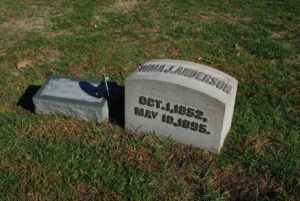
Named for Major General James B. McPherson, buried here July 29, 1864. Here also are graves of George Burton Meek, U.S.N., first American serviceman killed in the War with Spain; Congressional Medal of Honor recipients Charles H. McCleary, Civil War, and Rodger W. Young, World War II; Emma Anderson, mother of author Sherwood Anderson.
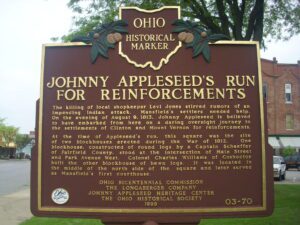
The killing of local shopkeeper Levi Jones stirred rumors of an impending Indian attack. Mansfield’s settlers needed help. On the evening of August 9, 1813, Johnny Appleseed is believed to have embarked from here on a daring overnight journey to the settlements of Clinton and Mount Vernon for reinforcements. At the time of Appleseed’s run, this square was the site of two blockhouses erected during the War of 1812. One blockhouse, constructed of round logs by a Captain Schaeffer of Fairfield County, stood at the intersection of Main Street and Park Avenue West. Colonel Charles Williams of Coshocton built the other blockhouse of hewn logs. It was located in the middle of the north side of the square and later served as Mansfield’s first courthouse.
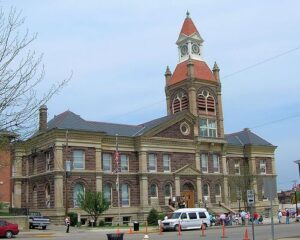
Established as the county seat of Pickaway County in 1810, Circleville derives its name from the circular portion of a large Hopewell-era earthwork upon which it was built. The Circleville earthworks, described in 1772 by Rev. David Jones for a Boston magazine, comprised an 1,100 foot diameter circle connected to a 900 foot square. Town director Daniel Dreisbach platted the town directly atop the earthworks, integrating the town plan into the prehistoric landscape. An octagonal courthouse stood directly in the center.
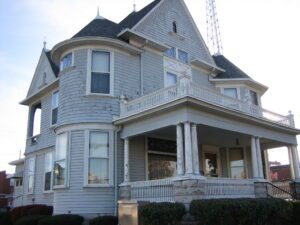
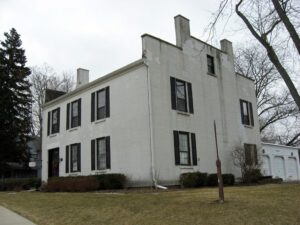
The museum of the Mercer County Historical Society, the Riley Home represents six generations of the Riley family in the county. The first Riley to arrive here was Captain James Riley, who surveyed the area in 1819, after it was opened to American settlement following the Treaty of Saint Marys in 1818. Captain Riley was elected to the Ohio General Assembly in 1823. Captain Riley’s son, James Watson Riley platted Celina in 1834, was Mercer County’s Clerk of Courts, and then represented the area in the Ohio General Assembly beginning in 1843. (Continued on other side.)
The Wakeman Red Caps, perhaps one of the area’s best semi-pro baseball teams during the 1930s and 40s, first played night baseball under lights installed at Wakeman Field on July 24, 1935. The Field, no longer extant, was bounded by Hyde, Clark, Pleasant, and Townsend (Ohio Route 303) streets. The game was played only two months after Franklin D. Roosevelt switched on lights at Crosley Field for the Cincinnati Reds. The Red Caps were part of the Wakeman Baseball Club, an organization which was founded in 1889 and was sponsored by Charles S. Clark, Sr., and others. For aspiring local baseball players, playing night baseball for the Red Caps was a great honor. Wakeman Field was annually graced with Abe Saperstein’s Ethipian Clowns, an African-American traveling baseball team, and also saw appearances by Tom Manning, Satchel Paige, Josh Gibson, Al Schacht, Jesse Owens, and other sports greats.
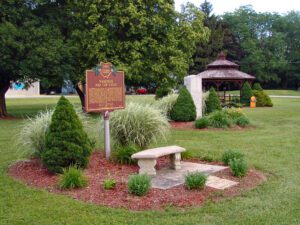
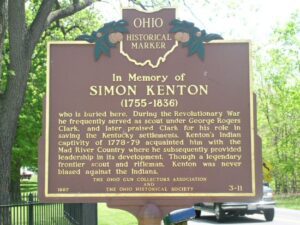
Simon Kenton who is buried here. During the Revolutionary War he frequently served as scout under George Rogers Clark, and later praised Clark for his role in saving the Kentucky settlements. Kenton’s Indian captivity of 1778-79 acquainted him with the Mad River Country where he subsequently provided leadership in its development. Though a legendary frontier scout and rifleman, Kenton was never biased against the Indians.
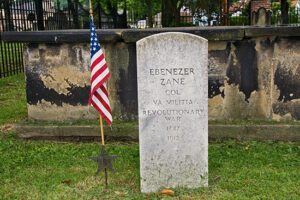
The Walnut Grove Cemetery is the burial place of members of the Zane and Martin families. Their graves lie within the brick enclosure. The cemetery is also the resting-place of many early Martins Ferry residents, including veterans of the Revolutionary War, the War of 1812, the Mexican War, and the Civil War. The Zane and Martin families were significant in the pioneer history of the region. Betty Zane’s legendary heroism at Fort Henry (now Wheeling, West Virginia) helped settlers resist an attack by the British and their Native American allies in September 1782. (Continued on other side)
Old Wood County Jail 1847-1870. Built in 1847, during the Presidency of Polk, when Perrysburg was the County Seat, and used as the Jail and Infirmary until 1870. Continued to serve as the Perrysburg Jail until 1899, sold by the town in 1918. Acquired and restored by Mr. and Mrs. Charles W. Hoffmann in 1954. Listed in the Historic American Building Survey and National Register of Historical Landmarks, Library of Congress.