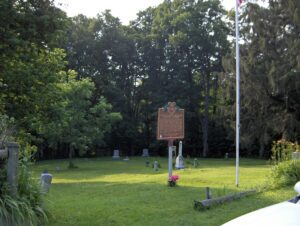
This cemetery stands as evidence of a once thriving African American farming community established in the 1820s. With the aid of community leader, Alexander “Sandy” Harper (c.1804-1889), Captina, originally called Guinea, became a stop on the Underground Railroad, a national network, shrouded in secrecy, of volunteers who directed slaves northward. Harper is buried in this cemetery, along with Benjamin Oliver McMichael (1865-1941), an educator who taught for twelve years in Captina/ Flatrock at a segregated schoolhouse. There are 113 known burials in the cemetery, including nine Civil War veterans. At this site in 1825, an African Methodist Episcopal Church was established to serve the community. Many of its members left Captina to work in cities, but the church continued services until 1962. The building then fell into disrepair and collapsed during a windstorm in 1978.
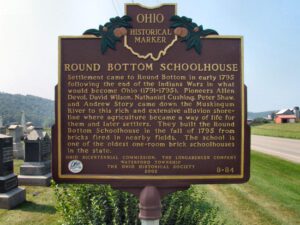
Settlement came to Round Bottom in early 1795 following the end of the Indians Wars in what would become Ohio (1791-1795). Pioneers Allen Devol, David Wilson, Nathaniel Cushing, Peter Shaw, and Andrew Story came down the Muskingum River to this rich and extensive alluvion shoreline where agriculture became a way of life for them and later settlers. They built the Round Bottom Schoolhouse in the fall of 1795 from bricks fired in nearby fields. The school is one of the oldest one-room brick schoolhouses in the state.
A prominent early 20th century illustrator and artist, Howard Chandler Christy was born on a farm in Morgan Township. He first gained notice as an illustrator during the Spanish-American War, but achieved lasting fame for his trademark “Christy Girls,” dream girls who idealized feminine beauty during this era. Between 1908 and 1915, he worked from a studio perched above the Muskingum River near Duncan Falls. In the 1920s Christy began to paint portraits and historical scenes. The Signing of the Constitution of the United States, displayed in the Capitol, is his most famous work. The Signing of the Treaty of Green Ville hangs in the Ohio Statehouse.
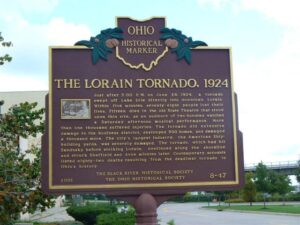
Just after 5:00 P.M on June 28, 1924, a tornado swept off Lake Erie directly into downtown Lorain. Within five minutes, seventy-eight people lost their lives. Fifteen died in the old State Theatre that stood upon this site, as an audience of two hundred watched a Saturday afternoon musical performance. More than one thousand suffered injuries. The tornado did extensive damage to the business district, destroyed 500 homes, and damaged a thousand more. The city’s largest industry, the American Shipbuilding yards, was severely damaged. The tornado, which had hit Sandusky before striking Lorain, continued along the shoreline and struck Sheffield and Avon minutes later. Contemporary accounts listed eighty-two deaths resulting from the deadliest tornado in Ohio’s history.
W side of intersection of Riverside Drive and Busenbark Road
Trenton
, OH
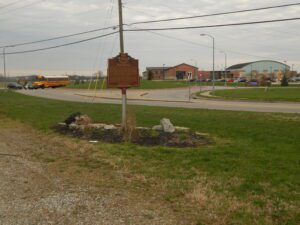
In 1833, Robert Busenbark deeded land to the directors of School District No. 6 for Busenbark School. Twenty years later, Robert and son David granted a right-of-way on their property for a station on the Cincinnati, Hamilton & Dayton Railroad (CH&D). One of eleven depots in Butler County, Busenbark station attracted the Kinsinger-Augspurger Warehouse and the Kennel Grain Elevator to the area in the 1860s. The railroad also enabled the cross-roads settlement to host an American championship prize fight in 1867. Fighting with bare knuckles in an outdoor ring, Mike McCoole bested Aaron Jones in a match seen by thousands. The Busenbark generating station supplied power to interurban lines until 1912 and later furnished electricity to local residents. Farmers and the Miami Poultry Yards depended on the trains and interurban to ship produce. The railroad depot disappeared between 1914 and 1916; the school closed after 1937; interurban service ended in 1939. All that remains of Busenbark is Busenbark Road, which was established in 1858.
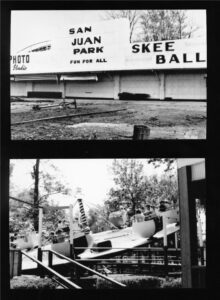
Nicknamed “Ohio’s Million Dollar Playground” or “Atlantic City of the Midwest,” Sandy Beach Amusement Park opened here on May 29, 1924. The park at Indian Lake featured a 2,000-foot long roller coaster and other popular rides, a boardwalk, and the Minnewawa Dance Hall. The Minnewawa and its succeeding dance pavilions hosted the greatest names of the Big Band era, and thousands of people came from all over Ohio to listen and dance to these popular entertainers. Societal turmoil and rioting in the 1960s affected the popularity of the park. Diminishing crowds, plus competition from larger theme parks such as Cedar Point and Kings Island, led to the park closing in the early 1970s. The lone remnant of the park is the steel arch bridge that spans the harbor.
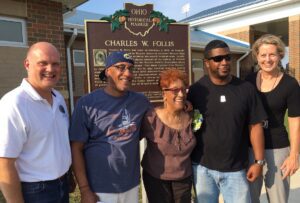
Charles W. Follis was born on February 3, 1879, in Virginia. His family moved to Wooster where he attended Wooster High School and helped establish the school’s football team. In 1901, Follis enrolled and played baseball at the College of Wooster and played football for the Wooster Athletic Association where he earned the nickname “The Black Cyclone from Wooster.” In 1904, Follis signed a contract to play football with Shelby Athletic Club, making him the first African-American professional football player. Follis faced discrimination on and off the field leading to many injuries. After a career-ending injury in 1906, Follis played baseball for the Cuban Giants of Long Island. He died of pneumonia in 1910 at the age of 31 and is buried in Wooster Cemetery.
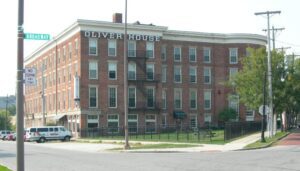
Overlooking the “Middlegrounds,” an early site of railroad, immigration, and commercial activity, the Oliver House opened in 1859 as Toledo’s premier hotel. It was designed by nationally prominent architect Isaiah Rogers, in the Greek Revival style, and built by the family of William Oliver for whom the hotel was named; owner of this land, Oliver was one of Toledo’s earliest real estate investors. (Continued on other side)