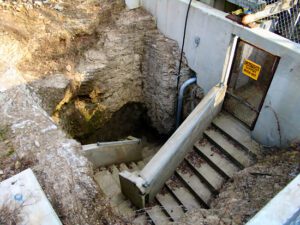
Indian Trail Caverns, first opened in 1927, is one of many caves that occur on the dolomite ridge traversed by State Route 568 in Wyandot and Hancock counties. Sheriden Cave, a karst sinkhole associated with the caverns, was discovered in 1989. It has collected a remarkable record of Ice Age animal and human activity in its sediments. Excavations have revealed remains of many extinct Late Pleistocene Epoch animals-giant beaver, stag moose, flat-headed and long-nosed peccary, and short-faced bear, among many others-that were sealed in the cave by glacial deposits more than ten thousand years ago. Paleo-Indian tools, including projectile points and scrapers, are evidence of the earliest-known human activity in this region.
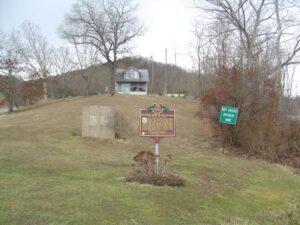
One of the most influential icons of American popular culture in the mid-20th century, Roy Rogers was born Leonard Franklin Sly on November 5, 1911 in Cincinnati. He moved to this farm at age 8 from Portsmouth and lived here with his family until the Great Depression. He went to California in 1930, working as a truck driver, fruit picker, and country musician before signing a movie contract with Republic Pictures in 1937. Immediately popular, the clean-cut singing cowboy appeared in more than 100 western films, often making six or more movies a year during the 1940s. With his nearly equally-famous horse Trigger and his wife and partner Dale Evans-“the Queen of the West”-he subsequently starred in more than 100 television episodes of the family-oriented Roy Rogers Show from 1951 to 1957. A perennial hero and “good guy,” Rogers personified the mythical American cowboy who always fought fairly and lived by a strong moral code. He died in California on July 6, 1998.
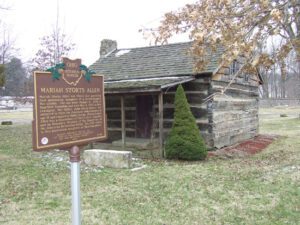
Mariah Storts Allen was Ohio’s last surviving first generation daughter of a Revolutionary War soldier. She was born August 4, 1842 in Bearfield Township and died May 2, 1933 in New Lexington. Her father, John Jacob Storts, volunteered to fight for American independence at age 13 and camped at Valley Forge, Pennsylvania. Allen was a descendant of Ohio’s First Families and an Honorary Member of the Daughters of the American Revolution (DAR). The DAR refers to first generation daughters as “Real Daughters.”
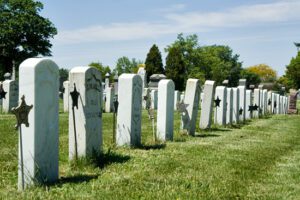
In 1884 the Ohio General Assembly authorized “the burial of the body of any honorably discharged union soldier, sailor or marine of this state who shall hereafter die without leaving means sufficient to defray funeral expenses.” Permanent government-issued headstones have been provided to veterans since the late 19th century. Between 1884 and the 1930s, Washington Cemetery buried 47 white soldiers (including 15 unknown) and 35 African-American soldiers. These veterans served in the Civil War, the Spanish-American War, and WWI. They are remembered for the sacrifices they made. In the fall of 2001, the cemetery underwent significant renovations, in which students of the Washington Senior High School Research History program aided in identifying the buried soldiers and restoring and replacing the gravestones. Here in Soldiers’ Row, the words of local United States Colored Troops veteran, Albert Bird, echo centuries later: “We have suffered to save the country; we ought to be remembered.”
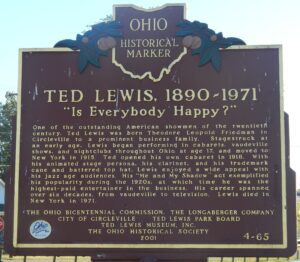
One of the outstanding American showmen of the twentieth century, Ted Lewis was born Theodore Leopold Friedman in Circleville to a prominent business family. Stagestruck at an early age, Lewis began performing in cabarets, vaudeville shows, and nightclubs throughout Ohio at age 17, and moved to New York in 1915. Ted opened his own cabaret in 1918. With his animated stage persona, his clarinet, and his trademark cane and battered top hat, Lewis enjoyed a wide appeal with his jazz age audiences. His “Me and My Shadow” act exemplified his popularity during the 1920s, at which time he was the highest-paid entertainer in the business. His career spanned over six decades, from vaudeville to television. Lewis died in New York in 1971.
SW corner of W Main Street and S Broadway Street (Public Square)
Greenville
, OH
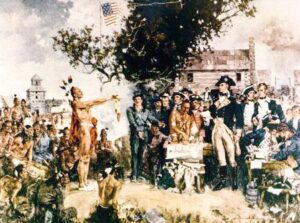
Following General Anthony Wayne’s victory at Fallen Timbers, members of the western tribes assembled at Fort Greene Ville to settle on terms of peace. Representatives of the Wyandot, Delaware, Shawnee, Ottawas, Chippewa, Ottawa, Patawatimi, Miami, Eel River, Wea, Piankeshaw, Kickapoo, and Kaskaskia signed the treaty on August 3, and agreed to cede claims to lands east of the Cuyahoga River to Fort Laurens in Tuscarawas County and south of a line running west to Fort Recovery. In return, the United States offered payment and annuities in the form of goods and ceded claim to most land north and west of the treaty line. This treaty marked the end of the Indian Wars in the Ohio Country, forsaking boundary violations by both parties, and established the official western border of the United States, opening much of Ohio for settlement.
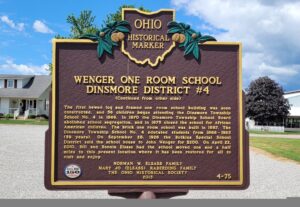
Dinsmore Township School District #4 was formed in 1865following a decision by the township’s board of education that a school would be built in the center of every four sections of land, or every four square miles. This placement of school buildings gave township children the opportunity to attend school close to home and the chance at receiving a public education up to the eighth grade, Nine districts were created for the children of white households, and an additional district was formed to educate the children of the African American families, for a total of ten districts in the township. On June 11, 1866, the Dinsmore Township School Board purchased land from George Wenger to build the District #4 school near the intersection of Ohio Route 274 and Wenger Road. (Continued on other side)
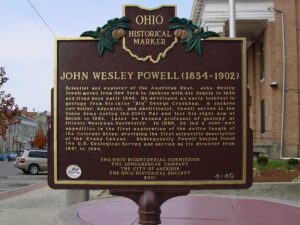
Scientist and explorer of the American West, John Wesley Powell moved from New York to Jackson with his family in 1838 and lived here until 1846. He developed an early interest in geology from his tutor “Big” George Crookham, a Jackson salt boiler, educator, and abolitionist. Powell served in the Union Army during the Civil War and lost his right arm at Shiloh in 1862. Later he became professor of geology at Illinois Wesleyan University. In 1869, he led a nine-man expedition in the first exploration of the entire length of the Colorado River, providing the first scientific description of the Grand Canyon. Subsequently Powell helped found the U.S. Geological Survey and served as its director from 1881 to 1894.