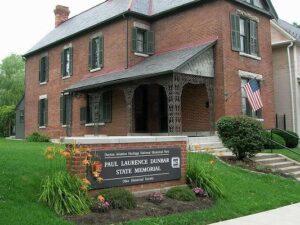
The first African-American to achieve prominence as a poet, Paul Laurence Dunbar was born and raised in Dayton, the son of former slaves. Working as an elevator operator while he established himself as a writer, Dunbar published his first book of poems, Oak and Ivy, in 1893. His third collection, Lyrics of a Lowly Life (1896) with an introduction by another Ohio-born author William Dean Howells, gained Dunbar widespread critical acclaim and popular recognition. Widely published in contemporary journals and literary magazines, Dunbar employed both turn-of-the-century African-American dialect and standard English verse to give a voice to the themes of everyday discrimination and struggles for racial equality. Tuberculosis cut his life short at age 33. Dunbar’s body of work includes twelve volumes of poetry, four books of short stories, a play, and five novels.
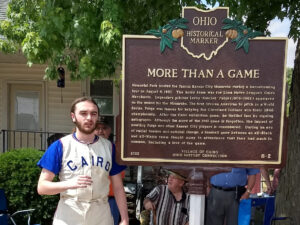
Memorial Park hosted the famous Kansas City Monarchs during a barnstorming tour on August 4, 1961. The home team was the Lima Metro League’s Cairo Merchants. Legendary pitcher Leroy “Satchel” Paige (1906-1982) appeared on the mound for the Monarchs. The first African American to pitch a World Series, Paige was famous for helping the Cleveland Indians win their 1948 championship. After the Cairo exhibition game, he thrilled fans by signing autographs. Although the score of the 1961 game is forgotten, the impact of meeting Paige and other Kansas City players is remembered. During an era of racial tension and national change, a baseball game between an all-Black and all-White team taught many in attendance that they had much in common, including a love of the game.
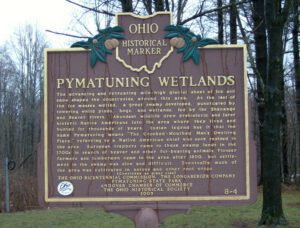
The advancing and retreating mile-high glacial sheet of ice and snow shaped the countryside around this area. As the last of the ice masses melted, a great swamp developed, punctuated by towering white pines, bogs, and wetlands, fed by the Shenango and Beaver rivers. Abundant wildlife drew prehistoric and later historic Native Americans into the area where they lived and hunted for thousands of years. Indian legend has it that the name Pymatuning means “The Crooked-Mouthed Man’s Dwelling Place,” referring to a Native American chief who once resided in the area. European trappers came to these swamp lands in the 1700s in search of beaver and other fur-bearing animals. Pioneer farmers and lumbermen came to the area after 1800, but settlement in the swamp was slow and difficult. Eventually much of the area was cultivated in onions and other root crops. (continued on other side)
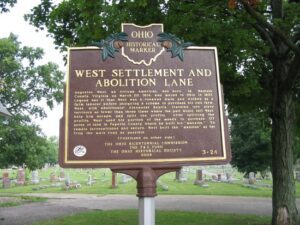
Augustus West, an African American, was born in Madison County, Virginia on March 20, 1814, and moved to Ohio in 1837. Legend has it that West was a runaway slave and worked as a farm laborer before designing a scheme to purchase his own farm. West, with abolitionist Alexander Beatty, traveled into slave territory no fewer than three times where the pair would sell West, help him escape, and split the profits. After splitting the profits, West used his portion of the money to purchase 177 acres of land in Fayette County where he built his “mansion.” To remain inconspicuous and secure, West built the “mansion” as far from the main road as possible. (continued on other side)
Augustus West, an African American, was born in Madison County, Virginia on March 20, 1814, and moved to Ohio in 1837. Legend has it that West was a runaway slave and worked as a farm laborer before designing a scheme to purchase his own farm. West, with abolitionist Alexander Beatty, traveled into slave territory no fewer than three times where the pair would sell West, help him escape, and split the profits. After splitting the profits, West used his portion of the money to purchase 177 acres of land in Fayette County where he built his “mansion.” To remain inconspicuous and secure, West built the “mansion” as far from the main road as possible. (continued on other side)
Approximately 1000 feet east of this marker lies the graves of sixteen American soldiers from Fort McArthur who gave their lives during the War of 1812. The fort, a one-half acre timber stockade containing huts, was built in the summer of 1812 to guard the Scioto River crossing of Gen. William Hull’s “Trace” to Detroit. Construction of the fort was under the command of a future Ohio governor, Col. Duncan McArthur.
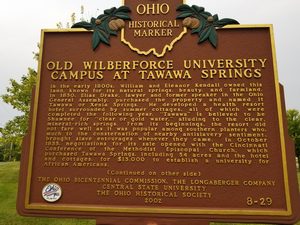
In the early 1800s, William and Eleanor Kendall owned this land, known for its natural springs, beauty, and farmland. In 1850, Elias Drake, lawyer and former speaker in the Ohio General Assembly, purchased the property and named it Tawana or Xenia Springs. He developed a health resort hotel surrounded by summer cottages, all of which were completed the following year. “Tawana” is believed to be Shawnee for “clear or gold water,” alluding to the clear, mineral-rich springs. From its beginnings, the resort did not fare well as it was popular among southern planters who, much to the consternation of nearby antislavery sentiment, brought slave entourages whenever they came. In October 1855, negotiations for its sale opened with the Cincinnati Conference of the Methodist Episcopal Church, which purchased Tawana Springs, including 54 acres and the hotel and cottages, for $13,000 to establish a university for African Americans. (Continued on other side)
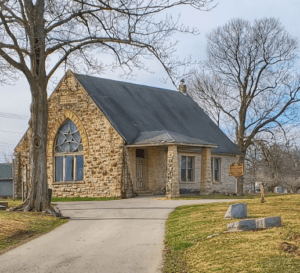
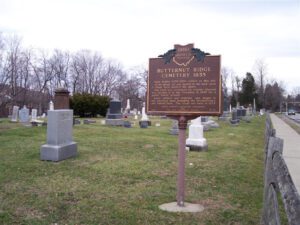
Isaac Scales (1786-1821) settled on this site. At his death, he was buried in his back yard. A large rock marked his grave. The land was reclaimed by Charles Olmsted who deeded it to the Township in 1835 for a public burial ground. Early settlers and veterans, who fought in six American wars including the Revolutionary, are buried here. The crypt was built in 1879.