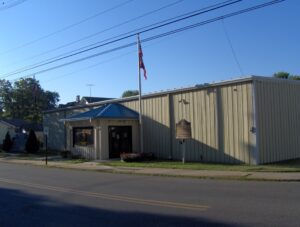
General James V. Hartinger, 1925-2000, was born in Middleport, Ohio, and graduated from Middleport High School in 1943. He graduated from the United States Military Academy at West Point in 1949 and was a career-long fighter pilot with the United States Air Force, flying every type of fighter craft the Air Force procured during his 35 years of active duty. He saw military action during World War II, the Korean War, and the Vietnam War. Named commander-in-chief of the North American Aerospace Defense Command (NORAD) in Colorado Springs in 1979, he was promoted to four stars and became the “founding father” of Air Force Space Command. The headquarters building of Air Force Space Command is named the James V. Hartinger Building in his honor and the Hartinger Medal is awarded annually for extraordinary achievement in space.
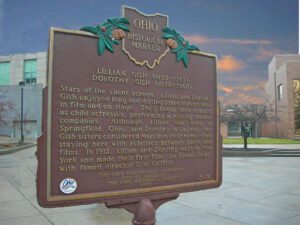
Stars of the silent screen, Lillian and Dorothy Gish enjoyed long and distinguished careers both in film and on stage. They began their careers as child actresses, performing in touring theater companies. Although Lillian was born in Springfield, Ohio, and Dorothy in Dayton, the Gish sisters considered Massillon their home, often staying here with relatives between plays and films. In 1912, Lillian and Dorothy went to New York and made their first film, An Unseen Enemy, with famed director D.W. Griffith.
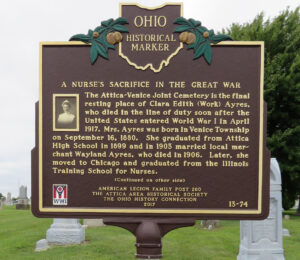
The Attica-Venice Joint Cemetery is the final resting place of Clara Edith (Work) Ayres, who died in the line of duty soon after the United States entered World War I in April 1917. Mrs. Ayres was born in Venice Township on September 16, 1880. She graduated from Attica High School in 1899 and in 1903 married local merchant Wayland Ayres, who died in 1906. Later, she moved to Chicago and graduated from the Illinois Training School for Nurses. (Continued on other side)
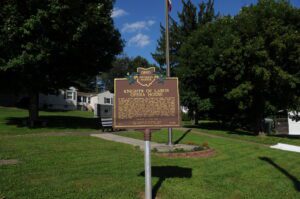
In 1869 a secret organization, The Knights of Labor, was founded in Philadelphia. The K.O.L. promoted an ideal society based on bettering life for others with the slogans, “labor was the first capital” and “an injury to one is the concern of all.” Shawnee’s Local Assembly #169 Knights of Labor was organized in 1876, and quickly became a powerful voice for labor in Ohio. National labor leader, William T. Lewis, later Labor Commissioner of Ohio, taught free grammer classes at night for the miners. Lewis initiated “The Ohio Plan,” the first free empployment bureaus in the United States. William H. Bailey, later head of National District Assembly #135 of Miners and T.L. Lewis, President of the United Mine Workers in 1910, also started their careers here. Meetings involving these leaders led to the formation of the United Mine Workers in 1890. (Continued on other side)
The first African American congregation and first African American Methodist Episcopal (AME) Church in Dayton trace their roots back to the early 1830s. They were organized by Father Thomas Willis and a small group of faithful men and women. After several moves, the congregation settled on Eaker Street and the church was dedicated in the early 1870s. The church was rededicated in 1882 and renamed Wayman Chapel AME Church. The eminent poet Paul Laurence Dunbar and his mother Matilda attended and worshiped at the Eaker Street church. His untimely death in 1906 brought family and friends to his funeral services held at the church. By 1923 church leadership felt the need for more secure space for the growing congregation and moved to a new building at Fifth and Banks streets. Three elegant chandeliers for the sanctuary were donated by the city’s newspaper, the Dayton Daily News. (Continued on other side)
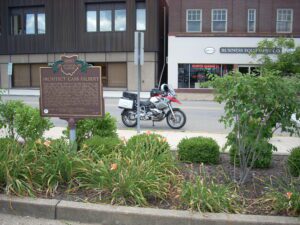
One of America’s leading architects of the early 20th century, Cass Gilbert (1859-1934), was born in a home that stood at this site. After studying at the Massachusetts Institute of Technology, Gilbert apprenticed with prominent architectural firm McKim, Mead, and White. The critical success of his first major public building, the design of the 1895 Minnesota State Capitol, established his national reputation. His influential 1912 Woolworth building, at 792 feet, was then the world’s tallest building, earning Gilbert’s nickname of “Father of the Modern Skyscraper.” Combining classical designs with modern technology, Gilbert also created the United State Supreme Court building (1932) in Washington, D.C., an enduring icon of American justice and democracy. His other achievements include the Arkansas and West Virginia capitols, the U.S. Custom House in New York, and several buildings at Oberlin College. Gilbert served as the president of the American Institute of Architects and the National Academy of Design.
The house of Ebenezer Zane was built here in 1805. The structure was the meeting place for the First Methodist Quarterly Conference in 1819 where over 300 settlers in the area and about sixty members of the Wyandot tribe came together. Although the cabin was reconstructed in 1997, it is a symbol of harmonious relations between American settlers and the Wyandot in the years before the latter’s removal from Ohio in 1842.
907 Scioto Street-Marker was inadvertently numbered 11-14 instead of 14-11
Urbana
, OH
Robert L. Eichelberger was born in Urbana on March 9, 1886, the youngest of the five children of George Maley Eichelberger, an Urbana lawyer, and Emma (Ring) Eichelberger. After graduating from Urbana High School in 1903, he attended Ohio State University and then was appointed to the United States Military Academy at West Point. Graduating in 1909, he was appointed a second lieutenant of infantry. Four years later he married Emma Gudger, daughter of Judge H. A. Gudger of Asheville, North Carolina. For several years, he saw service in Panama and the Mexican border before joining the American Expeditionary Forces in Siberia. From 1918 to 1920 Major Eichelberger observed the Japanese incursion into Siberia and became aware of Japanese methods. In 1940 he was appointed Superintendent of the Military Academy at West Point where he established regular courses to include flight training for Flying Army Officers. [continued on other side]