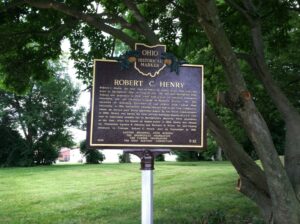
Robert C. Henry, the first African-American mayor of an Ohio city, was born in Springfield, Ohio, on July 16, 1921. He attended Springfield High School and graduated in 1939. After high school, he attended Wittenberg University and the Cleveland College of Mortuary Science. He also received an honorary Doctorate of Law degree from Central State University. In 1961, Springfield citizens elected him to the City Commission, where he served until being appointed mayor by his fellow commissioners in 1966. Henry was among the first African-American mayors of a U.S. city, and is especially notable due to Springfield’s majority white population at the time. After his tenure as mayor ended in 1968, Henry was chosen by presidents Lyndon B. Johnson and Richard M. Nixon for fact- finding missions in Vietnam. Robert C. Henry died on September 8, 1981.
Israel Harrington (1779-1841) established a tavern at Lower Sandusky (now Fremont) shortly after the War of 1812. As a judge and land speculator, Harrington influenced the organization of much of northwestern Ohio. In 1824 he traded the tavern for land a short distance from this site, where an Indian trail crossed the Portage River. Elmore grew from this settlement. Harrington and his father (also Israel Harrington, a veteran of the American Revolution) are interred here, along with many of the pioneers who transformed this section of the Black Swamp into productive farmland.
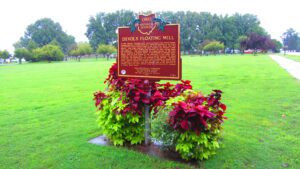
In 1791, Captain Jonathan Devol, upon a proposal from Griffin Greene, designed and built a floating grain mill, which was erected on two boats and anchored within several yards of the Ohio River shore near this marker. Oak planks fastened the boats together and formed a deck, upon which sat a frame building that enclosed the mill’s running gears and millstones. The mill’s position in a rapid portion of the river and its proximity to Farmer’s Castle, a fortification of thirteen blockhouses, built by local farmers at the beginning of the Indian Wars, shielded it from Indian raids. The river’s current revolved the wheel of the mill, and depending on the strength of the current, between twenty-five and fifty bushels of grain were processed in twenty-four hours. Devol’s floating mill replaced the hand mill, which had become too laborious to operate. The mill supplied meal to the garrison at Farmer’s Castle and other settlers along the Ohio River for a distance of nearly thirty miles.
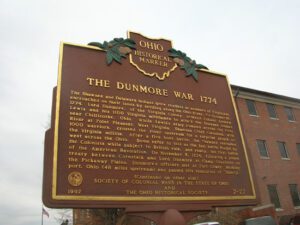
The Shawnee and Delaware Indians grew restless as numbers of Virginians encroached on their lands by settling along the Ohio River. On October 10, 1774, Lord Dunmore, of the Virginia Colony, ordered Colonel Andrew Lewis and his 1100 Virginia militiamen to attack the Shawnee Indians near Chillicothe, Ohio. While Lewis’s army camped across the Ohio River at Point Pleasant, West Virginia, Shawnee Chief Cornstalk, with 1000 warriors, crossed the river upstream for a surprise attack on the Virginia militia. After a five hour battle, the Shawnee retreated west across the Ohio. Some refer to this as the last battle fought by the Colonists while subject to British rule, and really, the first battle of the American Revolution. On November 5, 1774, following a peace treaty between Cornstalk and Lord Dunmore at Camp Charlotte on the Pickaway Plains, Dunmore’s officers met at Fort Gower, Hockingport, Ohio (48 miles upstream) and passed this resolution of “liberty”: (continued on other side)
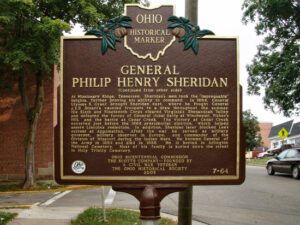
Philip Sheridan was most likely born in County Cavan, Ireland in 1831, but records do not indicate his actual birthplace. His family moved to Somerset when Philip was a child and lived down the avenue from this site. His family later owned the house across the street. His military interest was inspired by “Muster” day and frequent visits from a young West Pointer named William T. Sherman. Sheridan graduated from the United States Military Academy in 1853 and served on the Western Frontier Indian campaigns prior to the Civil War. In 1862, Sheridan became Colonel of the Second Michigan Calvary. At Stones River, Tennessee, he commanded a Division of the Twentieth Corps and stubbornly held General William S. Rosecrans’ right flank, distinguishing himself in battle. (continued on other side)
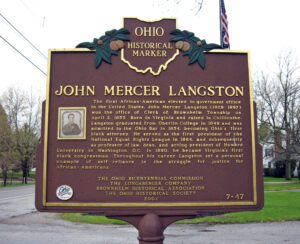
The first African-American elected to government office in the United States, John Mercer Langston (1829-1897) won the office of Clerk of Brownhelm Township on April 2, 1855. Born in Virginia and raised in Chillicothe, Langston graduated from Oberlin College in 1849 and was admitted to the Ohio Bar in 1854, becoming Ohio’s first black attorney. He served as the first president of the National Equal Rights League in 1864, and subsequently as professor of law, dean, and acting president of Howard University in Washington, D.C. In 1890, he became Virginia’s first black congressman. Throughout his career Langston set a personal example of self-reliance in the struggle for justice for African-Americans.
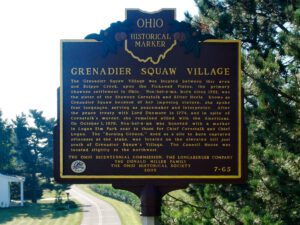
The Grenadier Squaw Village was located between this area and Scippo Creek, upon the Pickaway Plains, the primary Shawnee settlement in Ohio. Non-hel-e-ma, born circa 1722, was the sister of the Shawnee Cornstalk and Silver Heels. Known as Grenadier Squaw because of her imposing stature, she spoke four languages, serving as peacemaker and interpreter. After the peace treaty with Lord Dunmore in 1774, and in spite of Cornstalk’s murder, she remained allied with the Americans. On October 1, 1978, Non-hel-e-ma was honored with a marker in Logan Elm Park near to those for Chief Cornstalk and Chief Logan. The “Burning Ground,” used as a site to burn captured prisoners at the stake, was located on the elevated hill just south of Grenadier Squaw’s Village. The Council House was located slightly to the northwest.
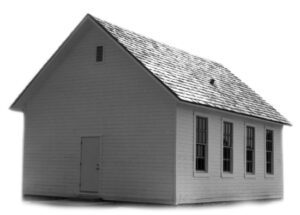
Descendants of slaves, who may have reached Ohio through the Underground Railroad, and other African Americans, formed the community of Flatwoods in the southwest part of Bokescreek Township. This one-room schoolhouse was built circa 1868 for African American children of Flatwoods and remained open until 1923. Remnants of past lessons remain inscribed on the chalkboard. The schoolhouse was threatened with demolition in 1999 and later moved to Veteran’s Park. The Logan County Historical Society owns and maintains the site as a living history museum.