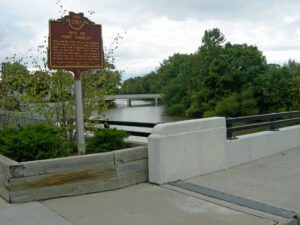
Early in the War of 1812, Gen. Wm. Hull, commander of Ohio troops, ordered Col. James Findlay to open a road from Ft. McArthur on the Scioto River to Blanchard’s Fork. Under Findlay, a stockade 50 yards square, with a blockhouse at each corner, was erected here and named in his honor. The fort was used as a supply depot.
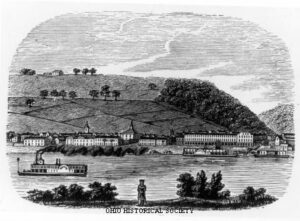
Ripley was incorporated as the village of Staunton in 1812. Its name was changed in 1816 to honor General Eleazer Wheelock Ripley, a hero of the War of 1812. In the years before railroads, Ripley was a principal Ohio River shipping center. Also important were its extensive boat-building, tobacco, pork, and timber industries. Ripley too was the home of saw and planing mills, iron foundries, and a piano factory. Such varied commerce enabled Ripley to remain vibrant throughout the nineteenth century. Although noted as a port, Ripley is best remembered as an abolitionist stronghold. Many of its citizens, including Rev. John Rankin and John P. Parker, served as conductors on the famed “Underground Railroad.” The notoriety of Ripley’s anti-slavery network perhaps eclipsed that of nearby Cincinnati, earning the town a reputation as the “Black Hole of Abolitionism.” (Continued on side two)
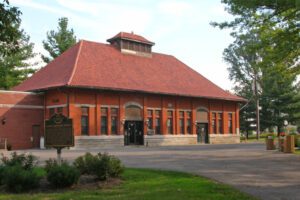
Frances Rappaport Horwich was born in Ottawa on July 16, 1907, the daughter of Sam Rappaport, an Austrian immigrant who operated a general store, and Rosa Gratz Rappaport, a Russian immigrant. The youngest of six children, she attended the Ottawa elementary school and graduated from Ottawa High School in 1924. After high school, she attended the University of Chicago where she earned a bachelor’s degree in philosophy and taught first grade for three years. “Miss Frances,” as she was called, then earned a master’s degree from Columbia University in 1933 and a Ph.D. in 1942 from Northwestern University. From 1942 to 1952, she was involved in teaching and education development. The basic education she received in the Ottawa schools enabled her to achieve great skills and abilities. [continued on other side]
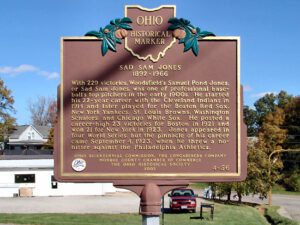
With 229 victories, Woodsfield’s Samuel Pond Jones, or Sad Sam Jones, was one of professional baseball’s top pitchers in the early 1900s. He started his 22-year career with the Cleveland Indians in 1914 and later played for the Boston Red Sox, New York Yankees, St. Louis Browns, Washington Senators, and Chicago White Sox. He posted a career-high 23 victories for Boston in 1921 and won 21 for New York in 1923. Jones appeared in four World Series, but the pinnacle of his career came September 4, 1923, when he threw a no-hitter against the Philadelphia Athletics.
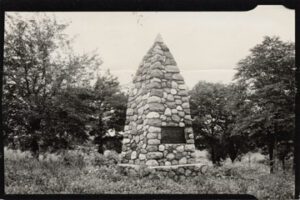
During the Indian Wars of 1790-1795, the United States built a chain of forts in the contested area of what is today western Ohio. These forts were built as a result of various tribes of the region attacking the encroaching American population as they moved north of the Ohio River. In October 1791, General Arthur St. Clair, governor of the Northwest Territory, set out on a mission to punish the tribes and on October 12, ordered his forces to build Fort Jefferson, the fourth link in that chain of forts stretching north from Fort Washington (Cincinnati) to Fort Deposit (Waterville). Each fort was generally a hard day’s march of each other, and the site was chosen because of nearness to a supply of fresh water. The fort was named in honor of Secretary of State Thomas Jefferson.
The Bloomingburg Presbyterian Church and cemetery were established in the northwest corner of the current cemetery grounds on March 7, 1818. Several years later it became a center for anti-slavery activity. The Reverend William Dickey, who presided over the church and other members, devoted their lives to the anti-slavery cause not only in voice but also in abolitionist activity. By the mid-1800s, their work, as well as the fact that Bloomingburg had become home to a vibrant African American community, led to the town becoming the area center for the Underground Railroad, which helped transport many fugitive slaves to freedom in the north. Six soldiers from the American Revolutionary War, nineteen from the War of 1812, and over 100 from the Civil War and Spanish-American War are buried in the Bloomingburg Cemetery, including Henry Casey, who was awarded the Congressional Medal of Honor for his valor at Vicksburg.
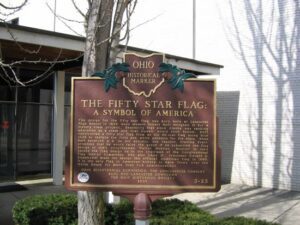
The design for the fifty star flag was born here at Lancaster High School in 1958 when student Robert Heft designed it for a history class project. Reasoning that since Alaska was seeking admission as a state and that Hawaii would soon follow, Heft constructed a fifty star flag from an old 48-star flag using blue cloth to replace the field and white adhesive for the stars. When Heft received a B- on his project, his teacher, Stanley Pratt, promised that he would raise the grade if he submitted the flag design to their congressman, Walter Moeller. Moeller in turn passed the flag design on to the chairman of the Congressional Flag Design Committee, who also liked it. President Dwight D. Eisenhower made the design the official American flag in 1960. It is the only flag in American history to have flown over the White House for more than five administrations.
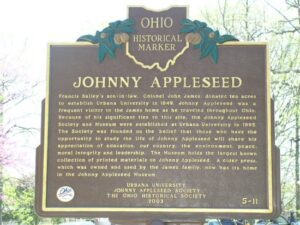
Urbana University was established by the Swedenborgian Church in 1850. Bailey Hall (1853), named after Francis Bailey (1735-1815), was designed by W. Russell West, architect of the Statehouse of Ohio. Bailey was an American Revolutionary War hero, official printer of the Continental Congress and printer of The Freeman’s Journal or the North American Intelligencer. He also printed The True Christian Religion papers. John (Johnny Appleseed) Chapman (1774-1845) distributed The True Christian Religion papers along with his famous apple trees throughout Ohio as a missionary for the Swedenborgian Church. Barclay Hall (1883) was named after Hester Barclay, a ward of Francis Bailey. It was Hester Barclay’s brother-in-law, John Young, who converted Chapman to the Swedenborg faith. Francis Bailey and Hester Barclay were the first male and female Swedenborgian converts in North America. Both Bailey and Barclay halls appear on the National Register of Historic Places.