Brown County Fairgrounds off W. State Street/OH 125
Georgetown
, OH
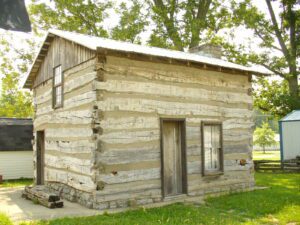
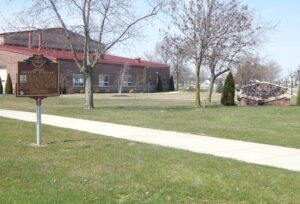
This house originally stood at Logan’s Gap, Union Township. By tradition, it was constructed in 1793 by Indian scouts William Dixon and Cornelius Washburn who became residents of Brown County. Dixon lived in this house until 1800.
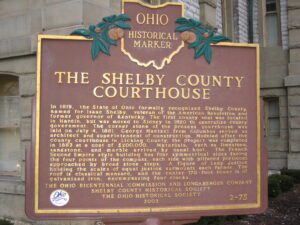
In 1819, the State of Ohio formally recognized Shelby County, named for Isaac Shelby, veteran of the American Revolution and former governor of Kentucky. The first county seat was located in Hardin, but was moved to Sidney in 1820 to centralize county government. The corner stone of the present courthouse was laid on July 4, 1881. George Maetzel from Columbus served as architect and superintendent of construction. Modeled after the county courthouse in Licking County, the project was completed in 1883 at a cost of $200,000. Materials, such as limestone, sandstone, and marble arrived by canal boat. The French Second Empire style building has four symmetrical sides facing the four points of the compass, each side with pillared porticoes approached by broad stone steps. A figure of Lady Justice holding the scales of equal justice surmounts each facade. The roof is classical mansard, and the center170-foot tower is of galvanized iron, encompassing four clocks.
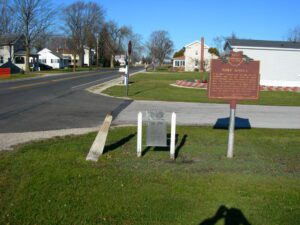
In the 1820s a general store and grist mill were established on this site, where the famous Scioto-Sandusky Indian trail neared the Sandusky River. The settlement was first known as McNutt’s, later as Swope’s Corners. The village of Fort Seneca was surveyed January 14, 1836. Its name was derived from Gen. Harrison’s War of 1812 fort, which was located a few miles downstream.
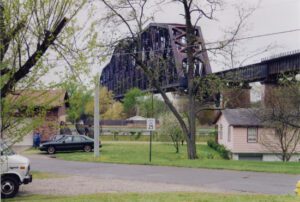
Sciotoville Bridge, 1917, designed and built by two famous American Civil Engineers, Gustav Lindenthal, D.Sc. (1850-1935), the Consulting Engineer (and) David Barnard Steinman, D.Sc. (1887-1960), the designer and stress analyst. A double track railroad bridge of twin spans each 775 feet long, it remained until 1935 the longest continuous truss bridge in the world and stands today as the prototype for continuous structures. Its construction marked a major advance in the art of bridge engineering and was a pioneer achievement in continuous truss analysis. In beauty of design, size and erection techniques it stands as a landmark of progress in man’s mastery of his environment.
Described as a Columbus “institution” when he died in 1969, Emerson C. Burkhart was born on a farm in Union Township, Putnam County in 1905. The son of Albert and Nora Burkhart, Emerson graduated from Kalida High School in 1924 and from Ohio Wesleyan University in 1927. After studying art in Provincetown, Massachusetts and in New York City, he settled in Columbus and, in 1937, married Mary Ann Martin, an artists’ model who devoted herself to his career. Burkhart was a prolific painter and completed an estimated 3,000 pictures during his 40-year career, including street scenes, rural landscapes, and more than 250 self-portraits, once noting his face was “cheaper than a model’s and always there.”
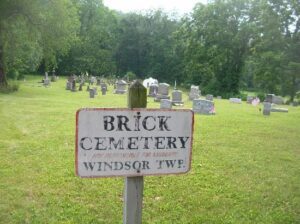
The Windsor Township Baptist Association was organized January 11, 1818 by Elder William Davis with 35 members who met in homes, barns and schoolhouses. At the death of the six-year-old granddaughter of Samuel and Tabitha Davis Henery, this plot by the river was laid out of a church yard and deeded by John Henery in 1837. In 1838 a brick church was built at the cost of $1,000. It served this community until the road and church were destroyed by the flood of 1913. More than 50 men from this area served in the Civil War. Twenty-six War of 1812 veterans are buried here as well as William Davis, veteran of the American Revolution; Obadiah Brokaw, founder of Big Bottom State Memorial; and Captain Isaac Newton Hook, river pilot at the age of ten and U.S. master of inland navigation, 1860-1873, who ran supplies on the Tennessee and Cumberland rivers for the Union Army. At Captain Hook’s death in 1906, the steamers Valley Gem, Zanesville, and Sonoma from Marietta in his honor landed passengers at the church here for his funeral, “largest ever held in the Muskingum Valley.” “The Lord and the River giveth and then taketh away.”
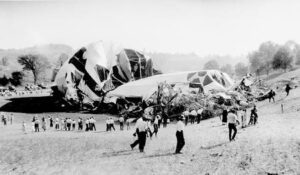
On a stormy autumn morning in 1925, the giant Navy airship, christened Shenandoah, crashed near this site. Initially, the Shenandoah was commissioned to perform scouting missions for the Navy; however, she would soon be flying promotional missions. The Shenandoah had recently begun a six-day publicity tour across the Midwest when she crashed. The turbulent weather of late summer created strong winds, which ripped the 680-feet long Shenandoah in two and tore the control car from the keel. A majority of the 14 crewmen who died in the crash, including the captain, Lt. Commander Zachary Lansdowne of Greenville, Ohio, were killed when the control car plummeted to the ground. The stern section fell in a valley near Ava and the bow was carried southwest nearly twelve miles before landing near Sharon, Ohio. The Ohio National Guard was called in to control the crowds of spectators who traveled to the crash sites.
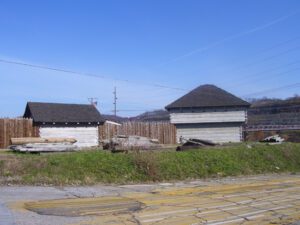
In 1787, the construction of Fort Steuben was completed by Captain John Francis Hamtramck and soldiers of the 1st American Regiment, who were sent to the frontier by the United States government to remove illegal squatters and protect government surveyors from American Indian raids. The surveyors were platting the First Seven Ranges of the Northwest Territory. The surveyed land was sold for settlement or offered to soldiers as payment for military service during the Revolutionary War. Consequently, the states of Ohio, Illinois, Indiana, Michigan, and Wisconsin were formed from the settlement of the Northwest Territory. Fort Steuben was named after Baron Frederich Wilhelm Augustus Steuben, who had served in the Revolutionary War and from which the town derived its name. Captain Hamtramck abandoned the fort in 1787 by order of Colonel Josiah Harmar, and by 1790 the remains of the fort had disappeared. Fort Steuben has been reconstructed on its original location.