On this site are re-interred 118 exhumed remains from Lot 17, Friends Burying Grounds, adjacent to Damascus Friends Church on Walnut Street. Among those re-interred here are: Catlit Jones, a scout with Quaker Daniel Boone in Kentucky, a captain in the Revolutionary War, and a recorded Friends minister; and Samuel Coppock Jr., father of Edwin Coppock, who was hanged in 1859 for his part in abolitionist John Brown’s raid on the United States Arsenal at Harpers Ferry, Virginia. The exhumation (2001-2002) was directed by Prof. Dr. John White of Youngstown State University, assisted by staff, students, and volunteers.
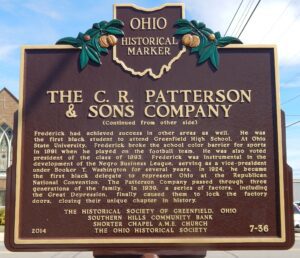
The factory of the C. R. Patterson & Sons Company once stood near here at 138 N. Washington Street. Established in the mid-nineteenth century by the black businessman Charles Richard (C. R.) Patterson and his white partner, J. P. Lowe, the business, originally known as J. P. Lowe & Company, became a successful carriage firm. Patterson became the sole owner in 1893 and changed the name to C. R. Patterson & Sons. After succeeding his father as owner, C. R.’s son, Frederick, became the first known African-American automobile manufacturer. Under his leadership, the company transitioned from building carriages to automobiles, then to trucks and buses to keep up with the changing demands of the transportation industry. (Continued on other side)
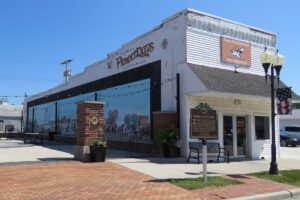
In 1847, after completion of the Miami & Erie Canal, 66 residents were recorded in Liberty Township. Construction of Wabash Railway in 1854 encouraged trade at the half way point between Washington Station and Napoleon. Proprietors such as George W. Buchanan, Frank Prey, Alexander Cooper, and Benjamin Penncock began business around 1860. On June 4, 1863, Alphaeus Buchanan registered a plot of 12 lots, which became Liberty Center. On April 9, 1874, the Village of Liberty Center was incorporated and became a prosperous town along the Wabash Railway. (Continued on other side)
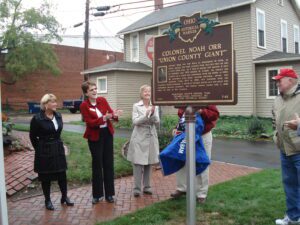
Cyprian Lee (1792-1854) settled in the Union County wilderness in 1820 and purchased the 118 West Sixth Street lot in 1828 for $6. County treasurer, coroner, shoemaker, and anti-slavery activist, Lee lived here in a log cabin until 1832 when this Greek Revival two-story brick house was completed. Other notable citizens to have resided in this oldest brick house in Marysville were showman Noah Orr (1836-1882), also known as the “Union County Giant,” and Josiah Jacob Morelock (1833-1899), a member of the Marysville City Council and the first Fire Department in Marysville. The Morelock family tannery business and stables were located behind this house.
On December 21, 1818, The Grand Lodge of Free and Accepted Masons of Ohio granted a Charter to Middlebury Lodge No. 34 marking the beginning of Freemasonry in Summit County. The Lodge was located on Case Avenue, then known as Water Street. Two members of this early lodge had much to do with the pioneer history of Akron, Brothers Amos Spicer and Eliakim Crosby. [Masonic Emblem]
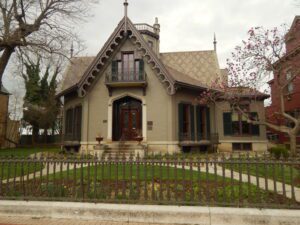
James Elrick, a local carpenter, built the Lane-Hooven House in 1863 for Clark Lane (1823-1907), a Hamilton industrialist and philanthropist. Lane, who first came to the area at age twenty-one as a blacksmith, resided in the house for more than eleven years. In 1866, Lane built the library, also originally an octagon, across the street. In 1868, he conveyed the library to the city. The C. Earl Hooven family resided in the house from 1895 to 1942. In 1943, Bertrand Kahn purchased the residence and presented it to the community for civic and charitable uses. It was donated as a memorial to his father, Lazard Kahn, a Hamilton industrialist and civic leader. The Lane-Hooven House was added to the National Register of Historic Places in 1973. (Continued on other side)
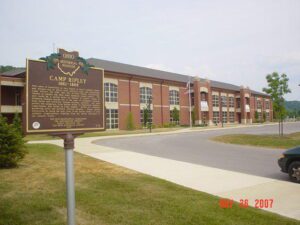
With news of hostilities at Fort Sumter in South Carolina, Ripley men formed one of Ohio’s first military units and established Camp Ripley on what was the 12-acre Ripley Fairgrounds. Chosen as Captain was West Point graduate Jacob Ammen. His unit would be a saving force for Ulysses S. Grant’s troops at Pittsburg Landing raising him to the rank of Brigadier General. Soon barns and buildings became military quarters, and tents dotted the landscape from William Street to Maplewood Cemetery. Camp Ripley, also known as Camp Ammen, served as a regional mustering point and military drilling location. Ripley gained distinction as being the only town in the United States to have soldier’s organizations fighting from the Rocky Mountains to the Atlantic Ocean.
The Putnam County Pioneer Association was organized September 6, 1873, at a meeting in Kalida, Ohio. Its stated purpose was to “perpetuate the early history of our county.” Members gathered oral histories from early residents and published two volumes of Pioneer Reminiscences in 1878 and 1887. The all-day annual meeting, held every year in September, grew into a larger festival. In 1970, the Kalida Lions Club, with funds generated from the event, purchased the former Kalida Methodist Church at 201 E. Main Street and “sold” it for $10 to the Pioneer Association for use as a museum. The Pioneer Association adopted a revised constitution and changed its name to The Putnam County Historical Society in 1971. It continues to hold its annual meeting during the “Pioneer Days” weekend.